Home › Sweets to the Sweet › Sweets to the Sweet (Jam jam efficaci do manus)
Sweets to the Sweet (Jam jam efficaci do manus)
Jam jam efficaci do manus scientiæ.1 HOWEVER HORACE, Epode xvii, 1.
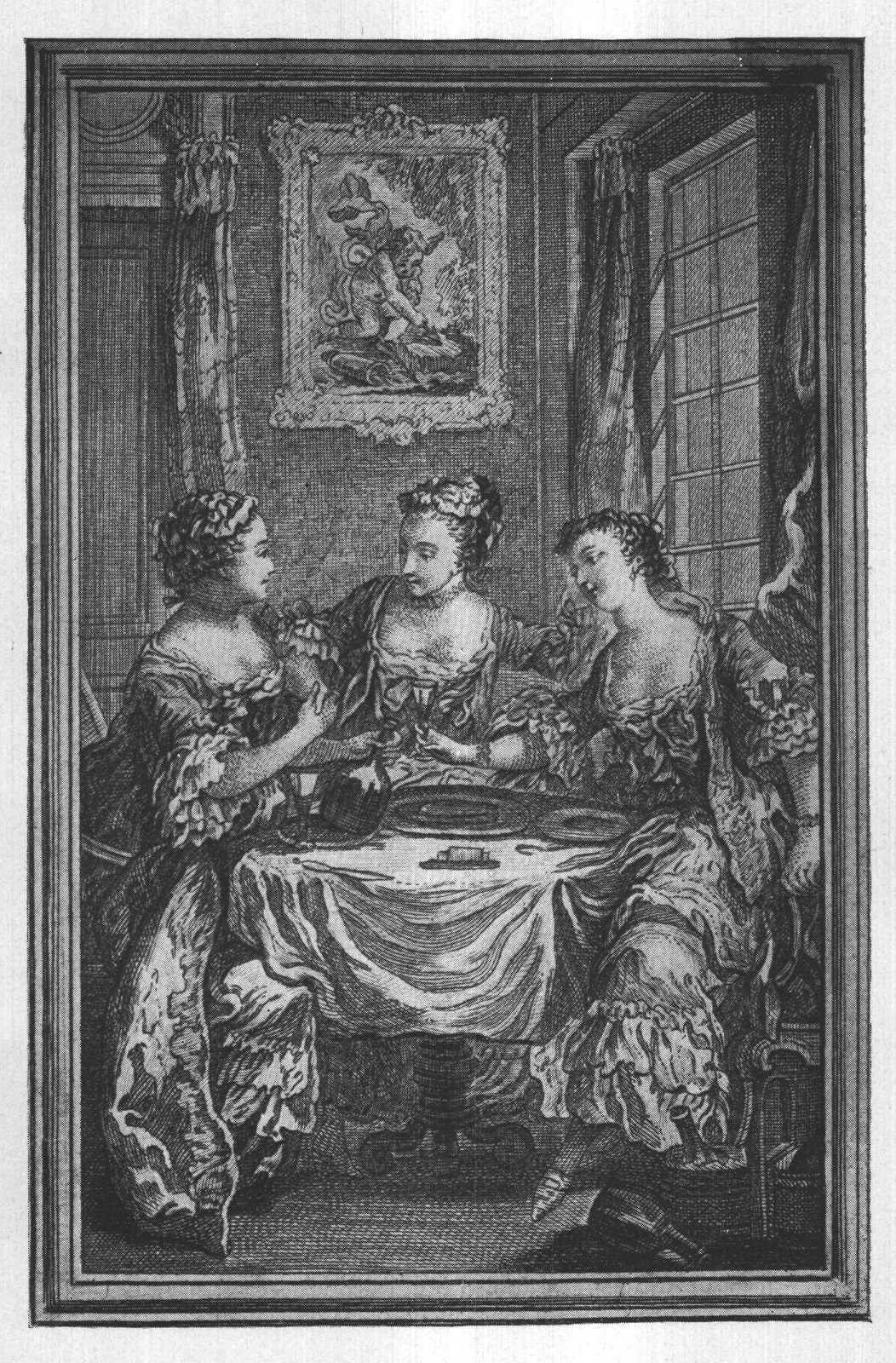
OWEVER scholiasts may have interpreted Horace's line, and by no two is it interpreted alike, the repetition or intensification of the first word in connection with the thought that follows must certainly carry conviction to the gastronomer that no mere stress upon a common adverb was intended, but rather a definite allusion to some particular object. The more the sentence is analysed, the greater seems the emphasis laid upon the power of sweets to attract and charm. Apart, moreover, from the iteration of the subject extolled, one is impressed by the force of the expression "do manus," which 1 "Jam! jam! I yield me to thy potent charm." "APRÈS BON VIN" From the engraving by Eisen in the Fermiers-Généreaux edition of the "Contes et Nouvelles" (1762) means here, not, as one would suspect, to shake hands; but "I yield," "I surrender," "I throw up my hands" -the strongest form of complete capitulation. And when it is further considered that one who was so careful in his advice and hygienic precepts, as well as so dainty in epithet (curiosa felicitas), has expressed his love for an entremets sucré in such emphatic terms, it should be conceded that woman is justified in her predilection for the final course of the dinner, which man is apt to decry. The question of dessert, indeed, is only another instance of where a man thinks he knows, but a woman knows better.
Le dessert est tout le dîner pour une jolie femme.
Let her enjoy it and the sweet champagne or Muscat- Lunel that goes with it, even if to her opposite "things sweet to taste prove in digestion sour." For, after all, it is unquestionably to woman that we must look for the improvement of cookery. The highest art will still find its expression through the professional chef; the useful, the daily alimentation of the household, must depend upon the ministrations of the housewife and her capacity for extending and improving the list of dishes à la bonne femme. Assuredly, appetising cookery will tend more than any other means to maintain the masculine element in good humour, and thereby foster a spirit of liberality and the condoning of feminine foibles.
The dessert is said to be to the dinner what the madrigal is to literature-it is the light poetry of the kitchen, addressed largely to the gentler sex.
To the finer fancy of woman, the many forms of dainties which figure in the last course are mainly due; and that they are not more appreciated by man is no doubt owing to the fact that the consumption of tobacco and the use of ardent spirits have blunted his perceptivity in this respect. Herein he is the loser; the mission of the dessert being that of a comforter of the stomach, which, already appeased, nevertheless craves a little reflex flattery through the palate. There are those of the sterner sex, notwithstanding, who still preserve the sweet tooth of childhood, and others who enjoy pastry equally with its most devoted feminine admirers. Charles Lamb held that a man cannot have a pure mind who refuses apple-dumplings. Tasso was so fond of sweetmeats that he even ate his salad with sugar. Henry VIII presented a manor to the inventor of a new puddingsauce. Goethe adored sweet champagne, and of Horace's partiality for sweets he has doubly assured us. For all such the cook whose pies are perfect will not have lived in vain; the more so as the artist in piemaking is usually an adept at frying, and to bad frying and poor pie-making may be charged much of the misery inflicted upon mankind where eating is regarded solely as a necessary function. A cook, moreover, who can make fine puff-paste is more apt to succeed in all the more substantial parts of the art. So that to encourage the dessert and sweetmeats is to beguile and conciliate woman, and thus indirectly promote progress in other branches of cookery. With a little tact and perseverance it becomes relatively easy to persuade her that her fondness for sweets is injurious to her complexion; and this much instilled, it is the less difficult to lead her by gradual steps to the perfection of the entrée and dishes more favoured by man.
There are comparatively few, nevertheless, who really are averse to the dessert if it unite all the qualities that should compose the final course-if it be light and palatable, if it flatter the eye, and if it convey the greatest amount of pleasure to the taste with little sense of fulness. Good pies or puddings and various entremets de douceur are as much a feature of the well-appointed dinner as a well-made salad; and all have their part to perform. Coming last in the order of the repast, like the peroration of a discourse, they should receive more than ordinary attention, both with respect to their immediate impression and the sensation they leave. To the dessert is often unjustly attributed a consequent that really belongs to the reprehensible practice of serving brut champagne at the end of the dinner, whereby digestion is seriously disturbed through the acidity it necessarily provokes. Already pernicious during the early stages, it becomes still more baneful when appetite has palled. The lamb thus must answer for the crime of the wolf; and woman is held responsible for what is directly the fault of man himself.
If a sparkling wine must be served at the end of a dinner, to the exclusion of the early portion, let it partake of the nature of the dainties themselves, in order that it may leave the most dulcet souvenirs.
But, apart from the dessert, sweets enter into many forms of aliments that lend variety and distinction to the table. Who is so wedded to acidity as not to hail with renewed pleasure the appearance of a rum omelette, or that entremets par excellence omelette aux confitures-if served by a pretty woman at a dinner of two and accompanied by a Rhein Auslese of noble growth? The soufflée, too, has its charms, if woman be present, for which one should always be grateful. What were the turkey without cranberry sauce, in which sugar forms a component, or a mallard without currant-jelly to match the rosy richness of his breast? But in lieu of this universal accessory to many forms of game, a pleasing variety may be had if a lesson be only taken from the Germans, with whom the "Compot" is so highly esteemed in various guises and various grades of sweetness. Of such, one of the most delicious is composed of strawberries and sour cherries in combination, flavoured with Kirsch. An exquisite preserve of southern Germany is the "Hagenmark," which one sees in brimming pails in the market-places during November: a conserve prepared by the peasant women from the hips of the wild dog-rose, as vivid in colour as a cardinal by Vibert.
As for the strawberry, so fragrant and delicious when fresh, but so deadly to the uric-acid diathesis, how safely it may be partaken of when, through madame's deft manipulations, it attains the form of shortcake or preserves! Served with sugar and cream, after baking, as a prelude to the winter breakfast, even the flatulence of the apple is dissipated and the fruit which tempted Eve becomes innocuous.
Through sugar and stewing, the currant loses its verjuice, the raspberry under similar treatment is transformed, the acrid quince acquires new virtues, the She puckery crab-apple diffuses a silken softness. Cooked with sugar and brandy, the peach may appeal to the most hardened total abstainer, and the fruit of the Psidium, through the magic touch of saccharine, attain a magnificent triumph as guava jelly. To remove sugar from the kitchen were to deprive alimentation of many of its benefits and pleasures, as well as to rob woman of much of her allurement. would become lean and scrawny, her rounded outlines would gradually disappear, the contours of her tailormade gown would end by becoming rectilinear, and for her habiliment a strait-jacket would usurp the place of her proud corsage and bouffant petticoat.
There would then be no more love-poetry, for there would exist no incentive for the poet, nor could a pretty heroine figure in a novel, or the bust of woman prove the most convincing illustration that the line of beauty is a curve.
One should never lose sight of that excellent sentiment of Blaze de Bury, which will apply to desserts as well, Qui ne veut point vieillir doit aimer les femmes, et, pour bien les aimer, il faut les aimer toutes. What a wave of grateful coolness the ice and its yet more seductive sister, ice-cream, contribute when the dog-star reigns and cicadas have begun to shrill! Who among the calumniators of sweets could wish them banished in support of a fallacious theory that sweetmeats render woman more capricious, and are injurious to the roses and lilies of her skin? For the plainer form of these refreshing entremets we are indebted to Catherine de' Medici and her cooks who accompanied her to France from Italy, where ices were already much esteemed. The discoverer of icecream is said to be a French chef in the employ of the Duc de Chartres, who exultingly set the dish before him on a hot day in 1774. This was subsequent to the discovery of the pâté de Chartres, which, according to Anatole France, is of itself sufficient to make one revere the country of its origin.
About this period the baba, beloved by the fair sex, met with great favour in France. The baba was the invention of King Stanislas Leszcynski of Poland, a noted epicure, to make amends for the harshness of his name; its ingredients being German yeast, flour, butter, eggs, cream, sugar, saffron, candied citron, Corinthian raisins, currants, and Madeira, Malaga, or rum. It is said to be a difficult entremets to "seize," so as to preserve its attractive reddish colour, which should recall a late October afterglow. It at once appealed to the sweet tooth of femininity, even though that most delectable of garden herbs, angelica, when candied, was overlooked among the sweet ingredients. Like the truffle as described by Savarin, the baba was supposed to render woman more plastic and man more expansive, rien que le voir, les yeux rient et les cœurs chantent.