Important: Safety Warning
This page offers rules for telling edible mushrooms from poisonous ones. No such rules are reliable, and these identifications predate modern mycology. Deadly species closely resemble edible ones, and mistakes are regularly fatal. Never eat a wild mushroom on the strength of this text.
This page states that certain wild plants are safe to eat. Its identifications and edibility claims are more than a century old and in some cases simply wrong, and deadly look-alikes exist for many edible species. Never eat a wild plant on the strength of this text.
This information has been left in for historical purposes but should not be acted upon.
Home › Two Esculents Par Excellence › Two Esculents Par Excellence: Harkness
Two Esculents Par Excellence: Harkness
Harkness, in 1899, issued in the California Academy of Science Proceedings an illustrated article on the Hypogæus Fungi of California, wherein he describes thirteen species, of which seven are new and all of which he pronounces edible, though few, if any, of them are found in abundance or are worth considering from a practical standpoint.
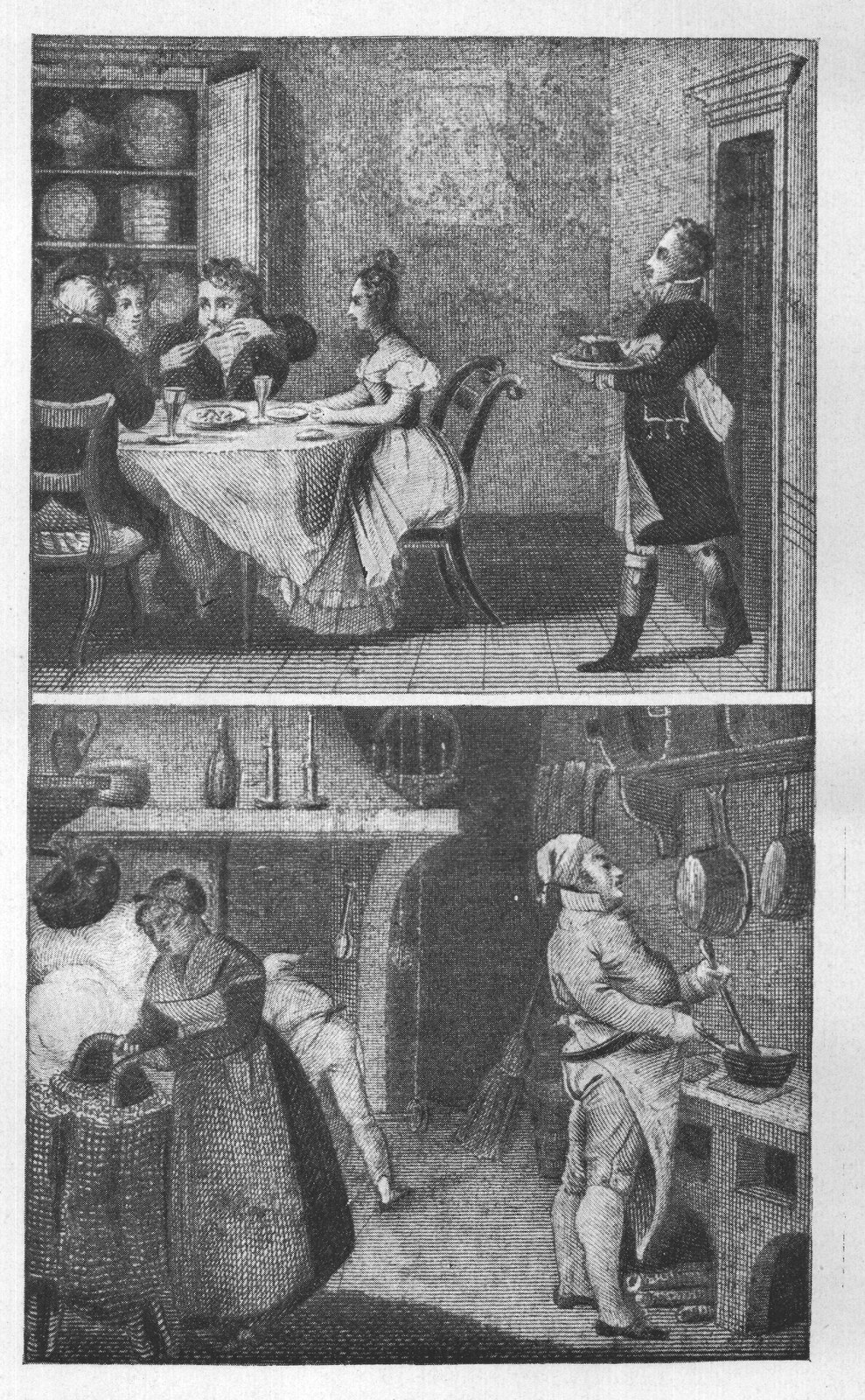
From this it may be inferred that if these fungi could be diligently sought for in other States by those who have carefully studied the haunts and habitat of the tuber abroad, many desirable species might be found to belong to our country. Dr. Harkness does not mention T. melanosporum among Califor- "NOUVEL MANUEL COMPLET DU CUISINIER ET DE LA CUISINIÈRE" Facsimile of frontispiece, 1822 nian species. At present we do not know whether this or T. magnatum, or some form possessing equally adorable qualities, occurs in our country at all; but they and others, it is possible, may yet be unearthed to disclose to the epicure a true "sample of Paradise." To do this, trained truffle-pigs and -dogs must be brought into requisition; and should the search then be unrewarded, the truffle-oak must needs be imported and planted under conditions corresponding to those of its native habitat. Let America add the truffle to her already rich alimentary resources, by all means, even if she must remain content with the wines of France as supplied from oversea.
IF the truffle may be described as an occult vegetable substance with no stem, cap, or visible mycelium, in great repute with epicures, and most generally found firmly embedded beneath the surface of pâté de foie gras, the mushroom, common to nearly all latitudes, grows in visible profusion, and may be readily obtained for the seeking. Some knowledge of genera and species, nevertheless, becomes necessary if one would avail himself of this nutritious esculent. One must know what to avoid as well as what to choose; for often highly dangerous sorts are very nearly allied to the harmless. Of recent years the study of fungi has received considerable attention, and the mushroom has become much better known with us than formerly. Compared with European countries, however, the average person still knows little concerning its edible varieties. Few are unacquainted with the most prevalent form, Agaricus campestris, whose shining white pileus dots the meadows, pastures, and roadsides. But whether familiar or unknown out of doors, no introduction to it will be required at table. Its very mention makes one's mouth water, and evokes a longing for the cool shadows of fall and the restful minor of the crickets' choir.
To appreciate it thoroughly, one should gather it himself, or, rather, in congenial companionship. And as its form is typical of femininity in its rounded contours, its white satiny gown and rose-silk petticoat, to say nothing of its dainty veil and frill, it is eminently proper that madame or mademoiselle, as the case may be, should join in the quest. On a bland September day, therefore, let the lanes and pastures remote from the highway be explored in company when the first ripening sprays of the sugar-maple are commencing to brighten and the clusters of the everlasting are beginning to unfold. Then will the delights of the chase prove doubly enjoyable; and with the common agaric as the object of pursuit there will equally be little danger from mistaken varieties. At most, the harmless horse-mushroom may obtrude, to be plucked and cast aside.
But the mushroom is far from being confined to the pastures and fields, or its duration limited to a few weeks of autumn; and despite the excellent general dietetic advice of the fourth satire of the second book, Horace's dictum should not be taken too seriously,- "Best flavoured mushrooms meadow-land supplies, In other kinds a dangerous poison lies."
By many A. Rodmani, the small compact species common to cities and found growing along the sidewalks and curb, is preferred to campestris. Less rich, it still possesses a full, nutty fragrance and flavour, and is more digestible. Even more distinguished is another agaric, Lepiota procura, or the tall parasolmushroom-one of the most delicious of all edible fungi.. Many valuable species throng the woods and shady places during a large portion of the genial season, to push through the mould or clothe the stumps and decaying logs in most instances ungathered or unseen. And though Claudius, Tiberius, Pope Clement VII, Charles V of France, Czar Alexis of Russia, and many other celebrated personages met their death from eating deleterious mushrooms, and every year scores of families are poisoned through them, the esculent continues to occupy a highly exalted place among aliments. Ignorance and carelessness are almost entirely responsible for disastrous results, owing to its use as food, although ill effects naturally occur through over-indulgence in eating perfectly harmless varieties, or where these may have passed the edible stage. Extremely rich in nitrogenous elements as well as in sapid properties, mushrooms should be sparingly partaken of. Sliced and placed on hot toast which has been moistened with broth and the juices of the cooking, one may often obtain all the flavour of the mushroom by its employment in moderate quantities, and thus over-ingestion will be avoided. The study of fungi has always proved a fascinating one for the botanist. With the aid of nearly any of numerous monographs in which the various genera are described, as also faithfully reproduced in colours, the student and nature-lover may easily familiarize himself with at least the more important species. In his search for practical information he will be led through many a smiling scene removed from the haunts of man; while his chief precaution in his pursuit out of doors need only be to avoid the Taurus and the deadly Amanita. The trained mycologist, however, will readily distinguish between the beautiful toxic Fly-Amanita and the inviting edible orange variety, which, having graced the table of a Roman emperor, received the name "Cæsar's mushroom," whence its botanical appellation. This is the "Oronge" of the French and "Kaiserling" of the Germans, more prized, perhaps, than the Morel, the white Helvella, or the handsome Chanterelle. Its odour is said to resemble a combination of vanilla and truffles. The variety rubescens is also regarded as one of the best of edible mushrooms. Of all fungi the Amanitas are most to be feared; and while numerous other kinds possess unwholesome and forbidden properties, the dangerously poisonous belong principally to this single genus. To them Gerard's definitions, "excressences," "Toadstooles," "very venomous and full of poison," may well apply.
By the seventeenth-century poet William Browne, bard of "Britannia's Pastorals" and "The Shepherd's Pipe," the mushroom is thus alluded to: "Down in a valley by a forest's side, Near where the crystal Thames rolls on her waves, I saw a mushroom stand in haughty pride As if the lilies grew to be his slaves." n Then, after praising the daisy, violet, and other flowers whose beauty was overpowered by the fungus, he thus concludes a much-admired sonnet: "These, with a many more, methought complained That Nature should those needless things produce, Which not alone the sun from others gained, But turn it wholly to their proper use.
I could not choose but grieve that Nature made So glorious flowers to live in such a shade."
Where noisome toadstools crowd out violets and daisies, it may be right for poets to protest. As it is, we have little in the description to guide us to the species, whether it was a desirable or an undesirable kind. There is no allusion as to its toxic properties, nor yet to its colour; and its seeming size-if the simile of the lilies be considered-may only be a license which poets are allowed. But the bard of Tavistock, whose "oaten melodye" still rings sweet and clear, has written too lovingly of trees to suppose he could perceive no use or beauty in a striking vegetable growth; and therefore the particular form he refers to would appear to have been a noxious one.
Surely, it was not the lovely mauve-coloured Cortinarius, that seeks the "forest's shade"; the expanded pea-green cope of the sweet and nutty Russula; or the glowing orange hood of the dulcet Lactarius that incurred his disapproval! Nor can one conceive it to have been the tall-stemmed, fluted-capped Coprinus, or the stylish parasolled Lepiota, which stands as upright as the stilted Bartramian sandpiper, and that is held in equal esteem by the epicure. Rather let us suppose it was the great poison Amanita, which has slain its thousands, and whose brilliant reds and salmons and yellows, and white scales borne aloft on their hollow pedestal, cry aloud from every gill, "Beware!" Or if it was not this or the equally deadly A. phalloides on which his graceful sonnet was based, it must have been the Lycoperdon which cast its shade upon the violets-the giant puff-ball that the poet did not recognise as a valuable food product when neatly sliced and fried, and that it is still the rule to kick out of one's way.
In like manner, one is curious to know what was the enormous fungus or mushroom Thoreau describes as meeting on one of his rambles, and which, in turn, incurs his malediction, -the huge thallogen he found and plucked high up on the open side of a dry hill, in the midst of and rising above the thin June grass, its sharply conical parasol in the form of a sugarloaf slightly turned up at the edges, which were rent half an inch for every inch or two. The whole length, he states, was sixteen inches, the cap being six inches long by seven wide, the stem about one inch in diameter and naked, the top of the cap pure white within and without. He marvels how its soft cone ever broke through the earth. It represents to him a vegetable force which may almost make man tremble for his dominion. It carries him back to the era of the formation of the coal measures, the age of the Saurus and the Pliosaurus, when bull-frogs were as big as bulls. What part has it to perform in the economy of the world? It brought before him pictures of parasols of Chinese mandarins; or it might have been used by the great fossil bull-frog in his walks. Returning home with it, he placed it in the cellar to note its decay. Like the mighty, it fell. By night there remained not more than two of the six inches of the height of the cap, and it went on rapidly melting from the edges upward, spreading as it dissolved till it was shaped like a dish-cover and the barrel head beneath it and its own stem looked as if a large bottle of ink had been broken there. It defiled all it touched. Is it not a giant mildew or mould? he inquires. The offspring of a night, it was wasted in a day. One thinks of Coprinus comatus-a colossal specimen of the "shaggy mane"; and doubtless this was the species encountered by the Walden sage, rearing its silver shaft through the thin June grass in his early morning tramp to Pinxter Spring.