Home › Recipes › Bread and Biscuits
Bread and Biscuits
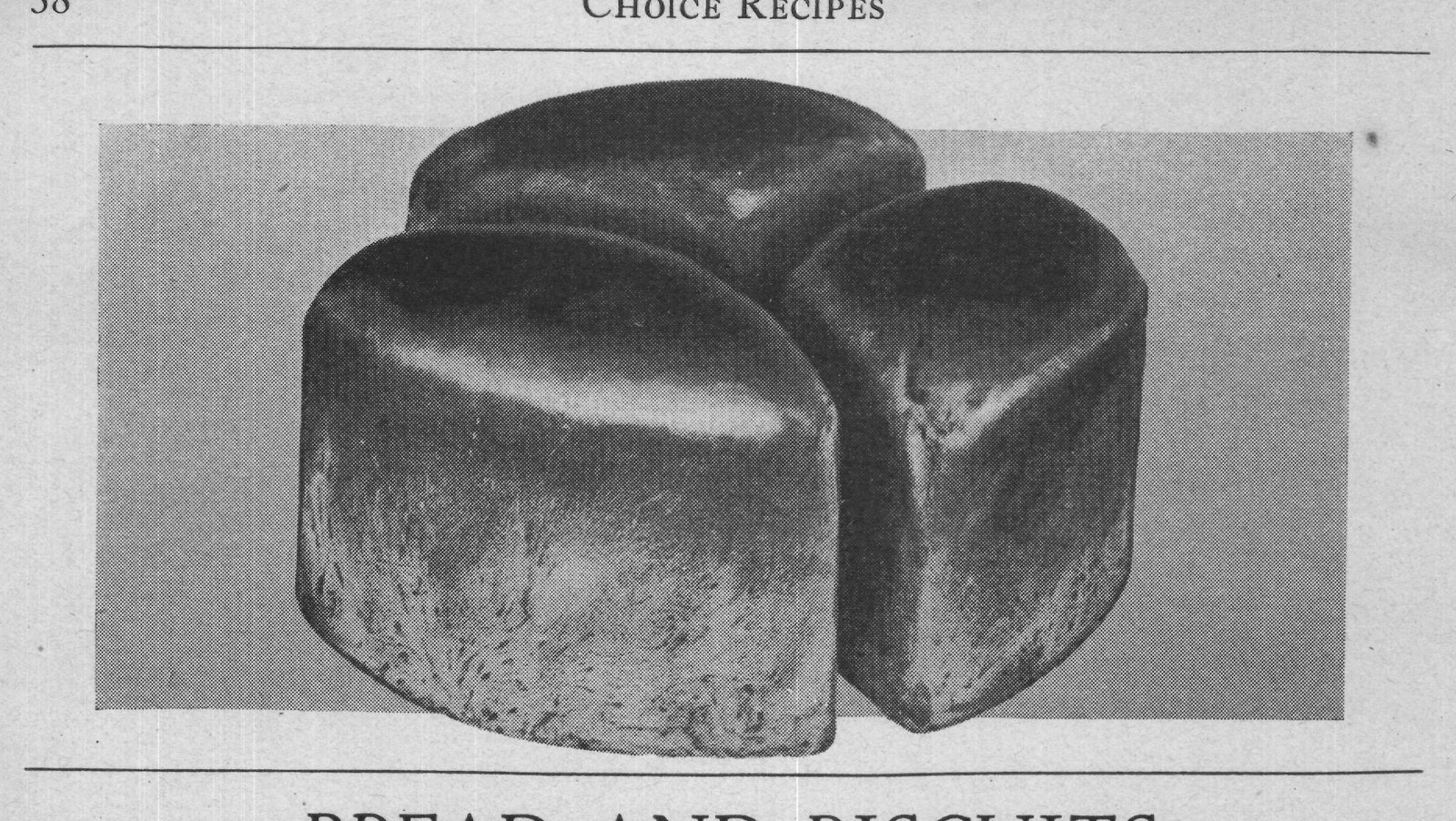
N baking bread or biscuits, the Fireless Cookstove is a pronounced success, as it browns the crusts and bakes thoroughly without burning. The fireless is also an excellent place in which to set the bread to rise, for the temperature is always the same and no matter what the temperature of the kitchen may be over night, the bread will be kept perfectly warm. Use two radiators for baking bread, biscuits, cakes and pies, placing one radiator below bread or pastry rack and one above, and have only one pan of bread, cake or pie in the rack at a time.
Bread Sift 3 quarts of flour and 4 teaspoons salt into a bread bowl. Cream 3 tablespoons sugar, 3 tablespoons butter and 2 compressed yeast cakes together, and add 1 quart lukewarm water. Add this to flour, mixing to a hard loaf. Let rise in cooker until it doubles its bulk. Knead into four loaves, placing two in each 8-quart kettle, greasing between loaves. When these loaves have doubled their bulk again, bake between radiators 400 degrees 1 hour. The triplicate pails. may also be used, one loaf to the pail.
Whole Wheat Bread Soften 1 cake of compressed yeast in 1/4 cup lukewarm water. Sift a scant quart of whole wheat flour into a bowl with 1 teaspoon salt. Make into a batter with a pint of warm water, a tablespoon of melted butter and yeast. Beat well and work in sifted flour until the bread can be handled lightly on board. Place in 8-quart utensil and remove to the fireless until it doubles its bulk. Shape into two loaves as directed for wheat bread. Let it rise again. Bake 1 hour, using two radiators heated 400 Cinnamon Rolls Two cups flour, 2 teaspoons baking powder, 1 teaspoon salt sifted together, 2 tablespoons butter mixed into flour and make into soft dough with sweet milk. Roll out 1/2 inch thick, longer than wide, spread with melted butter and sprinkle thickly with sugar and cinnamon. Then roll tightly the long way like jelly roll, cut in 1/2 inch pieces and put in pan in baking rack for 25 minutes. Use two radiators heated 425 degrees.
Breakfast Muffins Beat 1 egg well, 2 tablespoons melted butter, 2 tablespoonsful sugar and heat thoroughly. Add 1 cup of milk, sift in slowly 2 cups flour and 3 teaspoons baking powder, add generous pinch salt. Place in gem pans in rack and bake 20 minutes with two radiators heated 400 degrees.
Bread Sticks Cut bread, roll sticks in melted butter, put on plate in fireless with two hot radiators 20 minutes.
Brown Bread 2 cups cornmeal 1½ cups graham flour 1/2 cup molasses 2 cups sweet milk 1 level teaspoon soda 1 level teaspoon salt Raisins if desired Mix cornmeal, graham flour, salt and soda together. Add molasses and milk. Place in mold into 8-quart utensil and surround with water.
Boil 15 minutes on stove, bake in fireless 3 hours. Use one radiator heated 450 degrees.
Biscuits Two tablespoons lard or butter, 4 level teaspoons baking powder, 1 teaspoon salt, 2 cups flour, 1 cup milk. Mix dry ingredients, add the lard and butter. Rub together. Add milk slowly. Toss on well-floured board and roll 1½ inch thick. Place in buttered pans and bake between two radiators heated 425 degrees 15 to 20 minutes.
Steamed Graham Bread fold over, put in pans and let rise Mix 3 cups of graham flour, 1 cup of white flour, 1 teaspoon of salt, 2 teaspoons of soda, 1 cup of molasses, 2½ cups of sour milk. Mix and cook the same as Boston Brown Bread, using one radiator heated 450 degrees.
Boston Brown Bread One cup buttermilk, 1 cup sweet milk, 1 cup molasses, 1 cup cornmeal, 2 cups graham flour, 1 teaspoon soda and 1 teaspoon salt. Place in one pail of triplicate set, immersing same with boiling water, nearly to top, using 8quart utensil as container. Boil 15 minutes. Steam in fireless 3 hours, using one radiator heated 450 degrees.
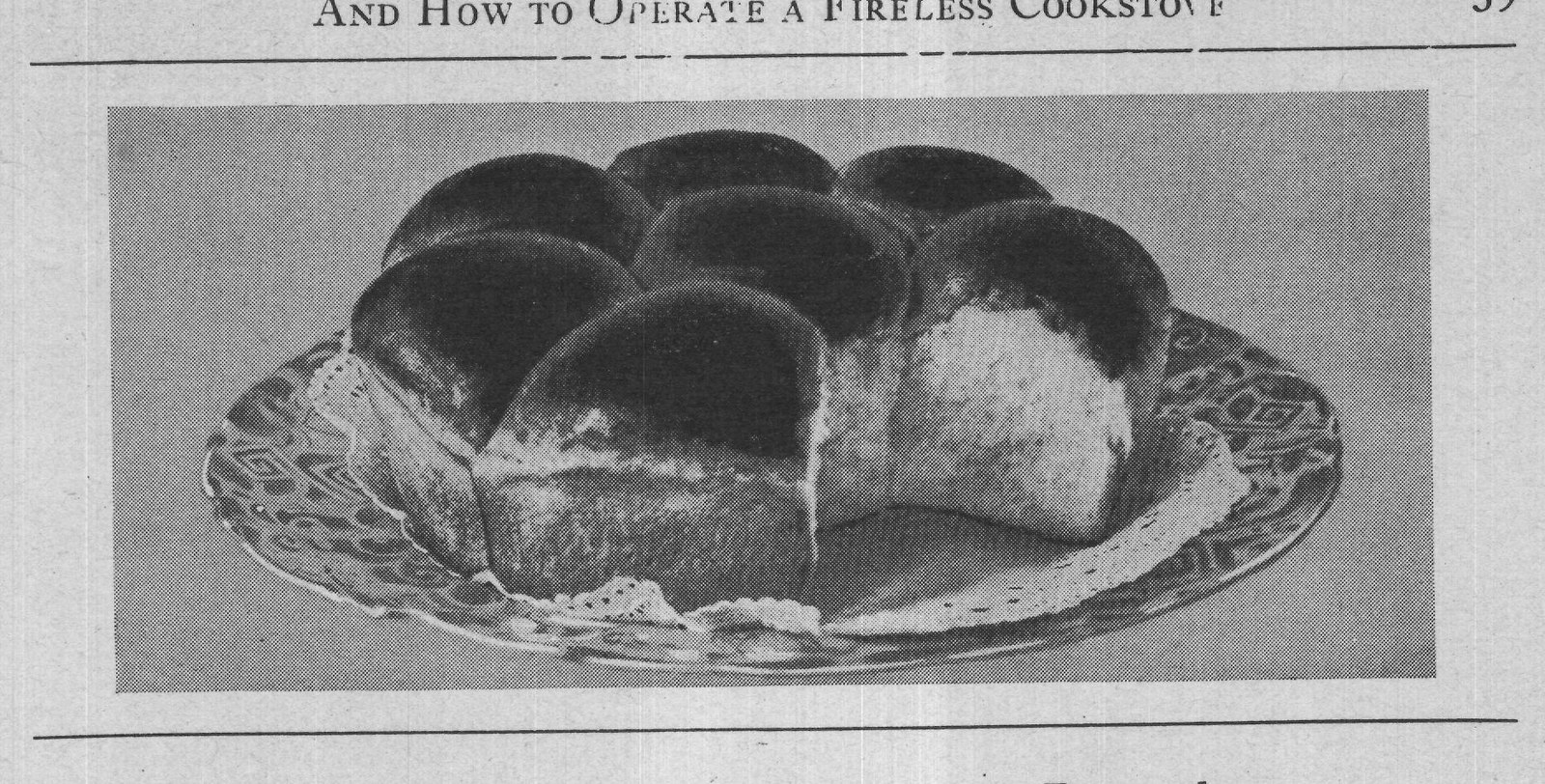
Rolls One pint sweet milk scalded, when cool add 1 compressed yeast cake, 1 teaspoon salt, 1 tablespoon sugar, butter size of an egg; mix down hard, when light roll 1/2 inch thick, cut round, spread with melted butter and again and bake in fireless with two very hot radiators 25 minutes. This makes 2 pans.
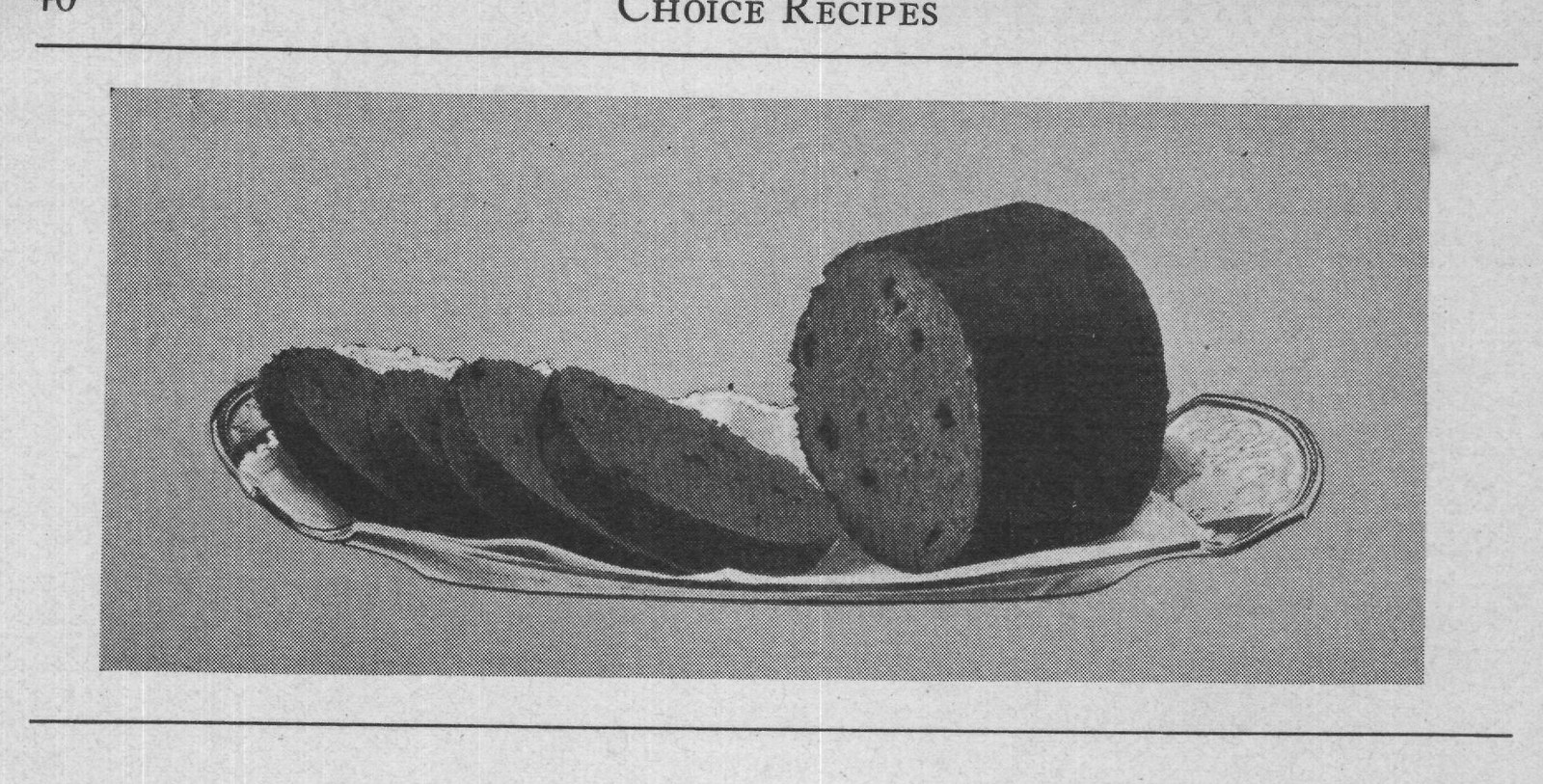
Nut Bread Two cups flour, 1 even teaspoon salt, 2 tablespoons sugar, 2 teaspoons baking powder, sift all together, add 1 cup sweet milk, 1 egg well beaten, 1/2 cup nut meats. Put in pan and let stand 10 minutes. Bake in fireless 1 hour with two radiators heated 375 degrees.
Corn Bread One cup cornmeal, 1 cup flour, 14 cup sugar, 5 teaspoons baking powder, 3/4 teaspoon salt, 1 cup milk, 1 egg, 2 tablespoons melted butter.
Mix and sift dry ingredients together, add milk, egg well beaten and butter. Bake 20 to 30 minutes, using two radiators heated 375 degrees. The 8-quart pail may be used in the same manner as for roasting meats.
W
These are conventional yeast and quick-bread formulas written for an insulated fireless cooker, where preheated soapstone or iron discs ("radiators") supply falling heat inside a sealed box. Translating them to a modern oven is mostly a matter of understanding what the radiators were doing and adjusting time accordingly.
- The radiators are the ovenA radiator is a heavy soapstone or cast-iron disc heated on the range top, then locked in the insulated compartment with the food. Heat falls steadily from the moment the lid closes, so the stated times assume a temperature curve, not a held setting. In a conventional oven at the same number, breads and biscuits will be done well before the times given.
- Times that need shorteningCinnamon rolls at 425F want 15 to 18 minutes in a real oven, not 25; biscuits 10 to 12 minutes, not 15 to 20; muffins 15 to 18 minutes at 400F. The one-hour loaves are closer to right, since a large loaf at 400F genuinely takes 30 to 40 minutes and the fireless was losing heat the whole time. Bake to color and to an internal 200-210F for yeast loaves.
- Compressed yeast cakesA compressed cake was commonly about 0.6 oz of fresh yeast, though sizes varied. Substitute one 2 1/4-teaspoon packet of active dry or instant yeast per cake. Do not cream dry yeast directly with butter and sugar as the bread recipe directs for fresh yeast; hydrate it in the lukewarm water instead.
- VesselsThe "8-quart utensil" or kettle is the cooker's large pail, used as a loaf container; a standard 9x5 loaf pan does the job for one loaf. The "triplicate pails" are a set of three cylindrical tins used inside the cooker, each taking one loaf; coffee cans or 1-pound pudding molds are a workable stand-in. "Gem pans" are muffin tins.
- Milk termsSweet milk simply means fresh unsoured milk. The sour milk in the steamed graham bread is what activates the soda; use cultured buttermilk, or whole milk soured with a tablespoon of vinegar or lemon juice per cup and left to stand ten minutes.
- Graham flour and cornmealGraham flour is coarse whole-wheat flour with the bran returned; ordinary stone-ground whole wheat is the closest match. The cornmeal in the brown breads should be plain, not a self-rising or degerminated fine grind, or the loaf turns pasty.
- Two obvious typographic slipsThe corn bread's "14 cup sugar" is 1/4 cup. The biscuits rolled "1 1/2 inch thick" should almost certainly be 1/2 inch. The Rolls recipe has lost both its flour quantity and a line of text where the sentence about folding was misplaced into the neighboring headings; work by feel, adding flour to a soft kneadable dough, roughly 4 to 5 cups to a pint of milk.
- Steaming the brown breadsBoston brown bread and the steamed graham bread are steamed, not baked. Fill molds two-thirds full, cover tightly with foil, set on a rack in a deep pot with boiling water halfway up the sides, and steam three hours over low heat, topping up the water. The single 450F radiator was simply holding the water at a simmer inside the insulated box.
- YieldThe main bread recipe uses 3 quarts of flour, roughly 12 to 13 cups, and gives four full-sized loaves. Halve it unless you intend to freeze. The biscuit and muffin recipes each make about a dozen; the corn bread makes one pan.
- Butter the size of an eggA standard nineteenth-century measure, about 2 ounces, or 4 tablespoons. Older books sometimes mean rather less; 3 tablespoons will not spoil the rolls.
The fireless cooker, sold in the United States roughly from 1905 into the 1920s, was an insulated wooden or metal chest lined with felt, mineral wool or cork, in which food cooked on retained heat alone. Its ancestor is the European hay box, in which a pot brought to the boil is buried in insulation to finish; what American manufacturers added was the soapstone or iron radiator, heated on the range and stacked above and below the food so that baking, not just simmering, became possible. Bread chapters like this one carried much of the sales argument for the devices, since a wood or coal range demanded constant tending and made a summer kitchen unbearable, while the sealed cooker held its own heat and could double overnight as a proofing box. Books of this type multiplied during the First World War, when fuel conservation was a matter of public campaign, and faded as reliable thermostatic gas and electric ovens reached ordinary kitchens.