Macaroni
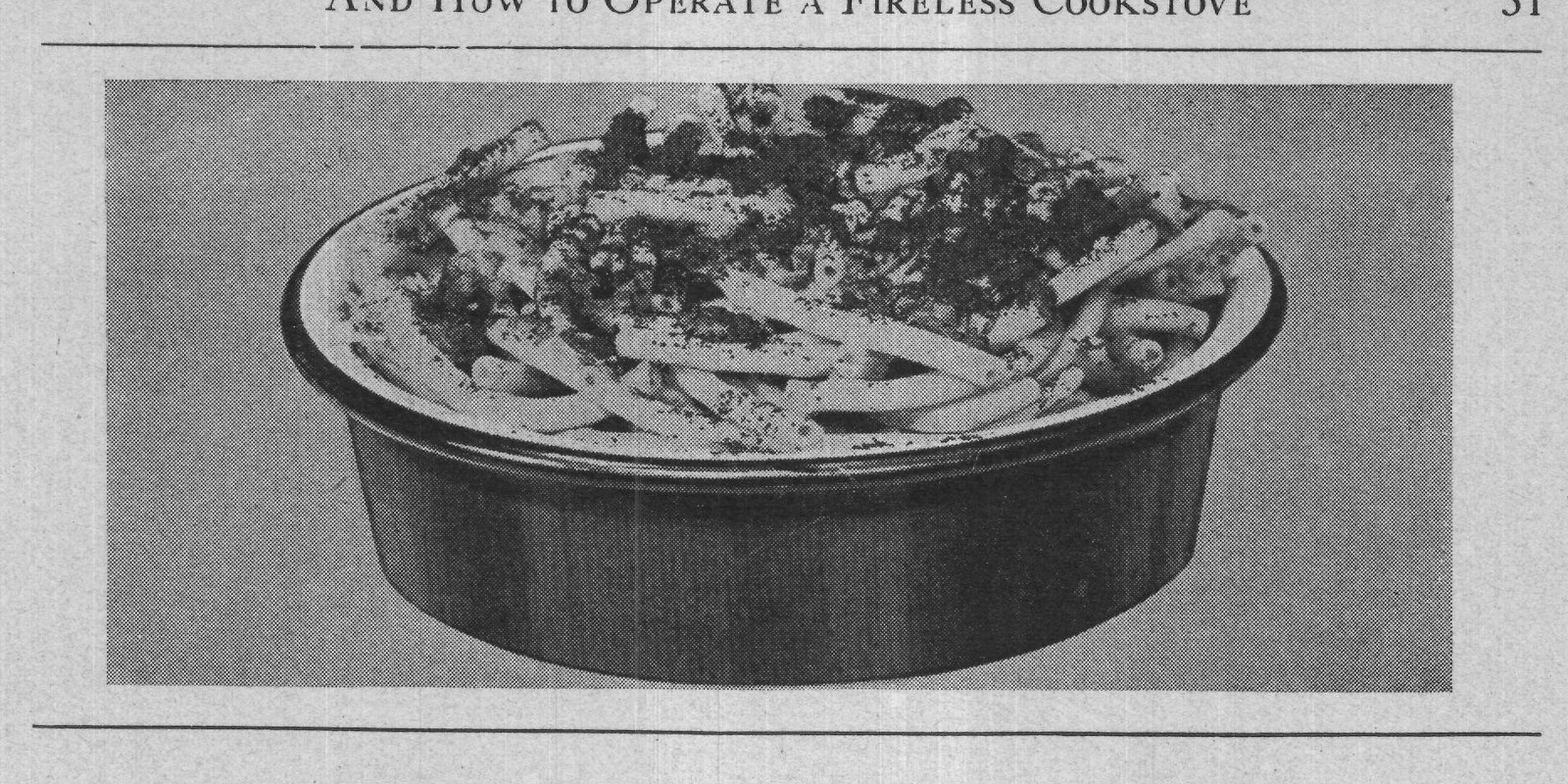
Plain Boiled Macaroni Three-quarters cup macaroni broken in inch pieces, 2 quarts boiling water, 1 teaspoon salt. Cook macaroni in boiling salted water 20 crumbs in the top with bits of butter.
Bake 1 hour in fireless. Use two radiators heated 450 degrees.
Baked Macaroni with minutes or until soft, drain in col- Tomatoes and Cheese ander and pour cold water on it to prevent pieces from adhering.
Plain Baked Macaroni For baked macaroni, to plain boiled add 1½ cups white sauce, cover with buttered bread crumbs and bake 1 hour in fireless between two radiators heated 450 degrees.
Macaroni with Tomatoes Boil macaroni. Put layer of tomatoes in shallow utensil or casserole, cover with macaroni, season with salt, pepper and butter. Repeat this until the dish is full. Sprinkle cracker For macaroni with tomatoes and cheese, use tomatoes and cheese between layers of boiled macaroni, omitting white sauce, and cover with buttered bread crumbs. Bake 1 hour between two radiators heated 450 degrees.
Baked Macaroni with Cheese Put layer boiled macaroni in buttered baking dish, sprinkle with grated cheese. Repeat. Pour over this white sauce. Cover with buttered bread crumbs, bake 1 hour in fireless between two radiators heated 450
A set of five macaroni dishes built on one boiled base, written for a fireless cooker: an insulated box in which preheated soapstone or iron discs, not a flame, do the cooking. Everything here translates to a conventional oven without much trouble.
- The radiators"Two radiators heated 450 degrees" refers to the cooker's metal or soapstone discs, heated on the range and packed above and below the dish inside the insulated box. There is no way to hold that heat steady in a modern oven; treat these bakes as a moderate oven, 350F, for 30 to 40 minutes, until bubbling and browned at the edges.
- Bake timeAn hour in the fireless is an hour of falling heat, not an hour at 450F. Most of the components are already cooked, so the oven stage is largely about heating through and browning the crumb topping; the tomato versions need long enough for the tomatoes to cook down.
- Boiling the macaroniTwenty minutes suits the heavier macaroni of the period. Modern dried elbows or broken tubes want 7 to 10 minutes, and since they get a second cooking, stop them a minute short of al dente.
- The cold-water rinseRinsing keeps the pieces separate, which matters when they are being layered by hand. It also strips the surface starch, so the white sauce clings less well; for the sauced versions, drain and toss with a little butter instead.
- White sauce quantityThe amount given for plain baked macaroni has lost its whole number and reads as a fraction alone. Three-quarters cup of macaroni dry yields roughly two cups cooked, which takes about a cup to a cup and a half of medium white sauce (2 tbsp butter, 2 tbsp flour, 1 cup milk, seasoned).
- TomatoesCanned tomatoes are probably what is meant, drained of their heaviest liquid or the layers will flood. Fresh tomatoes work if peeled and seeded, but expect a wetter dish.
- CheesePeriod 'grated cheese' in an American household book usually indicates a firm store cheese of the cheddar type. Anything that melts smoothly will do; about 4 to 6 oz for the quantities above.
- YieldThree-quarters cup dry macaroni is a small dish, two servings as a main course or four as a side. Scale the whole set proportionally.
Fireless cookery had a real vogue in American households between roughly 1900 and the 1920s, promoted as a fuel-saving method: heat a stone or iron disc on the range, seal it in a well-insulated box with the food, and let stored heat finish the job while the cook did something else. Manufactured cookers were sold commercially, and domestic-science bulletins gave instructions for building one from a packing crate and hay or excelsior. Macaroni suited the method well, since the boiling was quick and the baking was chiefly a matter of holding heat. The dishes themselves are the standard American repertoire of the period, descended from the baked macaroni-and-cheese that appears in English cookbooks in the eighteenth century and in American ones by the early nineteenth, here reduced to a modular scheme: boil once, then vary with white sauce, tomatoes, cheese, or all three.