Puddings
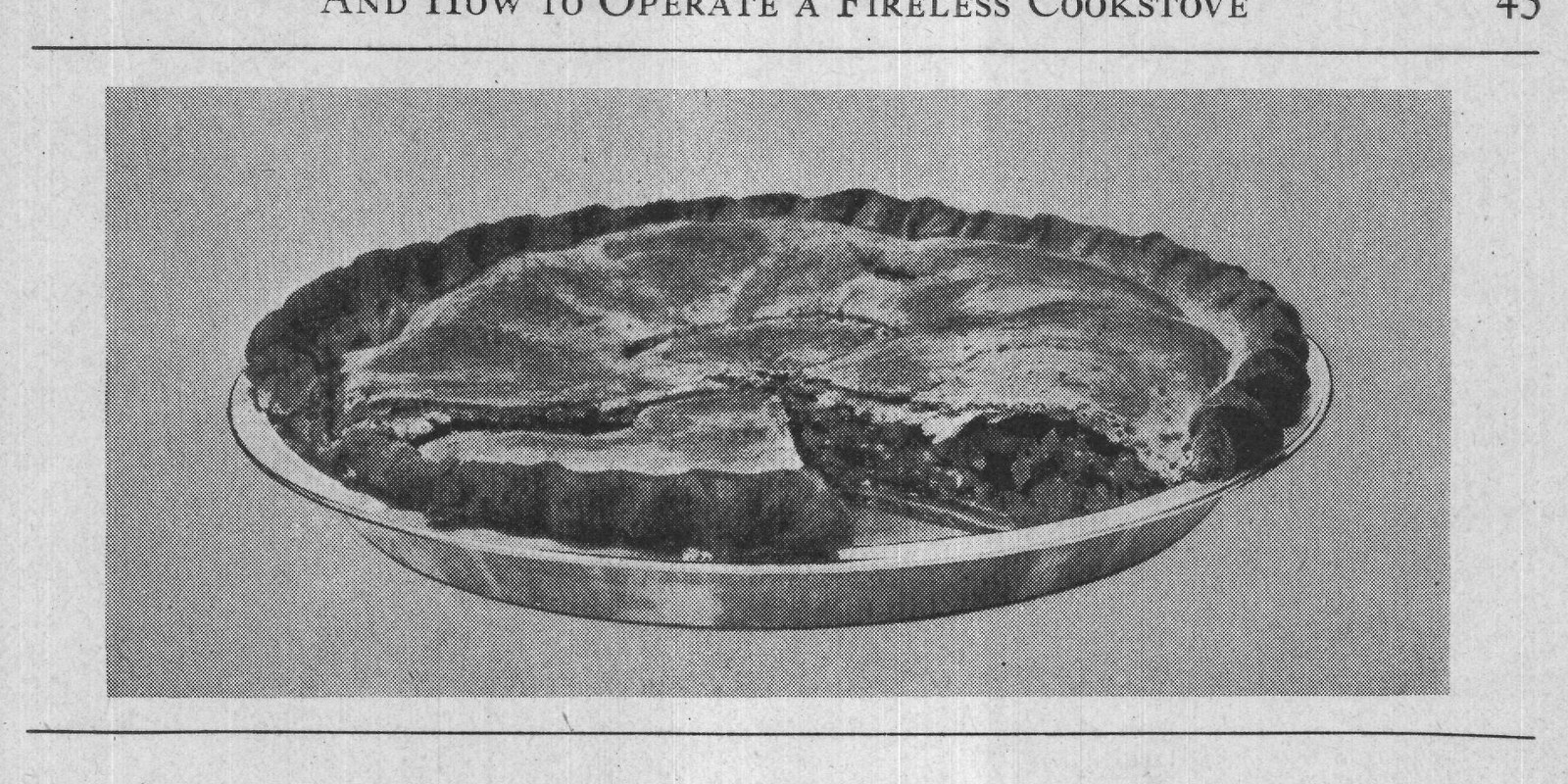
Two cups bread crumbs, 1 quart hot milk, 2 eggs, ½ cup sugar, piece of butter size of an egg, 1½ cup raisins and 1/2 teaspoon salt and cinnamon.
Put in well-buttered pudding pan in the fireless and let cook for 1 hour, using one radiator (on top only), heated 450 degrees.
New England Pudding Pour 2 quarts of milk scalding hot over 1/4 cups of corn meal moistened with 2/3 cup molasses. Let this cool 1/2 hour. Then add 1 pint cold water, salt, 2 teaspoons cinnamon, 2 cups raisins, bake in fireless 4 hours. Use one radiator on top heated 450 Brown Betty Take 2 cupfuls of tart apples, peeled, cored and minced, and mix with 1/2 cups of fine bread crumbs.
Add 1 cup of sugar, 1 tablespoon butter, 3 eggs beaten light, 1/2 teaspoon of mace and of cinnamon. Pour into a buttered pudding dish and cook in the fireless, using two radiators heated 400 degrees 1 hour. Serve with liquid sauce.
Rice Pudding 1 quart milk (heated) 1 cup raisins 1 cup sugar 2 cups cooked rice 3 eggs Cinnamon and salt to taste. Add butter size of an egg. Place in buttered pudding dish in the fireless and bake for 1 hour, using one radiator on top heated 450 degrees.
Baked Custard 3 eggs 3 tablespoons sugar 1 teaspoon vanilla or small quantity of grated nutmeg 1 pint milk Pinch of salt Heat the milk lukewarm, add beaten egg, sugar, flavor and salt.
Place in baking dish or small custard cups, remove to cooker, using one radiator on top. Bake 45 minutes at Baked Apple Dumpling One pint flour, 2 teaspoons baking powder, 1 teaspoon salt, 2 tablespoons butter, 1 cup milk, 1 quart of ripe, tart apples cut in slices. Sift baking powder and flour together. Rub in the butter and mix like biscuit dough.
Roll out and put the apples in a deep pie plate. Put crust on top and bake 30 minutes in the fireless, using two radiators heated 425 degrees. When done reverse and cover with sugar, bits of butter and cinnamon. Serve with cream and sugar.
Prune Whip I/2 lb. prunes I/2 cup sugar 1 tablespoon lemon juice Whites of five eggs Sort and wash prunes, then soak several hours. Heat to boiling point and place in cooker 4 hours or over night. Remove stones and press through a sieve, add sugar. Beat whites of eggs until stiff, add prunes when cold, and lemon juice. Pile lightly in pudding pan and bake in fireless ½ hour between two radiators heated 400 degrees.
Cherry Pudding Use same recipe as for fig pudding, adding 1 cup of fresh cherries. Blueberries, raspberries or other fruit may be used. If fruits are very juicy add 2 tablespoons more flour. Cooked cherries may be used, if drained, and the juice saved for sauce.
Apple Tapioca 3/4 cup pearl or 1/2 min. tapioca 2½ cups boiling water 7 sour apples 1½ teaspoon salt 1/2 cup sugar Cold water Cover tapioca with cold water and of eggs, sift baking powder with flour, and add milk and flour alternately; add figs and fold in whites of eggs.
Pour mixture into buttered molds; place molds in kettle and add boiling water until it almost comes to top of molds. Boil fifteen minutes and place in fireless 3 hours. Serve with hard sauce.
Use one radiator heated 450 soak 1 hour. Drain, add boiling degrees. water and salt, cook in double boiler until transparent. Core and pare apples. Arrange in buttered pudding Peach Tapioca dish, fill cavities with sugar and pour over tapioca and bake 1 hour with two radiators. Heat 400 degrees.
Minute tapioca requires no soaking.
Suet Pudding One cup chopped suet, 1 cup raisins, 1 cup molasses, 1 cup milk, 2½ cups flour, 1 teaspoon each of soda, cloves, allspice and cinnamon, 12 nutmeg; mix well together. Add the soda (dissolved in a little cold water) last.
Butter the small vessel and immerse it in the large vessel in boiling water; use one radiator heated 450 degrees.
Steam four hours.
Fig Pudding 1 can peaches 1/4 cup powdered sugar 1 cup tapioca 1/2 cup sugar 1/2 teaspoon salt Boiling water Drain peaches, sprinkle with powdered sugar and let stand 1 hour.
Soak tapioca 1 hour in cold water to cover. To peach syrup add enough boiling water to make three cups.
Drain tapioca and add to syrup, sugar, salt. Cook in double boiler until clear. Line a pudding dish with peaches, fill with tapioca. Bake in fireless 30 minutes between two radiators heated 400 degrees. Cottage Pudding One cup sugar, 1/4 cup butter and 1 egg, well beaten together. Add 1 cup milk, and 2 teaspoons baking 1 cup sugar 1/2 cup butter 1/2 cup water 2½ cups flour + level teaspoons baking powder well sifted in 2 cups flour. 2 eggs 1/2 cup figs chopped fine Bake for 20 minutes in shallow pan between two radiators heated 400 Cream butter and sugar, add yolks degrees. Serve with sauce. Christmas Pudding 5 cups flour I/2 cup brown sugar I 1 lb. currants 1/4 lb. citron, lemon and orange I peel mixed 1/2 teaspoon each mace, cloves and nutmeg 1/4 teaspoon cinnamon 1/2 lb. suet 1/4 lb. butter 1 lb. raisins 1 cup milk 6 eggs 1/2 cup brandy Put butter and sugar together, stir in beaten yolks of eggs and milk, add flour, beaten whites of eggs, spices, fruit cut fine, dredged with flour, and bastly brandy. Place in mold immersed in large utensil. Boil 20 minutes on stove. Remove to fireless 6 hours or over night. Use one radiator heated 450 degrees.
Steamed Plum Pudding Crumb two cups of bread fine and dry, add 1 cup of sugar, 1 cup of flour, 1/2 cup of molasses, 1 cup of milk, 1 cup of suet, 1 cup of seeded chopped raisins, 1 cup of currants washed and dried, 1/4 pound of citron sliced, 1 ounce of candied orange peel minced, 1/2 teaspoon of mace and cinnamon, 1 small teaspoon of soda dissolved in a little hot water. Mix this with the milk and add 3 eggs beaten light. Dredge the fruit well with flour and put in last. Beat well and pour into buttered mold or pudding dish and cook in the fireless 4 hours; leave on cover. Use one radiator heated 450 degrees. When ready to serve, turn out and pour the brandy over. Light. Serve with liquid or hard sauce.
Tapioca Custard Pudding 4 cups scalded milk 1 teaspoon salt 1/2 cup butter 3/4 cup pearl or 1/2 cup minute tapioca 3 eggs 1 teaspoon salt J Soak tapioca 1 hour in cold water and drain, add milk and cook in double boiler 30 minutes. Beat eggs, add sugar, pour gradually on hot mixture. Turn into buttered pudding dish, bake 1 hour, using one radiator (on top only), heated 400 degrees.
Graham Pudding 2½ cups graham flour 1 cup molasses 2 level teaspoons soda 1 cup milk 1 cup chopped raisins 1/4 teaspoon salt Sprinkle the raisins with a little flour. Sift the soda and salt into flour, add molasses and milk. Beat well, add raisins. Pour into wellgreased mold, place same in large kettle, surround with water, boil 15 minutes on stove. Steam in fireless 3 hours. Use one radiator heated 450 Plain Sauce
This is the pudding chapter from a fireless-cooker manual, and every direction in it assumes hardware almost nobody owns now. The recipes themselves are ordinary turn-of-the-century puddings; the cooking method is the part that needs translating.
- What a "radiator" isA fireless cookstove was an insulated box, not a heat source. The "radiators" were soapstone or cast-iron discs heated on a range to the stated temperature, then set above and/or below the food inside the box, where the retained heat cooked it slowly as it fell away. "One radiator on top, heated 450 degrees" means one very hot stone above the dish only.
- Translating to a conventional ovenBecause the stones cool steadily, the effective cooking temperature is well below 450F and falls throughout. For the custards and crumb puddings a moderate oven, somewhere around 325F, is probably the nearest equivalent, and a little hotter for the fruit and dumpling bakes. Baking times are likely to be much shorter than the fireless figures, so start checking well before the stated time.
- Steamed puddings without a cookerThe graham, fig and Christmas puddings are boiled in a covered mold set in water on the range for 15-20 minutes, then transferred to the box to coast for hours; the suet and plum puddings are simply immersed and left to steam in the box. In a modern kitchen, keep the mold in a covered pot of gently simmering water for the full stated time, topping up with boiling water as it evaporates.
- "Butter the size of an egg"Usually reckoned at about 2 tablespoons, though period sources run as high as 1/4 cup. The book gives nothing more precise, so err on the small side in the custards, where extra fat softens the set.
- SuetBeef suet is the hard fat from around the kidney, and it is what gives the plum and Christmas puddings their texture. Order it from a butcher and chop or grate it cold; packaged shredded suet keeps in the freezer. Butter substitutes but yields a heavier, cakier pudding.
- Pearl versus minute tapiocaThe recipes offer both. Pearl tapioca is whole, needs the full hour's soak, and cooks to distinct beads; "minute" tapioca is precooked and granulated, needs no soaking, and thickens faster. The quantities are not interchangeable one for one, which is why the apple tapioca and the tapioca custard pudding each give two different amounts.
- Custards and curdlingThe baked custard sets on egg alone; the tapioca custard pudding on egg plus tapioca. Keep them below a simmer and pull them when the center still trembles; a water bath is worth the trouble even though the original does not call for one. The retained heat of a fireless box was gentle by nature, which is why these recipes worked in it.
- The pumpkin pie has no pumpkinAs written, the first recipe is a bread-crumb and raisin custard pudding. It is perfectly good on its own terms, but expect nothing pumpkin-flavored from it.
- YieldsThese are family puddings, and the quart-of-milk recipes will serve several people. The Christmas pudding, with five cups of flour and better than two pounds of fruit, makes a large quantity and will need more than one mold; boiled puddings of this sort keep well wrapped and chilled.
Fireless cookstoves - insulated wooden or metal chests packed with hay, mineral wool or asbestos - were a genuine domestic craze in the United States in the first two decades of the twentieth century, and they were promoted as fuel savers during the First World War. The principle was retained heat: food was brought to a boil on the range, then sealed into the box with preheated soapstone discs and left to finish without further fuel. Puddings suited the method well, since long, low, moist heat is what a steamed suet pudding or a baked custard wants, and the makers' selling point was that a cook could load the box and leave it. The recipe list here is otherwise thoroughly conventional New England fare - Indian-meal pudding under the name New England Pudding, Brown Betty, cottage pudding - which appears to be the point: nothing in the ordinary repertoire had to be given up.