Eggs, Buttered
INGREDIENTS for sufficient for 4 persons.-4 new-laid eggs, 2 oz. of butter, 4 slices of hot buttered toast.
AVERAGE COST, 8d.
EGGS, CONSTITUENT PARTS.
Procure the eggs new-laid if possible; break them into a basin, and beat them well; put the butter into another basin, which place in boiling water, and stir till the butter is melted. Pour that and the eggs into a lined saucepan; hold it over a gentle fire, and, as the mixture begins to warm, pour it two or three times into the basin, and back again, that the two ingredients may be well incorporated. Keep stirring the eggs and butter one way until they are hot, without boiling, and serve on hot buttered toast. If the mixture is allowed to boil, it will curdle, and so be entirely spoiled. hot.
TIME.-About 5 minutes to make the eggs SEASONABLE at any time.
This is scrambled eggs made the slow, custard-like way, and the whole recipe hangs on one line: if it boils, it curdles. Everything else is bookkeeping.
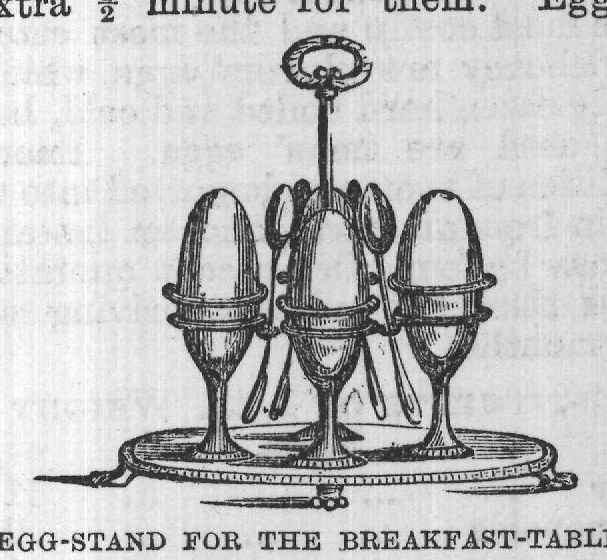
- The garbled edgesThe opening fragment ("for one that is three or four days old") belongs to a preceding note on egg freshness, and "EGGS, CONSTITUENT PARTS" and "EGG-STAND FOR THE BREAKFAST-TABLE" are captions to engravings that sat beside the text. Ignore them; the method itself is complete.
- Butter quantity2 oz is 4 tablespoons, half a stick, for four eggs. That is a very rich ratio by modern habit and it is what makes the dish soft and glossy; halving it gives ordinary scrambled eggs instead.
- "A lined saucepan"In 1861 this usually meant tin-lined copper, bare copper being avoided because it can discolour and react with eggs. Any heavy nonstick or stainless pan does the job now.
- "A gentle fire"The lowest setting your burner will hold, or a bowl over barely simmering water. Eggs begin to set from around 145F and tighten fast above 165F; boiling point is far past ruin.
- Why pour it back and forthTipping the warming mixture into the cold basin and back is tempering. It drops the temperature at the pan bottom, where curds form first, and emulsifies the melted butter into the eggs rather than letting it separate into a greasy layer.
- TimingFive minutes assumes a hot range and a shallow pan. On a low modern burner expect eight to twelve minutes of near-constant stirring. Pull the pan while the mixture still looks slightly loose; residual heat finishes it in the seconds before it reaches the toast.
- Yield and costFour servings, one slice of toast each, and best as a breakfast or supper dish. The average cost is given as 8d.
- Very soft eggsCooked below boiling, these stay quite moist. If serving anyone pregnant, elderly, or immune-compromised, use pasteurised shell eggs.
"Buttered eggs" was the standard English name for scrambled eggs well into the nineteenth century, and the phrasing is literal: the butter is melted separately and emulsified into the raw egg before any heat reaches the mixture, which is closer to a savoury custard technique than to the pan-scramble of today. Mrs Beeton's Book of Household Management (1861), from which this entry descends, is insistent on new-laid eggs throughout its egg chapter, a preoccupation that makes sense in a period when town households bought eggs of unknown age from carriers and hucksters and judged them by candling or by whether they sank in water. The name also survives in an unrelated Irish sense, where "buttered eggs" are whole eggs whose warm shells are rubbed with butter to seal the pores and keep them fresh; the two usages are often confused, though the connection is generally traced no further than the shared word.