Rabbit, Boiled
INGREDIENTS for dish for 4 persons. Rabbit; water. AVERAGE COST, 1s. to 1s. 6d. each.
For boiling, choose rabbits with smooth and sharp claws, as that denotes they are young: should these be blunt and rugged, the ears dry and tough, the animal is old. After emptying and skinning it, wash it well in cold water, and let it soak for about 1/4 hour in warm water, to draw out the blood. Bring the head round to the side, and fasten it there by means of a skewer run through that and the body.
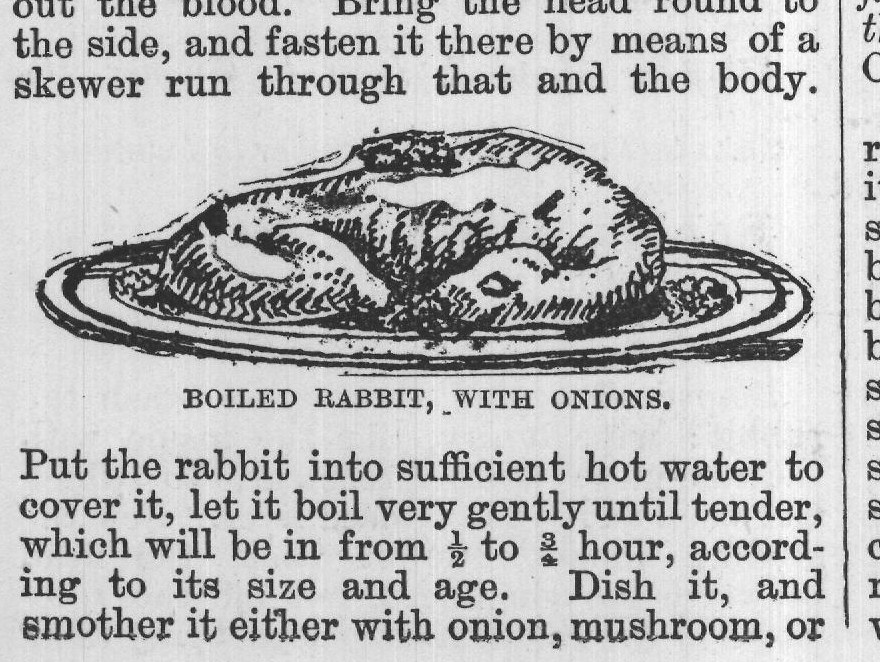
BOILED RABBIT, WITH ONIONS.
Put the rabbit into sufficient hot water to cover it, let it boil very gently until tender, which will be in from to hour, according to its size and age. Dish it, and smother it either with onion, mushroom, or THE KNIGHT'S GUEST.
RABBIT, CURRIED. liver-sauce, or parsley-and-butter; the former is, however, generally preferred to any of the last-named sauces. When liver-sauce is preferred, the liver should be boiled for a few minutes, and minced very finely or rubbed through a sieve, before it is added to the sauce. Boiled salted pork is another usual accompaniment.
TIME.-A very young rabbit, 1/2 hour ; a large one, 3/4 hour ; an old one, 1 hour or longer.
SEASONABLE from September to February.
A plain boiled rabbit, judged done by tenderness rather than the clock. The method works, but almost everything about the animal has changed since this was written.
- Farmed rabbit, not wildRabbit sold today is nearly always farmed, young and uniform, weighing about 2.5-3 lb. It behaves like the "very young rabbit" of the original and wants roughly 30-40 minutes at a bare simmer. The old, tough animal that justified an hour or more is not something you will meet at a butcher's counter.
- Never let it boilDespite the title, the water should stay just below a simmer with barely a tremble on the surface. Rabbit is very lean and a rolling boil shreds the loin and dries the legs long before the shoulder gives in.
- Judging donenessTest the thick part of the hind leg with a skewer: it should slide in with no resistance and the meat should be pulling from the bone at the joint. Rabbit is done at around 160F internal; carry-over will finish it as it drains.
- The soaking stepThe quarter hour in warm water to draw out blood suits a shot wild animal, which bruises and bleeds badly, though the book gives it for any rabbit. With farmed rabbit a quick rinse in cold water is enough, and warm water only encourages bacterial growth.
- Skewering the headBringing the head round and pinning it holds the carcass compactly, and served the way rabbit was dished at a Victorian table; the book gives no reason. Modern rabbit comes headless; skewer or truss the hind legs together instead so the carcass holds its shape in the pan.
- Parsley-and-butterThis means a white sauce -- butter, flour, milk or some of the cooking liquor -- finished with a good handful of chopped parsley, not simply melted butter. Onion sauce is the same base built on onions cooked soft in milk.
- Liver sauceIf you want the liver sauce, poach the liver two or three minutes only and sieve or chop it fine before stirring it into the finished white sauce off the heat. Boiled hard, it turns grainy and bitter.
- Cost and salt porkThe "1s. to 1s. 6d." price is Victorian currency and of no practical use. The boiled salt pork served alongside is doing real work: it supplies the fat and salt that lean rabbit lacks, and a few slices of good bacon or pancetta do the same job.
- YieldOne rabbit of this size serves four modestly, or two generously, with the sauce and a starch.
Boiled rabbit sits in Mrs Beeton's book as everyday meat rather than a treat: rabbit was cheap, plentiful and available to households well below the level that could afford much butcher's beef, and warreners supplied British towns in enormous numbers through the nineteenth century. The claw-and-ear test given here is old warreners' lore -- smooth sharp claws and supple ears for a young animal, blunt claws and dry ears for an old one -- and it mattered because age determined whether the carcass could be roasted or had to be boiled or stewed for an hour to be edible at all. The September-to-February season reflects wild rabbit taken in the cooler months, when the meat was in better condition and would keep. The insistence on a sauce is the giveaway: rabbit is so lean that Victorian cooks treated onion, parsley or liver sauce and a piece of salt pork as part of the dish rather than an option.