Home Uses
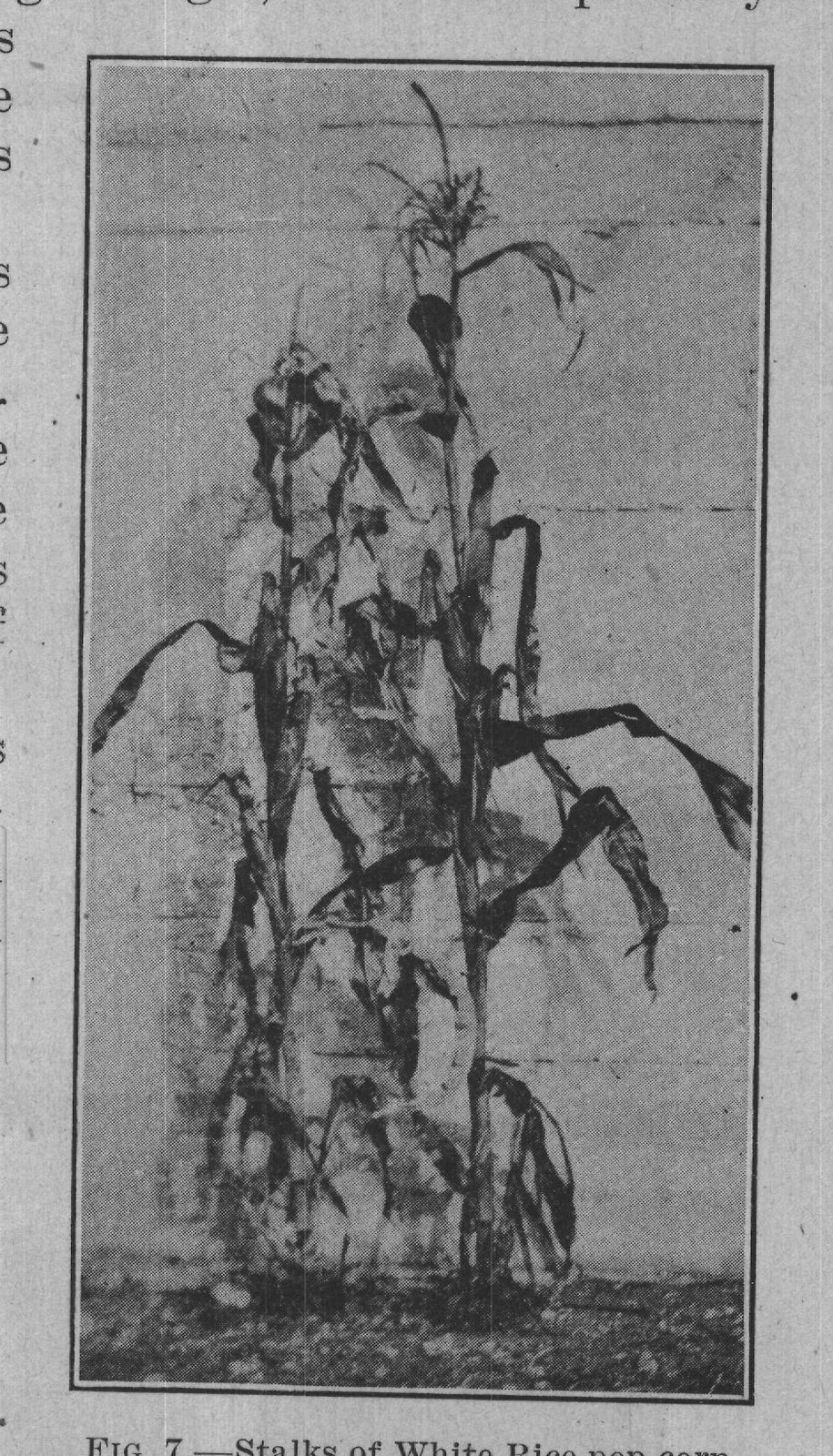
Pop corn is usually popped to be eaten at once, or it may be made into pop-corn balls, crackajack, or other forms of pop-corn confection. A common way of preparing it is by popping and sprinkling FIG. 7. Stalks of White Rice pop corn. it with salt or adding salt and melted butter. Sometimes the popped corn is eaten with milk and sugar like a breakfast food. The parched unpopped kernels when ground like coffee make a very good breakfast food for eating with cream and sugar or for boiling with water and serving like oatmeal. Some pop-corn venders make a palatable preparation by popping the corn in melted butter and lard with salt added. 1 For information regarding the food value of pop corn, see Farmers' Bulletin 298, entitled "Food Value of Corn and Corn Products."
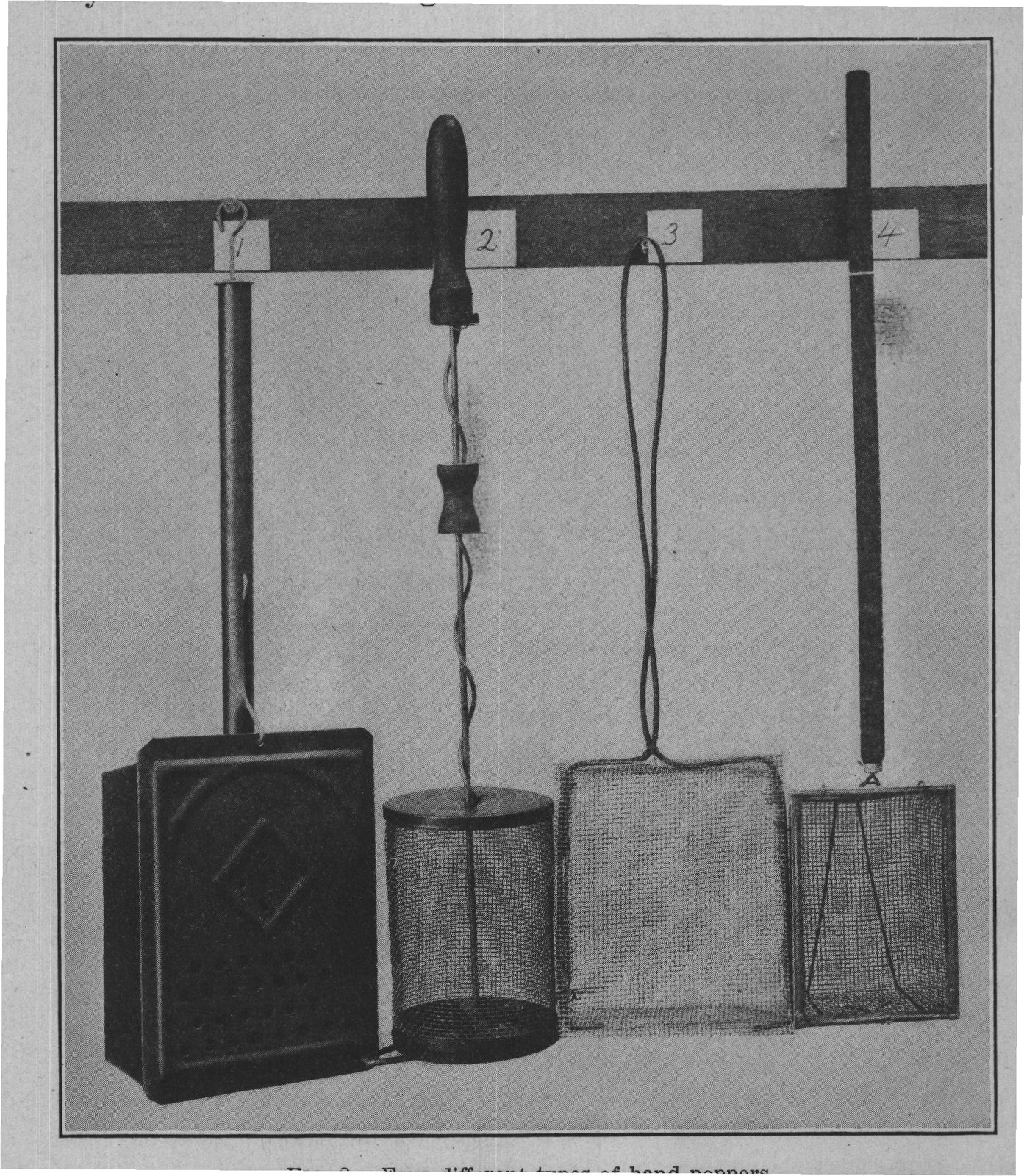
This It is customary on some farms at butchering time in the fall to wind up the day's work by cooking a kettle full of pop corn. is done by popping the corn in the greasy residue left in the kettle after the lard has been rendered. Salt is added to suit the taste and may be cooked in with the grease. 2 3 4 FIG. 8. Four different types of hand poppers.
In many farmhouses the delicious pop-corn cake is considered a necessary adjunct to the Christmas festivities and is regarded as a superior article of food.
Dealers who put up shelled pop corn in 10-cent packages for the retail trade usually have a number of good recipes printed on the outside of the packages. Cookbooks also give splendid recipes for making pop-corn confections. The following have given good results:
CHOCOLATE POP CORN. 2 teacupfuls of white sugar. cup of corn sirup. 2 ounces of chocolate. 1 cup of water.
Put these ingredients into a kettle and cook them until the sirup hardens, when put in cold water. Pour over 4 quarts of crisp, freshly popped corn and stir well to insure the uniform coating of the kernels. SUGARED POP CORN.
Make a sirup by boiling together 2 teacupfuls of granulated sugar and 1 teacup of water. Boil until the sirup strings from the spoon or hardens when dropped into cold water. Pour over 6 quarts of freshly popped corn and stir well. 1 pint of sirup. 1 pint of sugar.
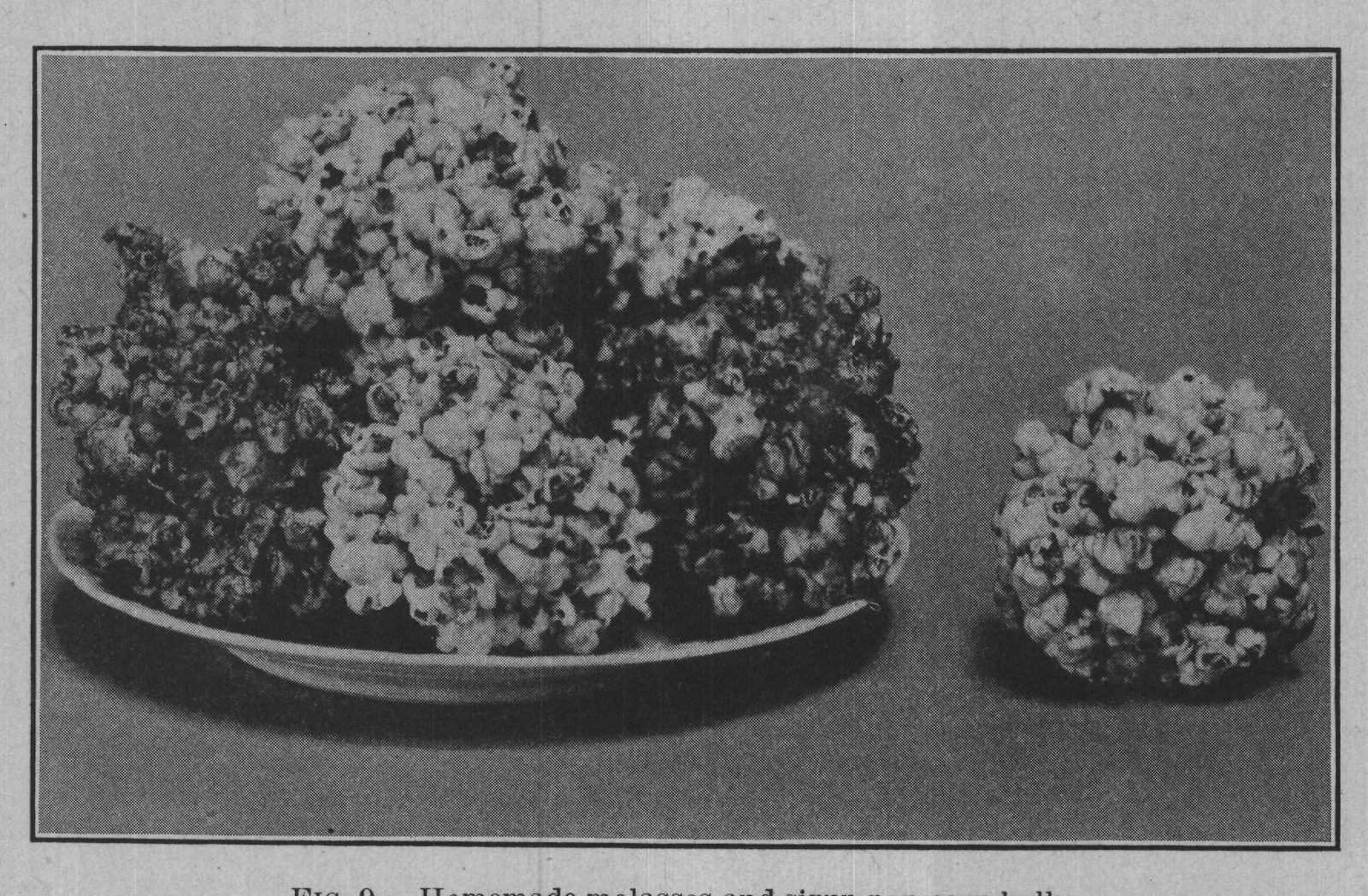
FIG. 9. Homemade molasses and sirup pop-corn balls.
POP-CORN BALLS. 2 tablespoonfuls of butter. 1 teaspoonful of vinegar.
Cook till the sirup hardens when dropped into cold water. Remove to back of stove and add one-half teaspoonful of soda dissolved in a tablespoonful of hot water and then pour the hot sirup over 4 quarts of freshly popped corn, stirring till each kernel is well coated, when it can be molded into balls or into any desired form.
The pop-corn balls shown in figure 9 were made by this last recipe. The darker balls were made by using New Orleans molasses and the lighter colored ones by the use of maple sirup. Any good sirup or molasses can be used.
Three confections sit inside a general essay on popcorn, and all three turn on the same skill: boiling sugar to the right stage without a thermometer. The rest is arithmetic and old vessels.
- The hinge: the cold-water testThe hinge: the cold-water test. "Cook until the sirup hardens when put in cold water" points to a hard stage, but the recipes do not say which. A brittle coating wants something near hard crack; syrup for balls that must still be molded is nearer hard ball. The sugared recipe's alternative test, "strings from the spoon," indicates a softer stage still. Judge by the drop in cold water rather than a fixed number; undercooked syrup gives sticky, weeping popcorn that never sets.
- TeacupfulA teacup in this period is roughly 3/4 of a standard 8-ounce measuring cup, though the term was loose. For the sugared popcorn, treating the ratio as 2 parts sugar to 1 part water by volume matters more than the absolute size of the cup.
- The pop-corn ball ingredient list is scrambledThe typesetting has split it: the pint of syrup and pint of sugar appear above the figure caption, the butter and vinegar below. Read it as 1 pint syrup or molasses, 1 pint sugar, 2 tablespoons butter, 1 teaspoon vinegar, plus the soda at the end. The vinegar is there to invert some of the sugar and discourage graining.
- ChocolateTwo ounces of chocolate here means unsweetened baking chocolate in cakes, not chips. Chop it so it melts into the syrup before the temperature climbs.
- "Remove to back of stove"On a wood range the back was the cool zone. Take the pan off the heat entirely before stirring in the dissolved soda, which will foam the syrup up considerably; use a pan at least twice the volume of the syrup.
- Corn sirup and New Orleans molassesCorn syrup here is light corn syrup, then a fairly new commercial product. New Orleans molasses is a full-flavoured unsulphured cane molasses, not blackstrap, which is too bitter for candy.
- How much popped cornFour quarts of popped corn comes from roughly 1/2 cup of unpopped kernels; six quarts from about 3/4 cup. Warm the popcorn in a low oven and work in a large greased bowl so the syrup does not set before it is distributed.
- Yield and handlingFour quarts will give something in the order of a dozen to sixteen balls, depending on how large you make them. Butter your hands and press lightly; hard packing makes them dense and tooth-breaking. They keep a few days wrapped, then go stale and soft.
- The parched-kernel breakfast foodGrinding unpopped parched kernels gives a coarse toasted meal. Cooked with water it behaves like a fine polenta and needs longer than oatmeal, closer to 20-30 minutes, with more liquid than you would expect.
This comes from the era when the U.S. Department of Agriculture published practical bulletins on single crops, and the footnote pointing readers to Farmers' Bulletin 298 on the food value of corn products places it squarely in that programme. The essay is as much a picture of farm economy as a set of recipes: popping corn in the greasy residue of the rendering kettle at fall butchering wastes nothing, and the hand poppers illustrated were a standard piece of hearth and range equipment. "Crackajack" refers to the caramel-coated popcorn and peanut confection popularised in Chicago in the 1890s and by this point already a commercial byword, which is why the author can use the term without explanation. The frank note that dealers print good recipes on their ten-cent packages is a reminder that popcorn was then a bulk agricultural commodity being marketed toward the home cook, and that the line between household knowledge and advertising copy was already thin.