Home › How to Pop Corn › How to Pop Corn
How to Pop Corn
For good results in popping, the main requisites are good corn and a good hot fire. and a good hot fire. In popping, certain precautions may be observed to good advantage.
Do not take too much pop corn at one time, not more than enough to barely cover the bottom of the popper one kernel deep. Hold the popper high enough above the fire or heat to keep from burning the kernels or scorching them too quickly. The right degree of heat for best results in popping should make good corn begin to pop in 1½ minutes. This should give the maximum volume increase in popping. If it begins to pop in less time or if a large quantity of corn is put into the popper, it will not pop up so crisp and flaky. If it takes much longer for the popping to begin, the heat is probably not great enough or the pop corn is of poor quality, or there may be other interfering causes, such as drafts of cold air.
To preserve the snowy whiteness of the popped kernels, the flame must be kept from striking them.
This can be done by placing a plate of iron or a stove lid between the corn and the fire if a wire popper is used or by using a pan popper if popping directly over a flame.
If the pop corn is in first-class condition and the heat properly applied, 1 pint of unpopped corn should give 15 to 20 pints of popped corn.
This is dry popping over a coal or wood fire in a wire basket popper, and nearly every instruction is really about heat management. On a modern stove the same principles apply, with a heavy lidded pot standing in for the popper.
- The hinge is kernel moistureCorn pops because water sealed inside the starchy endosperm flashes to steam. Kernels that have dried out in an open jar or a warm cupboard give small, tough flakes no matter how good the fire is; keep them in a sealed container at room temperature, not in the refrigerator or freezer.
- "A good hot fire" in stove termsAim for medium-high heat. The stated benchmark is the useful one: first pops at about 1½ minutes after the pan is loaded. Sooner and the outsides scorch before the centres steam; much later and, as the text says, the heat is probably too low or the corn of poor quality.
- One kernel deepThis is not fussiness. A crowded pan heats unevenly, the bottom layer burns while the top is still cold, and the flakes come out dense. Half a cup of kernels in a 4-quart pot is about right.
- Wire popper versus panThe iron plate or stove lid the text describes is a heat diffuser, standing between an open flame and the basket. Over a gas burner, a heavy-bottomed pot does the same job on its own; on induction or electric, no diffuser is needed.
- No fat is called forThis is dry popping, which is why whiteness and scorching are discussed at all. A tablespoon or two of a neutral high-smoke-point oil, heated with three test kernels until they pop, gives more even conduction.
- Expansion ratioFifteen to twenty volumes was excellent for the varieties of the day. Modern hybrid popcorn is bred for expansion and generally gives a good deal more, so a pint of kernels now yields more than this text predicts.
- DraftsThe warning about cold air mattered with an open basket over a range. A lidded pot removes the problem, but leave the lid slightly ajar so escaping steam does not soften the popped flakes.
- YieldA pint of unpopped corn is a lot: even at the conservative ratio given here it fills roughly two gallons, enough for eight to ten people.
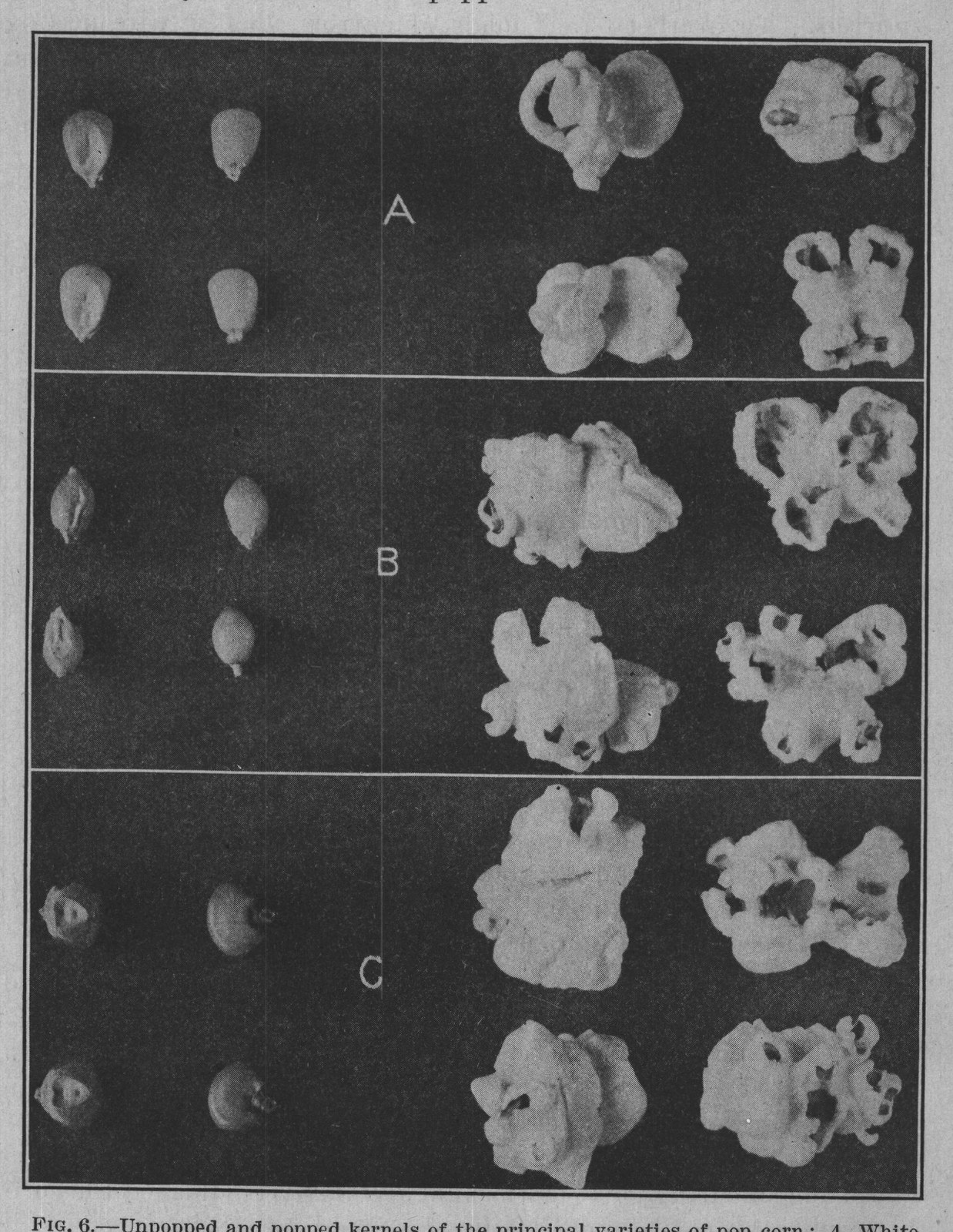
This reads like the practical core of an early twentieth-century agricultural extension pamphlet, the kind written when popcorn was still a farm crop with named field varieties rather than a packaged snack, and when home economists were measuring expansion volume as a way of grading seed quality. The reference to lettered figures showing "the principal varieties" points to the era of open-pollinated types such as White Rice, Japanese Hulless and the pearl corns, most of which have since been displaced by hybrids selected specifically for popping volume and hull tenderness. Popcorn itself is an ancient American food, its cultivation generally traced to Indigenous peoples of the Americas long before European contact, though the wire basket popper held over a kitchen range belongs squarely to the nineteenth-century stove. The obsession with "snowy whiteness" here reflects a period preference: a scorched or yellowed flake read as careless cooking.