Home › The Spoils of the Cover › The Spoils of the Cover: European (With the speckled trout)
The Spoils of the Cover: European (With the speckled trout)
With the speckled trout, the rainbow-trout, the sunapee-trout or saibling, the black-bass and muscalonge should also be included among distinctly native gamefish. The brown trout of Europe has recently been introduced into many American waters, as the Mongolian pheasant has been introduced in the fields. But the American speckled trout, who is in reality a char and smaller than the European trout, is higher flavoured, and, like the saibling and the rainbow-trout of the Rockies, is a far more beautiful fish. The brown trout thrives under warmer conditions than the speckled trout, and consequently is an acquisition.
But as he attains a much larger size, it is unwise to place him in waters tenanted by the native species, as the larger fish has already proved very destructive to the smaller fry of the Salvelinus fontinalis.
It is superfluous to state that fish cannot be too fresh, in which respect it is the reverse of game. The quail, and especially the ruffed grouse, should be hung long enough to develop their flavour. Eaten too soon, they do not represent game, as their quality is not attained; hung too long, on the other hand, they are not fit for the table. To cook quite fresh game is to deride its mission on earth. A happy medium should be observed in the case of maturing most species. The duck, woodcock, and snipe should only be mellowed or kept under favourable conditions for a short period. They are like a peach, which is best when recently plucked, as opposed to a pear, which requires to be slowly ripened after gathering. It is possible to eat a "high" grouse or pheasant, if not too gamy; but a duck past the meridian of maturity is well-nigh impossible, as is also a shore-bird or either of the longbills. There is no occasion to bury the wild boar, as is sometimes done in Europe for the purpose of mellowing him; inasmuch as he does not exist in America, and the razor-back hog of the South, however well he may have feasted on beech-mast, cannot take his place. But in place of the wild boar we have the lordly moose, elk, and caribou, and the picturesque Rocky Mountain sheep and goat, which, if not all desirable for the larder, nevertheless afford magnificent sport; while by many a young caribou or elk, as also a mountain sheep, is considered among the graces of edible furred game.
The relative time of keeping all game to savour it under the best conditions will depend upon the weather. It is always better when hung in the fur or feathers, and where it may have a circulation of air, than when confined in a close receptacle.
When frozen it loses in flavour and succulence.
Dark-fleshed birds, with few exceptions, are best rather underdone-rosy, but not raw. White-fleshed birds should be done sufficiently, but not cooked to the extent of drying their juices. The cooking of mutton will serve as a type for the one, and veal for the other. Most game-birds are best plainly roasted or broiled, although for variety they may be served in various appetising ways. In roasting the smaller species, the vine-leaf and a strip of larding-pork should not be overlooked; and where these or well-buttered paper are not employed, as in the case of over-fat birds, the basting-spoon should be kept in constant agitation.
Larding lightly often improves a white-fleshed bird where he has not been enveloped in pork.
Especially, let game be zealously watched in the cooking; let its appropriate wine be carefully considered; and let no delay occur in its flight through the butler's pantry to the dining-room. Its garnishing also should be studied, that it may flatter the eye as well as the palate; and, for the most part, with feathered game water-cress or filets of lemon should lend their colour and their zest.
Game-birds should always be hung by the head, not for the purpose of sending the juices to the legs, as is fantastically supposed by some, but to allow the lower viscera and their contents an approach to the natural exit. Were they hung by the feet, the visceral machinery-softening more and more, as it always does-would of course press upwards to their bodies and probably taint them. A game-bird should never be drawn until that office is performed by the cook. Hares are usually hung by their hind legs, it is true; but hares, if hung for any time, are invariably "paunched," so that no lower viscera remain in them. Fish, it has been pointed out, should never be covered up, or it will suffer fatally from the condensation of the steam. It may be noted that for an all-round sauce for broiled fish, none wears better than a maîtred'hôtel and, occasionally, its modification, a sauce au beurre noir.
A well-made bread-sauce, an accessory which we owe to England, always accords with quail and grouse, and is not amiss with prairie-chicken, even if they are already well moistened with the sauce of cooking them with pork and basting with bouillon. Francatelli's delicious sauce, Number 65, the recipe for which has been presented in a previous chapter, will need no recommendation as an adjunct for venison and mutton where it has once been enjoyed. Apple-sauce is indispensable with the domestic duck, and boiled onions should not be omitted by way of a vegetable accompaniment. Canard saignant is reprehensible, L and equally so is the overdone bird. A wildling should be fresh and sweet, and "passed through the kitchen" not "once," but thrice; the domestic fowl will, of course, be allowed more time on the range to plume himself for the table. The celery-fed bird (O avis jucundissima!) calls for no other sauce than his own, but with some species a stuffing of olives and an olive sauce are excellent additions. Then, if your bins of têtes de cuvée of the Vosne be not lacking, you may hear your whistler simply praying to be engulfed in Richebourg or Romanée.
The wild turkey, the "spruce-partridge," and the "cottontail" will prove more desirable subjects for the seasonings and provocative sauces of the French cookery books than their more princely companions.
The wild turkey, notably, despite his splendid wattles and emerald plumage, it must be conceded cannot compare with the tamer fowl in edible qualities; and it were well, where a stately gobbler has been sent as the result of the prowess of a friend, to dispense at once with his drum-sticks, which, owing to his roving habits and wide ranging, have become tougher than the ham-strings of a patriarchal sage-cock.
He should be treated as a somewhat plain-looking woman, who has passed the hey-day of her charms, pranks and accoutres herself for a ball, and the aid of art be summoned to amplify his good points and gloze over any of his deficiencies. His resonant voice of course will be stilled by the cooking, but his voluptuous breast will remain. Thus by neatly cutting across the lower part of the back and thighs, removing his shapely legs, and then inverting him, he will have been formed into a boat-like receptacle for an artistic chestnut stuffing. One may then proceed to lard him; and, while roasting, baste him thoroughly, send him to the table with some oak-leaves en couronne, a currant-jelly sauce in a saucière, and, with the assistance of a perfumed and generous red wine, make the most of his seductive contours. All this may be contrary to the tenets of Savarin, who pronounces the wild turkey superior to the tame. But it must be remembered that he is speaking of a wild turkey that he had the good fortune to kill by his own hand while in Connecticut a fact which, with the appetite engendered by his shooting-outings, will readily account for the preference he expresses for the wild form of this noble member of the Phasianide. At a certain season, however, when he has fattened on pecan-nuts, the flesh of the wild turkey is of excellent flavour; and to this circumstance Audubon's eulogy is probably due: "The ruffed grouse, in my humble opinion, far surpasses as an article of food every other land bird which we have in the United States, except the wild turkey when in good condition."
Furred game is more amenable to variety in preparation than feathered; and while marinéd venison and a civet of hare may be delicious, the fewer culinary frills on a grouse, woodcock, or snipe the better. A salmis, nevertheless, has its virtues; and as for the lord of the woodlands, when tired of him au naturel, if that be possible, he may be invested with a new glory as partridge aux choux, if one but follow the counsels of Baron Brisse, whose prescript is well worth transcribing and comes within the compass of all: "Perdrix aux choux. All housewives do not succeed with perdrix aux choux. This is the way to set about it in order to be complimented. Pluck, draw, singe, truss, and tie up the partridges. Blanch some cabbages, cut in quarters from which the cores have been removed; put them to soak in fresh water, dry them and press out all the water. Blanch also a small piece of lean pork from the breast. Make a light roux in a large stewpan, put the cabbages in with the small pieces of pork, some uncooked sausages, some carrots, an onion piquéd with two cloves, a bouquet-garni, salt and pepper. Plunge the partridges in the centre of the cabbages, cover with broth and cook gently in a closed stewpan. When done, remove the birds, the pork and sausages, dry off the juice of the cooking, then drain the cabbages that is, turn them in a stewpan, on a quick fire, until they are free from liquid. Untruss and dress the partridges on a platter, on a bed of cabbages, with the backs underneath, cut the pork and sausages in pieces, slice the carrots, and garnish with all. Partridge aux choux is accompanied with a sauce made from a roux moistened with broth and added to the juice of the cooking." 1 The touch of the baron in everything relating to the all-important office of eating is invariably delicate and sure. Nevertheless, if one may venture to suggest an improvement, not in the mode of cooking, wherein he is impeccable, but in the shading of the plat, it would be to remove the birds after they have simmered sufficiently in the cabbage, glaze them with melted butter, and place them for an instant in the oven, with a very lively fire, in order to brighten their otherwise somewhat blanched complexion. Sauerkraut, instead of cabbage, is frequently employed by the French, but 1" La Petite-Cuisine." with far less happy results. With care in its employment, the Brussels sprout, after it has felt the finger of the frost, might be used as a medium with no regrets unless on the score of a slight indigestion. Were one an ostrich, nothing could serve as a more delicious or colourful vehicle than the German roth-Kohl. Of sausages, the highly spiced little Wienerwurst is best adapted to the dish.
A game-pie composed of numerous spoils of field and cover-seasoned and stuffed with herbs, shallots, bay-leaf, mushrooms, truffles, chestnuts, sweetbreads, and various vegetables, and cooked in broth and red wine, with a fingerful of brandy and another or two of Madeira is a triumph of the chef when well executed. But to indulge in this requires a vigorous digestion and toes impervious to arthriticism. In its relation to wine, the maturity of game should be taken into consideration; as, for example, with dark-fleshed birds that are comparatively fresh, a fine Bordeaux; with those that are more matured, and particularly duck, the warmer and more generous red vintages of the Côte d'Or and the Côte du Rhône. For a well-hung prairie-chicken, a red wine will naturally be selected; for a "partridge" that inclines to freshness, either champagne or Bordeaux, Burgundy or a Deidesheimer Auslese may serve for a bath with equally good results. But game is too often undeservedly treated and served at the end of a dinner of numerous courses, when, whatever its merit or that of its accompanying wine, the palate and appetite are in scant mood to appreciate it.
With the advent of the autumnal equinox the calendar of seasonable sport begins. There is then an exhilaration in the air that irresistibly invites to out-ofdoor exercise and an exploration of the covers. Game is then matured, fleet of foot and strong of wing; and at no other period do upland and vale present such varied attractions. September is the true adagio of sport, October and November the allegro, and December the diminuendo. For pure sylvan beauty, no month may compare with October, when the torch of autumn kindles the woodlands into living flame, although the dreamy Indian summer possesses a charm that is matched only by May when she rolls away the resurrection-stone. Then when the purple landscape lies hushed in slumber, one may recall anew the forgotten ode of an unknown bard, in whose haunting cadences are subtly expressed all the rest and peace and rhythm, all the tone, the tenderness, and benediction, of the latter-year:
I.
Nothing stirs the stillness save a leaf that slowly rustles down, Dim, through sunny mists the trees uplift their branches bare and brown; Winds are hushed, and skies are soft and grey, and grassy slopes are sere, — Calm and sweet and still, ah! sure is this the twilight of the year.
II.
There is this in these November days, the message that is sent- Peace undying, rest, and sweet and measureless content; Life's wild fever over, sleep's soft mood enchanting, such as fills Golden dreams of gods immortal, sits enthroned upon these hills.
III.
Offered in day's golden chalice, sweet and dreamy peace is mine; All 's forgotten, lying here and watching tides of glorious light divine Slowly sweep along the hills, and vaguely thrilling to their sway- All that love hath lost or wrong hath won, O calm and royal day!
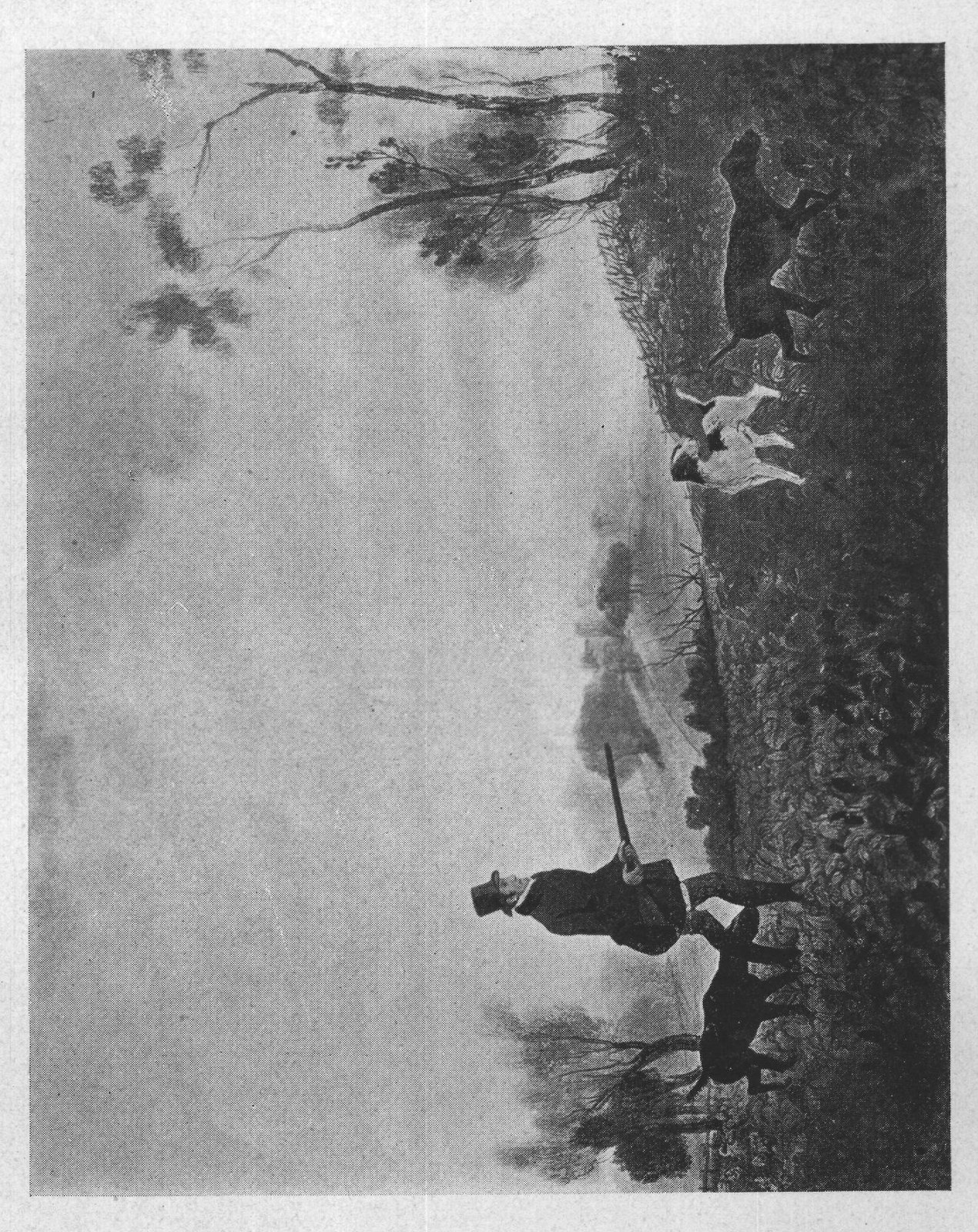
Days there are in late November and December, too, when the beauties of leafless vegetation are scarcely surpassed by the pomp of October or the glamour of the Red Man's summer; when tender tones of russet and grey bask over bare fields and fallows, and wanton amid mysterious woods; and strange, ripe hues, rich as those of old tapestries, smoulder and gleam the livelong day from the southern horizon's verge. There is a charm as well in the clear crispness of a winter's day, when the woods are cushioned with snow on which the sylvan denizens have left their imprint, and when one may penetrate into the swamp's most secluded labyrinths, where the hare and fox have gone before. But October and November for the delights of the chase and glories of the countryside! The gay medley of summer has passed, and in its place are the aster and goldenrod "PARTRIDGE SHOOTING - SEPTEMBER" From the colourea engraving by Reeve, after the painting by R. B. Davis, 1836 hosts, the bright berries of bittersweet and black alder, the fragrant life-everlasting and lingering yarrow. Ceased is the drone of insect choirs, and birds are silent save for the chattering of congregating flocks and call-notes of passing migrants. But through the rustle of Autumn amid her falling leaves the quail cries aloud from the coppice, "I am here!" the squirrel barks, and far within the woodland's depths the drum of the grouse proclaims the reign of sport.
What more appropriate at this most alluring moment, when everything incites to an outing, than a hunting-party in the woods? especially as one remembers that both the fall woodcock and time are on the wing. To a shooting-jaunt, therefore, with a wellprepared luncheon in the hampers, the reader is invited; it being understood that this is to include, as nearly as possible, an equal number of both sexes.
We will suppose a day in mid-October, after the frost has vivified the air, when the tints of vegetation vie with those of the noblest pressings of the vine, and the matured plumage of a game-bird in the cover far exceeds the liveliest gilding the chef may bestow upon him on the table.
Here, still more than at the dinner-table, success will depend largely upon careful forethought; for even should the birds be unusually wary, and there be not enough game in the pockets to weigh very heavy, the excursion will prove none the less enjoyable, provided the party and the lunch be well composed. And whether the goal be within driving distance, or accessible only by train, the details will have been planned by one who is thoroughly conversant with the region to be visited, and the refection have been looked after by hands that never fail. Let the luncheon never be neglected. If the sportsman's efforts turn to good account, appetite is a certain sequence; if not, an appetising spread will help to bridge over any chagrin at lapses of marksmanship, or the drawing of sparsely populated covers. Thus, under the most divergent circumstances, a choicely filled hamper answers an admirable purpose. Granted that one may shoot better during the first hour after a meagre repast, yet should an outing possess other features than mere weight and numbers. For hath not wise Montaigne declared, "He who hath no jouissance but in enjoying; who shoots not but to hit the marke; who loves not hunting but for the prey; it belongs not to him to intermeddle with our schoole." The start will necessarily follow a reasonably early breakfast; and ere arriving at the final destination of the morning, various covers may be explored by the devotees of the gun. And while the music of the barrels rings through the painted woods, and the russet bird of October tops the ranks of the aspens, there will be sufficient novelty in the situation and in the attractions of their own company, no doubt, to prevent any ennui on the part of those in waiting.
Meantime, while the bag of woodcock mounts, or an old cock grouse is neatly stopped in his rush through the thicket, the manifold beauties which the autumnal season weaves will naturally arrest one's attention; for he is callous indeed to all sense of beauty who even in the midst of exciting sport can fail to note the harmonies of the October countryside. To the true nature-lover, the shooting will be more of an excuse than the principal reason for the excursion, of which the surroundings and the joys of social companionship should constitute the greater entertainment. And thus ere leaving the scene of the last hour's sport, one involuntarily pauses at the skirts of the wood for a final survey, -to mark the gorgeous ambers of the beech, the garnets of the shad-blow and splendours of the dogwood and liquidambar; to view the fires of the swamp-maple, the ochres of the sassafras and clarets of the oak; while, fringing the edges of the thicket, the bronzed fronds of the ostrich-fern and gilded pennants of the aspens flutter their farewell to the passing year. On every side the insignia of autumn blaze. Thorns hang heavy with their burden of ruddy fruit, the black-alder berries gleam crimson in the swamp, hickory and elm shower down their ore.
And but for the patter of dropping nuts, the robin's angelus, and the lisping of migrants pluming for their southward flight, one might suppose the arrased woodland halls had never hearkened to the hermit's song or echoed to the veery's strain. In the air overhead the midges are holding their final dance; while from the lengthening shadows and plaintive autumn breeze comes a whispered admonition to seize the fleeting moment and make the most of the golden hour.
Nevertheless, however alive to the enchantments of nature, the tonical quality of the air will have asserted its sway, and the gunner's appetite have mounted apace with the bag. So, in that contented frame of mind and body which out-of-door exercise imparts, one arrives at the scene of the luncheon, which has been happily chosen in a glade through which the slanting sunbeam strays. And here the arrivals will note with delight the presence not only of certain vitreous receptacles with gilded capsules that are cooling in the stream, but also that of St. Ange, who so distinguished himself on a previous occasion with his wonderful salmis of quail. With the first glass of the foaming essence of the Marne, which blends admirably with the lobster-cutlets and tartare sauce, even the most enthusiastic of sportsmen will experience no regret at the change from the covers of the upland to those of the table. The more so as, passing to a vintage of the Haut-Médoc with its accompaniment of eggs farcis, chicken-breasts with a chestnut stuffing, lettuce sandwiches with pâté de foie gras, and the final tartlets of puff-paste, the brightness of bright eyes increases, the merry tale goes round, and St. Ange arises to this gastronomic homily: "The collation to which we have done such merited justice demonstrates that not only in the society of the fair sex may man enjoy a delightful hunting-jaunt, but that the care they are capable of bestowing upon the spread renders their companionship even yet more desirable. The best of all sauces is hunger engendered by exercise in the open air, and, equally, the best of digestives is pleasant company. you have asked me to present my views of a fête champêtre. In the present instance, as I consider the excellence of the repast, and survey the ideal scene that surrounds us, where even the trees disburse a golden tribute, I have but to draw from the hour itself to find all the elements that are neces- But sary for an ideal rural outing-congenial company, a faultless day, an unexceptionable lunch, and picturesque environment. As for the luncheon, its perfection consists in its piquancy and lightness. All heavy dishes should be scrupulously avoided. Taken at an unaccustomed time during the middle of the day, they are not only more or less indigestible and conducive to plethora, but they are inimical to the dinner . which necessarily succeeds at a later hour, and which, however well prepared, must prove a failure without appetite. In planning the luncheon one should always see to it that some tart relishes, as well as sweets, accompany the more substantial portions; for the taste out-of-doors invariably craves one or the other, if not both. It is equally important that the wines be served at the right temperature, — “The Roederer chilly to a charm, As Juno's breath the claret warm,'and that some one person be held strictly accountable for their condition. Where exercise is to be freely partaken of, beer or ale and some effervescent water should always form a part of the provision-box. At all seasons during which an outing may be taken with comfort, ice should be liberally provided. Its absence may spoil the day. If not wanted, its burden is light; and if required, nothing can take its place. Where women lend their attractions to the party, champagne of a fine vintage, neither too sweet nor too dry, should be allowed to flow freely. The advantage of this form of wine consists not only in the exhilarating sparkle and play of its mantling life, where the beads that airily rise are ever in pursuit of those that have merrily passed; but in the magnetism it possesses above all other wines-of tempting the fair sex to drink an extra glass. The location for the midday symposium, if well chosen, will add greatly to the enjoyment of the occasion. This should be free from draughts, by the side of a stream if possible, and offer an attractive view. These conditions fulfilled, nothing but pleasant remembrances can remain until the next villeggiatura. "You have requested of me a new dish. And if you forget La Bruyère's sentence that 'all has been said, and we arrive too late by more than seven thousand years since man has lived and thought,' I may observe that cookery is older than literature, and that new dishes are as difficult to devise as new thoughts are to be born; it is only by new combinations in both that one may hope to achieve applause. Yet there is everything in a delicate touch in cooking, which is always more inherent than acquired, a connaissance of herbs and flavourings, and a natural love for the good things of the table, inspired by robust health and inheritance. With precisely the same components, no two artisans will produce the same results. There is an art even in the boiling of a potato, as there is in the blending of a salad, the gilding of a roast fowl, and a game-bird cooked à point. "Baron Brisse, you will recollect, has contributed an invaluable recipe for a gigot rechauffé, whereby a leg of mutton may be made to do duty for two consecutive days. Here is the mode to prepare a gigot à la Richelieu which is not chronicled in the cook-books, - the allusion to the distinguished Cardinal referring both to its cardinal virtues and the colour of the sauce. It is unnecessary to state that this dish belongs to the dinner and not to the luncheon: "Gigot de mouton à la Richelieu. In the leg of mutton you have chosen, which should be that of a Pré-Salé or a South Down wether two years old and properly hung-the four-year-olds are too fat and are apt to taste tallowy-you will make a dozen incisions, placing in each its tithe or twelfth part of a clove of garlic. The gigot will then be rubbed over with flour, salt, and a little cayenne. Then roast, basting thoroughly, and serve somewhat underdone, with a tomato sauce composed as follows: Take half a can of tomatoes, add half a clove of garlic, a small piece of bay-leaf, two cloves, a sprig of parsley, a stick of celery, two small carrots, and a small piece of raw ham. Cook half an hour, pass through a sieve; take a tablespoonful each of flour and butter and make a roux in a separate stewpan; then add the tomato sauce, together with a little broth, salt and pepper, cooking until the proper consistency of the sauce is attained. On the sauce, to a great extent, depends the success of the dish, which, when well executed, is altogether too good to last for two consecutive days. I concede the merits of my deceased friend, the worthy baron; but try a gigot de mouton à la Richelieu! With this dish alone, including its vegetable accessories, and a salad, a bit of Rocquefort and a sound bottle of old Bordeaux, one may say with Joseph Délorme, — “Jouissons, jouissons de la douce journée, Et ne la troublons pas, cette heure fortunée.' (To the fullest enjoy the sweets of the day, And stay the bright hour ere it passeth away.) "I have now only to propose the health of the ladies who have so enhanced the pleasures of the occasion; and, finally, to remind the sportsmen who, with all their distractions, have admirably distinguished themselves prior to the luncheon, that sending game, which one may have secured at the expense of many a league of toil through field and covert-side, to certain friends is sometimes a waste of good-will: "It will soon be time for you to pull the trigger again,' observed one of two enthusiasts of the gun to a companion, as they were discussing the vinous virtues of the 1895 Clos- Lamarche, whilst the dun September evening rapidly shut out the twilight and proclaimed the advent of autumn once more. "Yes,' was the rejoinder; 'I intend to try the woodcock to-morrow. But I shall not repeat the experience I had last year on the same date, when, sending my bag of the longbills to a convalescing patient who was a connoisseur in art but not in feræ naturæ, I received a most appreciative acknowledgment by return mail, thanking me for the "delicious quail" I had sent him." " But the cigars are finished, the golden afternoon is waning, and the chill of the autumnal evening will descend swiftly upon the scene. There remains time, ere the return, only for a brief drawing of a neighbouring cover of alders, where a flight of fall woodcock may be probing amid their secluded glooms. The birds prove plentiful, the pointers are staunch, and notwithstanding the somewhat prolonged repast, the aim of the sportsmen is true. A bevy of quail, which at the final moment rise wildly from the edge of the covert and twist down the hillside, must be left for another occasion, with but three of their number to swell the score. How darkly blue the contours of the distant hills, seen athwart a patch of flaming sumach and bramble! With what brilliancy the beams of the sinking sun irradiate the gold of the beeches and the spun silver of the gossamer! And how the bright eyes of those in waiting sparkle at the sight of the woodcocks, as the hampers are hastily repacked, and the orange crescent of the hunter's moon speeds the party onward through the paling twilight and a wan mist that is stealthily creeping over the landscape, the grey ghost of the departed October day! ヒ
Two workable recipes sit inside this rambling essay on game: Baron Brisse's perdrix aux choux and Ellwanger's own gigot de mouton à la Richelieu. Both are cookable today with a few substitutions and some numbers the author assumed you already knew.
- The hinge of the partridge dishThe cabbage must be blanched, shocked, then squeezed genuinely dry before it goes into the roux, and the finished cabbage is dried off again over a brisk fire. Wet cabbage gives you a grey, watery braise instead of the concentrated bed the dish depends on.
- Timings the recipe omits"Cook gently in a closed stewpan" means a bare simmer, lidded; young birds will need well under an hour, older and tougher ones considerably longer. Ellwanger's suggested finish (butter the birds and put them in a "very lively fire") means a brief spell in a hot oven, purely for colour.
- Substituting the birdsWild grey partridge is not on sale in the United States; farmed chukar, guinea fowl legs, or two whole quail per person all behave similarly in a cabbage braise. Woodcock and ruffed grouse cannot legally be bought at all, only shot under licence.
- The pork and sausage"A small piece of lean pork from the breast" is pork belly or lean salt pork; blanching it removes excess salt. "Uncooked sausages" means fresh, unsmoked links.
- Roux and stewpanA "light roux" is flour cooked in fat only until it smells nutty, no colour. A stewpan is a wide, heavy, lidded pan; a Dutch oven does the job.
- The gigot's meatMutton, from a mature sheep, is scarce in American markets. A leg of lamb works, though it wants less time and has none of the tallowy risk the author warns about. Note the garlic: a dozen incisions each take a twelfth of a single clove, so about one clove in all.
- "Half a can of tomatoes"Period canned-tomato sizes varied, commonly from roughly 20 to 32 oz, so half a can means somewhere around 10 to 16 oz with the juice. The sauce is a small quantity, finished with roux and broth to nappe consistency.
- Roasting to "somewhat underdone"For lamb that means an internal temperature of 130 to 135F at the thickest part, rested 15 minutes. Roast at 425F for the first 20 minutes, then 350F, and baste as instructed since there is no barding fat.
- On hanging gameThe essay's advice to hang undrawn birds in the fur or feather at ambient temperature belongs to a period of cold larders and no refrigeration. Any aging today should be done under refrigeration, and the instruction to leave the viscera in place while the bird mellows is not something to carry over.
George Ellwanger's The Pleasures of the Table (1902) was written by the writer son of a Rochester nurseryman, an amateur gastronome writing at the high-water mark of American sporting cookery, when wild game still moved through markets and hotel kitchens freely — the Lacey Act had only just passed in 1900, and the Migratory Bird Treaty Act, which would end commercial traffic in woodcock and shorebirds, was still sixteen years off. That explains the casual assumption that a reader might have grouse, snipe and prairie chicken to dispose of. The two recipes reflect the period's two authorities: Baron Léon Brisse, whose daily menus and La Petite Cuisine made him a widely quoted French cookery journalist of the 1860s and 70s, and Brillat-Savarin, whose famous claim that the American wild turkey surpassed the domestic bird rested on one he shot himself in Connecticut — a preference Ellwanger politely attributes to hunger. His note that the "speckled trout" is really a char is correct: Salvelinus fontinalis, the brook trout, is a char, and the brown trout he describes as a recent introduction had indeed arrived in American waters only in the 1880s.