Home › Household Art and Taste › The Library
The Library
The library should be solidly furnished, and contain, besides the bookcases, writing table and desk, easy chairs, lounges, sofas, etc. The books may be kept either in movable cases or those built permanently into the walls. room In smaller houses the parlor may serve also as a library, and often the "living- " has to do duty as parlor, library and sitting-room. II. Guests of the House.
IT is the duty of the host and hostess to receive guests cordially and make them feel at home." The tact of the individual must teach how to do this properly. It comes of the usage that can only be learned by contact with polite people. Rules cannot be laid down. They must be learned by observation. It is in perfect accordance with good taste among people of small means that the master, mistress or children of the household perform all the offices necessary to the comfort of guests, including those of the table. If there are servants, well and good. If not, such service is only that of a friend to friends.
III. Etiquette of the Parlor.
ETIQUETTE has been said to be the code of unwritten laws that governs the manners of people living in polite society. All society is " polite," whatever the station in life, provided good breeding is observed. Good breeding is the exhibition of gentleness, deference, suavity of manner, thoughtfulness, generosity, modesty and self-respect. Ease and cordiality, without freedom of manner, mark the gentleman or lady; freedom without ease, the vulgarian. If you receive a letter of introduction by a postman, acknowledge it immediately or call upon the stranger. If the person introduced brings it in person, receive the gentleman or lady courteously, and if a continuation of the acquaintance is desirable, give an invitation for another day, upon leave-taking.
All must exercise their own discretion as to introductions. In small parties, the guests are, as a rule, introduced to each person separately. In large gatherings not. IV. Entertaining Visitors and Guests.
VISITORS are entertained by the ordinary gossip of the day, matters of loca. interest, society news, fashions, music, art, articles of taste, paintings, prints, poetry, and the general literature of the day. To entertain well, both parties should be well conversant with some of these. Gentlemen are interested in horses, fine stock, hunting, fishing, literature, art, science, and the out-door sports. The particular tastes of the visitor or guest being discovered, the drift into these channels is easy enough. In this, the visitor or guest should also come to understand the taste of the host and hostess, and then all comes easy enough.
V. Daily Duties not Interrupted by Guests.
On the farm there are always routine duties that must occupy the attention of the host. Guests should be careful never to intrude upon these, and the host and hostess as carefnl, while attending to all necessary duties of the farm and household, to give as much time to guests as possible. No sensible person will ever make a long visit at a time of pressure of business. There are, however, many farmers whose leisure is ample at all times, and who keep servants enough to attend to all household duties, supervision only being necessary. With the majority, however, there is at most seasons, an absolute necessity for daily labor. Yet there are few who cannot entertain visitors during some part of the day, or find time to receive guests, and yet neglect no necessary labor. The guest who cannot at such times entertain him or her self, and even assist, had far better stay at home. The guest who has the happy faculty of keeping out of the way at proper times, and of doing service at others, we have never yet seen unwelcome in the farm household. VI. Going to Bed.
Not every person knows when to go to bed, nor when to get up. In the country, hours are necessarily early. The great charm is the early summer morning. To enjoy this, we must see the sun rise, and to be up early enough to do this, one should be in bed by nine o'clock at night. The routine duties of the farm make these hours imperative upon the host and hostess, if working farmers, and country life should require their observance by all in summer.
Once a guest has been shown to his chamber, courtesy would require that the service should not be daily performed. Yet, many like to continue chatting after leaving the parlor. Ladies, especially, find pleasant amusement with each other in a short bed-room talk over the events of the day and plans for the morrow. VII. Servants and Parlor Service.
WHEN there are servants, the routine work must be performed by them. It is their duty to see that everything is done at the proper time. The parlors, library and dining-room are to be aired, swept and dusted before the family appear in the morning, and guests should scrupulously avoid being present at such times. Among the services to be performed is carrying hot or cold water to the guest chambers, attending to their occupants, and lighting these to bed at night, or, at least, bringing in the necessary candles to the parlor or bed-rooms and lighting them. In the winter, care should be taken that the bed-chambers are properly heated. In a country where fuel is so cheap as in the United States, there is at least no possible reason why a person should be obliged to undress or dress in a frozen room. There is neither economy nor wisdom in it.
VIII. Duty to Children.
CHILDREN should be early instructed in the ordinary amenities of life. At their time of life impressions are easily received and become a part of their character as men and women. Politeness and decorum in the parlor, dining-room or library costs nothing, and are as necessary when the parlor, dining-room and kitchen are one and the same room, as in more extensive houses. In this country we have no caste, and the child of the poorest parents may be called to the highest positions. If they are taught habits of cleanliness, decorum, and gentleness of manner, when young, it will cling to them through life, and go far to keep them out of bad company when they grow up. It gives habits of self-respect, and deters them alike from seeking bad company and from foolish or criminal expenditures. Children should by no means be curtailed of enjoyment. On the contrary, they should be given full liberty to indulge in innocent pleasures, guided by habits of self-restraint and self-reliance. They should feel they may always freely go to their parents for advice and sympathy. Thus they will come to regard home as the most pleasant place. They will naturally avoid rough and vulgar companions, and seldom, if ever, care for vicious or vulgar pastimes.
IX. What Constitutes Vulgarity.
IN. general terms that is vulgar which is not in accordance with the usage of refined society. Loud laughter or loud conversation in public places is vulgar. Not to pay the proper deference to each other is vulgar. Not to assist a woman in any difficulty is not only vulgar but positively brutal. Not to apologize to any person whom you may accidentally jostle in a thoroughfare, especially if roughly, is vulgar and causes the action to be brutal. To refuse to accept an apology under like circumstances is vulgar. It is vulgar not to show self-respect. Arrogance is equally vulgar. In fact, a dictionary of vulgar actions would fill a volume, and yet few persons are so lost to self-respect that they do not have a prick of conscience at a vulgar action, at least until their consciences are seared, or unless their education has been neglected at home. For conscience, although inherent in human nature, may be as much improved by education as any other faculty.
X. Parlor Decorations.
THE furniture and decoration of the parlor should be as rich as you can afford. In any event the room should have an air of light and cheerfulness. Both it and the library should be comfortable, home-like rooms. Avoid glaring colors or cheap finery. Never buy stiff "sets" of furniture and never crowd your rooms with trash. The handsomest effects are often produced where each piece of furniture has been bought when wanted or it was convenient to do so. Let there be comfortable easy chairs and sofas, and always some chairs light enough to be easily lifted and moved. The wall-paper should be rich and generally light-colored, but of no pronounced pattern. Wooden mantels are handsome and often costly. If of marble these may be white or clouded. The wood-work should be light, unless rich dark woods are used, and the door-plates to match. Where the heating is by a stove, it may be steel, bronze or ormolu, and the fixtures for lighting the apartment at night should match. A chandelier makes a pretty center-piece for the ceiling, or if the room is long and large, two or more.
XI. Decoration Not Necessarily Costly.
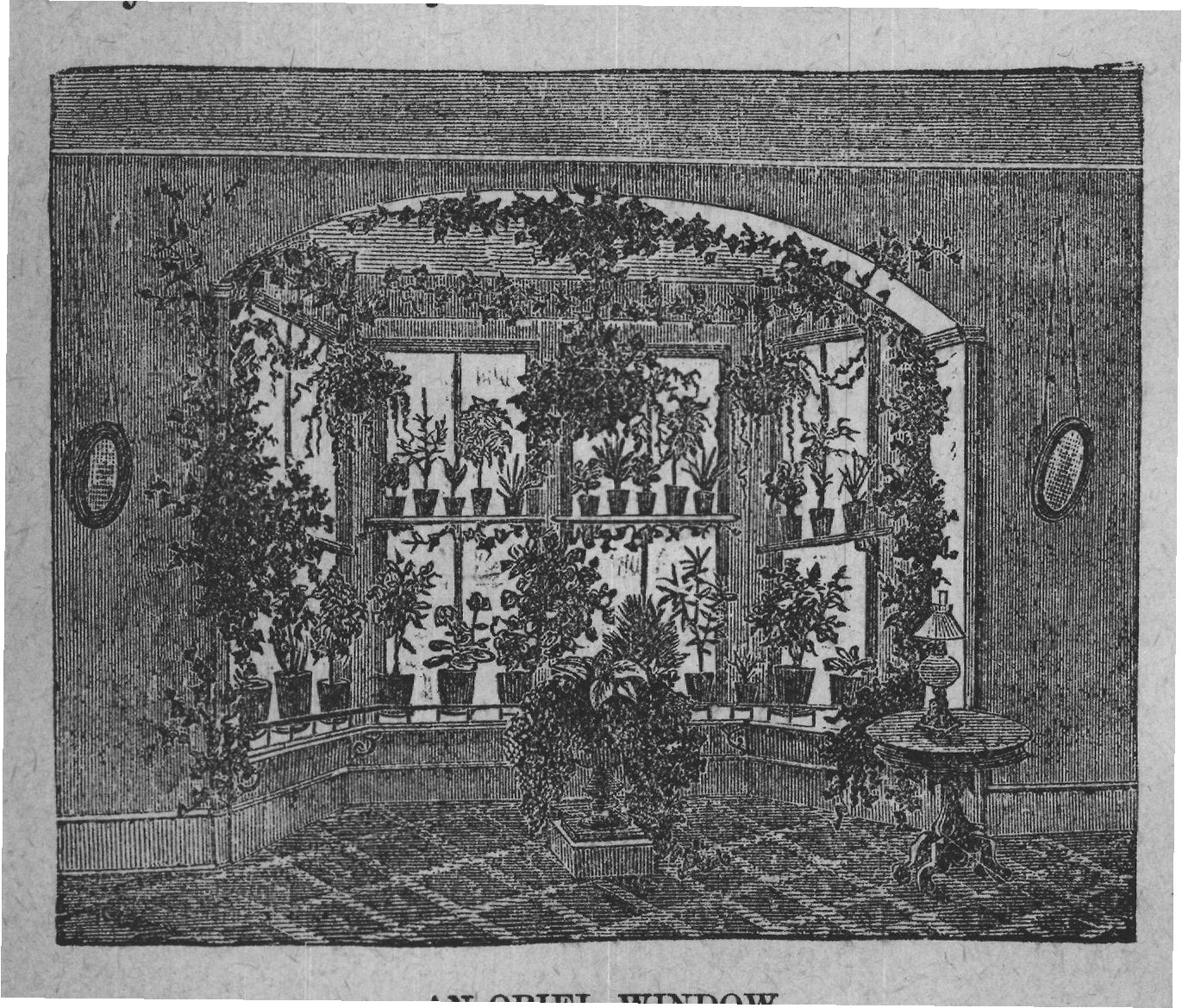
THE parlor must be, to be pretty, the room lived in. Never have a room too fine for yourself and your children to pass the evening in. It is part of the education of the latter to be in daily, familiar contact with the pretty household decorations that are always found in such rooms, when occupied by persons of taste, and an ordinary faculty of feminine ingenuity. We have seen better-kept and more healthy plants, in such a room where the family did the labor, and prettier arrangement of them, than we ever saw in households where the care was left entirely to servants. One case in particular we recall. A large oriel window like that shown in the illustration made