Home › Household Art and Taste › Towel Rack
Towel Rack
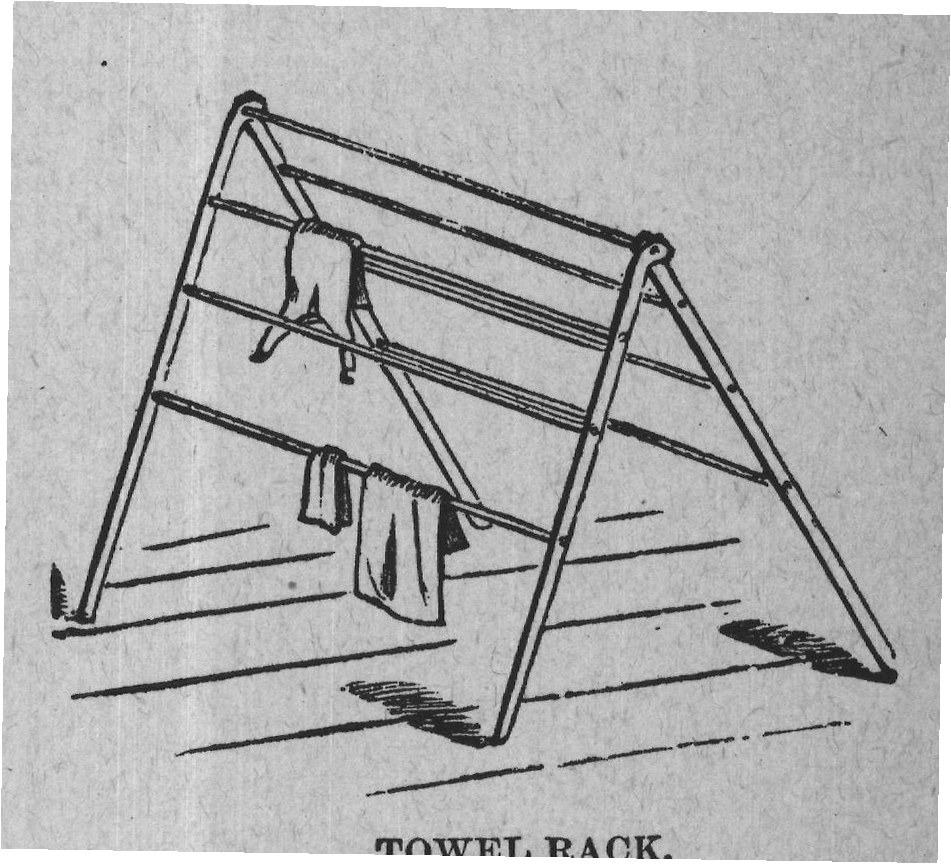
Every kitchen should be provided with a filter for water, especially where rainwater is used for drinking, as is the case in many districts. The cut of Tub Filter shows a home-made affair, but as good as the best where ice forms a part of the filter over the straining cloth and under the dust cloth or cover. A towel rack is also indistowel rack is also indispensable. The one shown in the cut needs no explanation; any man can make it. make it.
VI. The Bed-Rooms.
NOWHERE can better taste be displayed than in the sleeping apartments. As to carpets, every housekeeper must decide for herself. We should prefer a painted floor , and rugs so laid that the occupant would have no occasion to step on the wood after the shoes are removed. The rugs can be taken out in the sun, shaken and aired while the floor is mopped clean. Carpets in bed-rooms are unknown on the Continent of Europe in the grandest of private houses, and in such rooms, are traps for dust, germs of disease and death.
The furniture, however rich, should always be simple, and of solid material, to avoid dust and dirt, and be readily cleaned. The old-fashioned carpets and bedcurtains should be avoided. If possible, have in the bed-room only the bed, a rug , a rug and a few chairs; dress and undress in an adjoining room, which may be made as pretty as possible and kept much warmer in winter than the one which is used for sleeping in . In this dressing-room place the wardrobe, chest of drawers, pretty odds and ends, as well as the wash-hand stand and other such conveniences. This, too, is improved by a bright and pretty carpet, pictures and other wall decorations; the bedroom must have none of these. They only hold germs of disease, and dirt. VII. The Cellar.
EVEN the smallest cottage should contain this important adjunct, if the nature of the soil will, or can be made to admit of proper drainage therefrom. The arrangesoil will, or can be made to admit of proper drainage therefrom. The arrangement of the cellar is no less important. It should be fairly lighted, and be divided off into proper rooms according to the size of the house. In the smallest cottage the vegetable cellar should be separated from the rest, and proper ventilation should be looked to, else the odor will certainly reach every part of the house above. In large houses the laundry often occupies a portion of the cellar. If so, it should be provided with conveniences for hot and cold water, perfect ventilation, stationary tubs, with means for draining off wash-water, a sink and other fixtures.
VIII. The Water Supply.
Every farm-house-where there is a windmill for raising water-should have the necessary tanks for soft water for the house. These tanks may be in the barn or on other suitable elevations, from which the water may be conducted in pipes provided with faucets. In laying the pipes the greatest care should be taken that they are nowhere within reach of frost. If they are they become a source of constant annoyance in winter, and often of considerable damage to the building. Architects more often from frost than in any other respect. Plumbers are never mindful in this matter. They simply do their work according to the plan given. See, therefore, that no water pipes run next the outer wall of the building; that they are always where they can easily be gotten at, and, as an extra precaution, that they are always encased in some non-conducting material when there is any danger from frost; and, also, that in very cold weather a small flow may escape from connecting with all, during the night, so a constant current may be kept up. The supplypipe should be brought, underground, well beneath the frost line, to the center of the cellar beneath the house. A wooden box, of boards not less than one foot wide , should receive the pipe at the depth of about two feet under the cellar floor and conduct it to the story above. This box must have the pipe in its center and the space between be packed in sawdust. In northern climates the pipe must extend to no room not kept warm in winter. It is better to do without it than have it freeze and break.
IX. Soft-Water Cisterns.
CISTERNS for rain-water should always be placed where they will not freeze. This is especially necessary where they are built of brick or stone and cement, for we suppose no one nowadays will consent to have a cistern plastered up directly on the earth or clay. It is cheap, and it is as worthless as it is cheap. In some localities, drinking-water is so difficult to obtain, that cisterns which collect the rain-water furnish the only supply. In this case, the cistern should be in two parts with a filter between. When it is built in this way, and the water comes from clean roofs, the water, though insipid, is pure and healthful. The living water of wells is, however, better in every respect, but no well-water is entirely safe, unless means have been taken to keep out surface drainage, and they are liable to be contaminated by the seepage, from sewers, the out-houses or the barnyard.
The danger from this latter cause is much greater than many people suppose. The earth is always honey-combed with the borings of insects and small animals, which always carry their burrows to the nearest water, generally the well. Seepage once entering these cavities inevitably finds its way to the well. Unfortunately, the most deadly germs are often not to be detected by the taste or smell. For this reason, many persons prefer cistern water to that from the well. When danger is suspected from wells, the water should always be boiled. No filtering will take out the deadly germs. Indeed, half the disease of the world would be avoided if all the water drunk was first boiled.
X. Laying Down Carpets.
LAYING down the carpets is a task always dreaded by women. In fact, no heavy carpet should ever be undertaken by them. That it is a man's work always, may be easily discovered by anybody who has laid one. For this reason, in cities, the merchant who sells, undertakes to cut, fit and lay the carpet. In the country this is not always possible. With expensive carpets it will always be better to employ some one who thoroughly understands the art. An implement for stretching the carpet is always convenient and often indispensable.