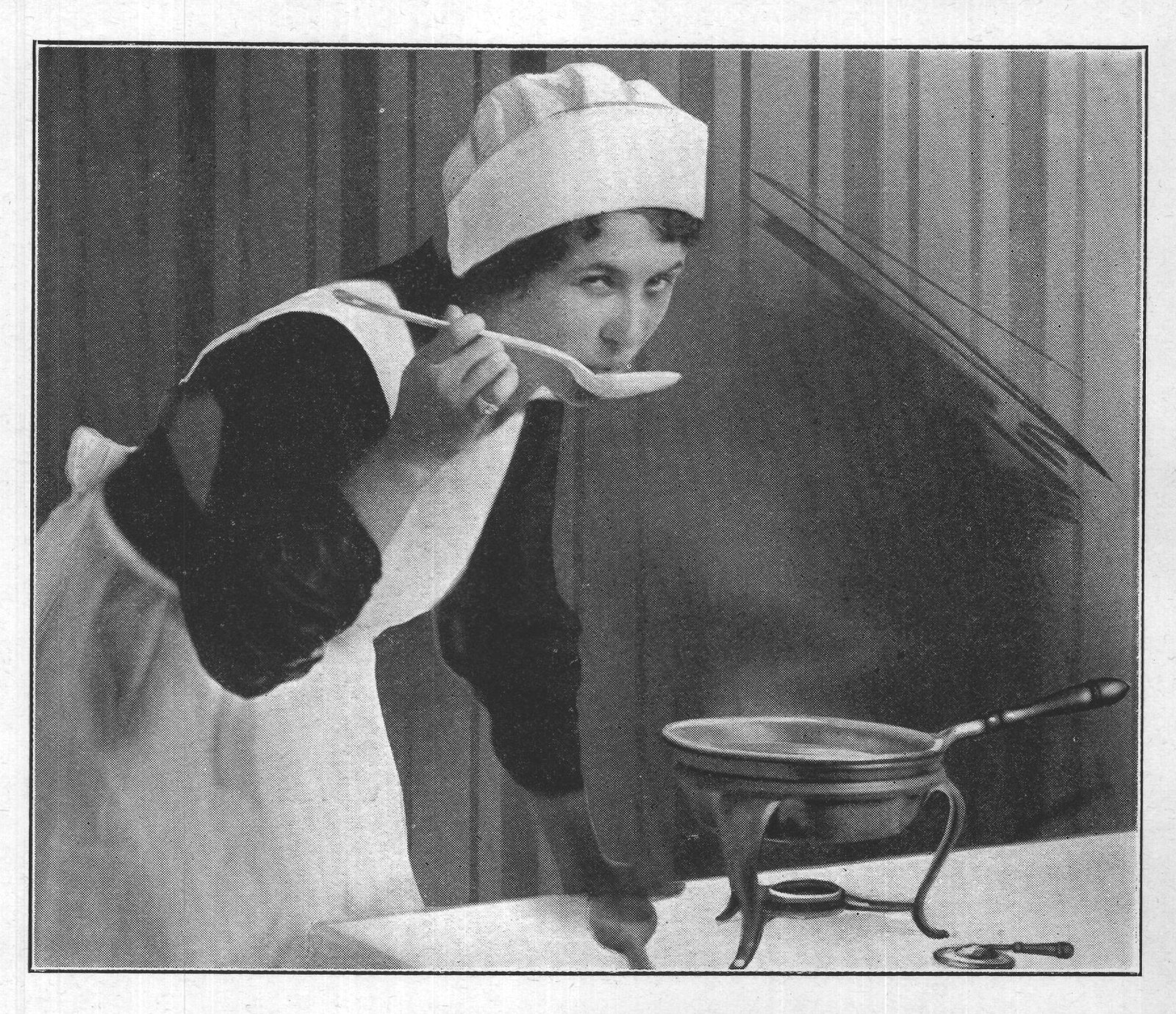
Adele Rowland

ADELE ROWLAND'S CLAM CHOWDER
25 hard clams and their juice Salt, pepper, cloves and bay 2 slices bacon, chopped 6 potatoes, diced 4 onions, grated leaf to season Pint water Pint cream Render bacon in bottom of chafing dish or stew kettle. Add water, potatoes, onions and seasoning.
Cook until potatoes are tender. Add clam juice which has been strained and skimmed. Then add cream and chopped clams, from which the hard part is removed.
When thoroughly heated, it is ready to serve.
WONDERFUL! 39 Very truly gom Welerland 1 cupful milk
KOLACHES
1/4 cupful tepid water 1½ yeast-cake 1 cupful flour 1 egg, well beaten 1 teaspoonful salt 1/3 cupful sugar 2 tablespoonfuls butter Flour to knead, about 3 cupfuls 1 cupful chopped, cooked prunepulp 1 teaspoonful cinnamon 1/3 cupful sugar Make a sponge of the milk, water, yeast, and the cupful of flour; when light, add the first third-cupful of sugar, salt, butter, egg, and enough flour to knead. Let rise again till double in bulk, stir down, roll out without further kneading and shape into biscuits. Lay on a well-oiled baking-sheet and let rise till light. Press down the centers of each and put in a teaspoonful of the prune-pulp mixed with the remaining sugar and cinnamon. Bake in a moderate oven at about 375° F. This makes three dozen good-sized cakes.
Two unrelated recipes share this page: Adele Rowland's clam chowder and a set of Bohemian kolaches. Both are workable as written, with a few translations.
- Hard clams"Hard clams" are quahogs — the same species sold as littlenecks, cherrystones and chowder clams depending on size. Twenty-five will yield somewhere in the region of one and a half to two cups of chopped meat, depending very much on their size; if you buy shucked clams instead, that quantity plus about a cup of their strained liquor is the equivalent.
- Removing the hard partOn a large quahog the tough adductor muscle is the usual thing to cut away, and some cooks also discard the dark belly; the firm white body and the softer parts around it are chopped. On small littlenecks there is little to trim.
- The hinge: heat the clams only brieflyChopped clams go in with the cream at the very end and need no more than two or three minutes to firm up. Held at a simmer they turn to rubber, and cream with clam liquor in it will break if boiled hard.
- Strained and skimmed juiceClam liquor always carries sand. Let it settle, pour off the clear part, or strain through a coffee filter — the recipe's insistence on this is the difference between chowder and grit.
- Chafing dishThe chafing dish was a spirit-lamp table cooker, and for a supper dish of this kind it was as much theatre as cookery. Any heavy saucepan does the same job; a chafing dish over a low flame simply prevents the boil that would spoil the clams.
- Chowder yield and seasoningEnough for four to six as a main course. "Cloves and bay leaf to season" means whole spices — two or three cloves and one bay leaf in the potato water, both fished out before the cream goes in.
- Yeast cakeA compressed yeast cake is usually reckoned at about 2¼ teaspoons of active dry yeast, though cake sizes of the period varied; on that basis 1½ cakes is roughly a tablespoon, or one and a half modern packets. Proof it in the quarter cup of tepid water (about 105°F) with the milk warmed to the same temperature.
- Sponge and rise timesThe recipe gives stages rather than clocks. The sponge is "light" when bubbly and domed, about 45 minutes to an hour; the dough doubles in roughly an hour and a half; the shaped kolaches need 30 to 45 minutes on the sheet before they are filled.
- Oven and bakingThis book has already converted "moderate" to 375°F, which is right for these. Small kolaches take 12 to 15 minutes, until the edges are golden and the bottoms sound hollow. Three dozen is a full recipe — the dough halves cleanly.
- Prune pulpSimmer pitted dried prunes in water until collapsed, drain well and mash to a thick paste; a wet filling will run out of the indentation. Prune lekvar sold in jars is close to the same thing, though it is already sweetened.
Adele Rowland was a musical-comedy singer and vaudeville performer of the 1910s and 1920s, and celebrity cookbooks of that era ran on exactly this currency: a signed page, a facsimile autograph, and a dish the public could imagine the star making after a performance. A chafing-dish clam chowder is a very theatrical choice — the chafing dish was the standard equipment of the late-night supper party, portable, sociable and requiring no kitchen, and clams were the cheap luxury of the Eastern seaboard. The chowder here is the New England style, milk- or cream-based rather than tomato, thickened only by its potatoes; the bacon rendered first is the older Anglo-American technique that predates the argument over Manhattan versus New England entirely. The kolaches printed below have no obvious connection to Rowland and were most likely filler set by the compiler: kolache, from the Czech kolo for wheel or circle, came to the United States with Bohemian and Moravian immigrants to Texas, Nebraska and the upper Midwest in the nineteenth century, and prune — povidla or lekvar — is among the oldest of the traditional fillings.