Important: Safety Warning
This page describes home-canning methods from before the causes of botulism were understood. Canning low-acid foods without a pressure canner, as described here, can allow the growth of Clostridium botulinum, whose toxin is among the deadliest known. Follow current USDA home-canning guidelines instead.
This information has been left in for historical purposes but should not be acted upon.
Home › Recipes › Canning in the Fireless Cookstove
Canning in the Fireless Cookstove
THE jars, covers and rubbers must be perfectly sterile. Sterilize these by placing in large utensil, covering with cold water, heating same over fire to boiling point and boiling for 15 minutes.
Rubbers should be new every season. Be careful not to boil rubbers too long. After sterilizing, remove jars, etc., from water but do not dry-fill with food when hot.
Canning Without Sugar All fruits may be canned successfully for future use for jelly making, pie filling, salad purposes, etc., without the use of sugar, by simply adding hot water instead of hot syrups.
In canning fruit without sugar, you must can the product the day it is picked. Pour boiling hot water over the product in the hot jar. Place sterilized rubbers and caps in position, not tight. Be sure water is boiling in jars then place same in cooker with one radiator 450 degrees for 3/4 hour.
Remove, fill to overflowing with boiling water and seal. Preserving Berries One pound of sugar, 1 pound of fruit; wash berries, then hull or stem.
Place a small quantity on a platter and cover with sugar, being careful not to break the fruit. Remove from the platter to 8-quart utensil, placing same on top of radiator while the latter is heating. When the fruit comes to the boiling point, place same in the fireless with one radiator heated 450 degrees, allowing about 1/2 hour to the quart to cook. The cover should be left off the utensil when preserving.
Peaches, pears, quinces, grapes, tomatoes and figs and other fruits of like nature can be preserved by first bringing the syrup to the boiling point while the radiator is heating, pouring same over the fruit and cooking in the fireless over night, using 1 radiator heated to 450 degrees. A heavy syrup can be made by using 1 pound of sugar, 1/2 cup of water. If preserves are not hot enough in the morning reheat over fire and bring to the boiling point, and place in the jars hot. Canning Fruits Proceed as when canning vegetables. Soft berries take 3/4 to 1 hour. Apples and pears 1 hour to 1/4 hours.
Pineapple takes 2½ hours.
After peaches are packed in the jars, cover with boiling syrup (syrup made of 1 cup sugar, 1 cup water to 1 quart fruit). Sterilize in fireless for 1 hour.
Remove and fill to overflowing with boiling syrup.
Pears are canned the same as peaches except 6 cassia buds are added to each quart jar. Use one radiator heated to 450 degrees, and be sure the syrup is boiling before placing same in the cooker.
Canning Vegetables Cold-pack vegetables in jars, filling with cold water and 1 teaspoon salt. 1 Set jars in large utensil on wire rack, and fill kettle with cold water to neck of jars. Bring to boiling point on the stove and then place in fireless for 3 hours using 1 radiator, 450 degrees.
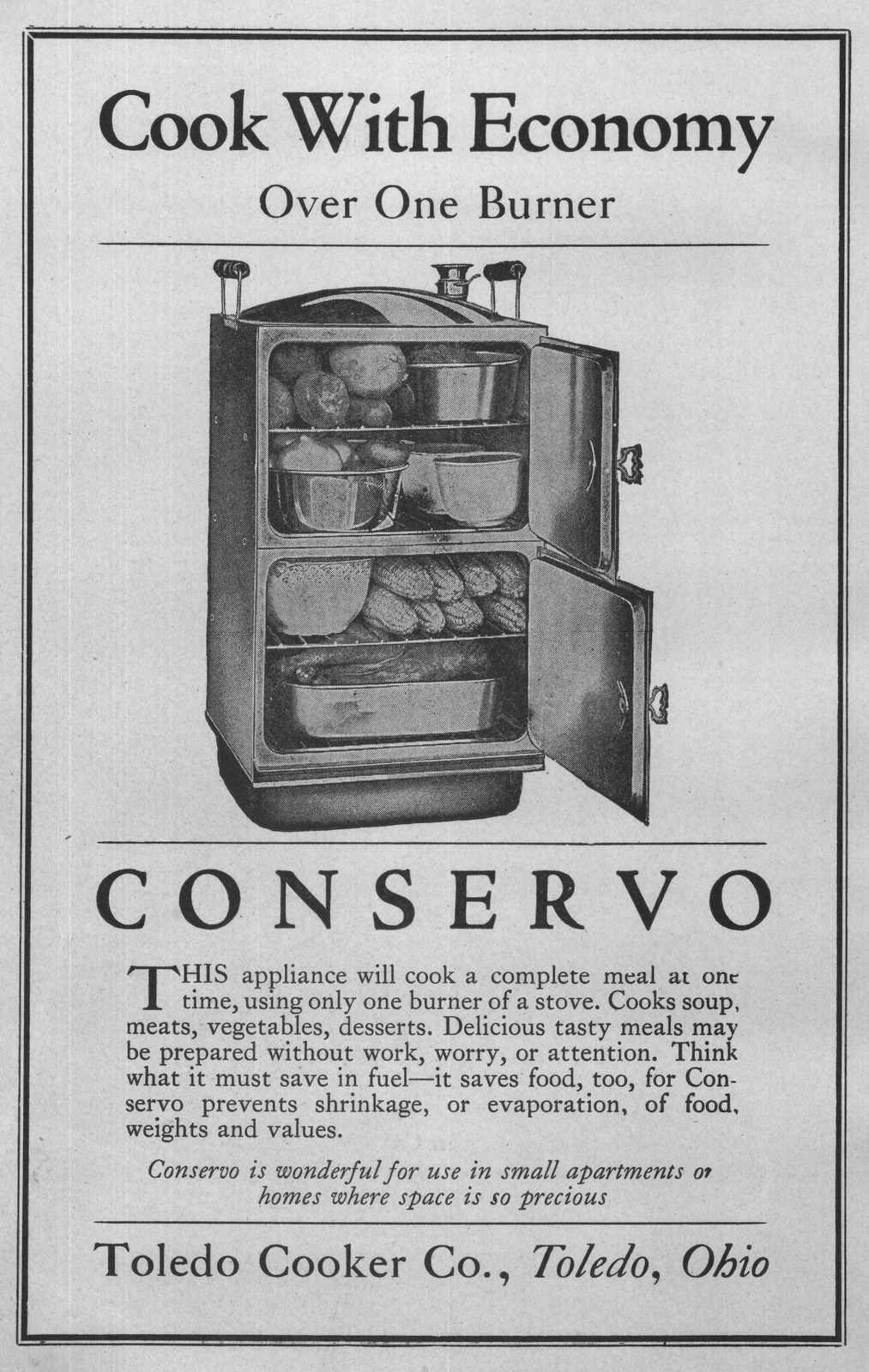
Beets, corn and hard vegetables should be sterilized 3½ hours. Corn at least 4 hours or longer. Hard vegetables take longer than soft. Cook With Economy Over One Burner
This is a set of canning schedules written for a fireless cookstove — an insulated box heated by iron or soapstone "radiators" preheated on a range. The method cannot produce safe canned vegetables, and several of the fruit directions are also below current standards. The notes below explain the vessel, the vocabulary and the specific failure points.
- Why the vegetable directions failA fireless cooker holds heat but adds none. Once the jars go into the insulated box the water temperature only falls, so the contents sit for three or four hours in a slowly cooling bath that never exceeds 212F and quickly drops below it. Beans, corn, beets and peas are low-acid foods in which Clostridium botulinum spores survive prolonged boiling; destroying them requires 240-250F, achievable only under pressure. Nothing in this chapter reaches that temperature.
- Cold pack in a cooling bathThe vegetables go in cold, in cold water, and the whole kettle is brought to a boil once before being moved off the heat. The centre of a quart jar of packed corn lags far behind the water, so the interior may never reach boiling at all — the worst case for spore survival, and corn is among the foods most often implicated in home-canning botulism.
- Fruit canned without sugarThe no-sugar method gives 45 minutes in a cooling box. Sugar is not a preservative here, so that is not the problem; the problem is that the process time is unvalidated and the seal is made by topping up with boiling water after the jars leave the heat, which reintroduces contact with unsterile rims and air.
- "Not tight," then sealed afterCaps are set loose, the jars are heated, then removed, refilled to overflowing and only then sealed. Modern practice seals before processing and lets the cooling jar draw its own vacuum. Sealing a hot open jar by hand gives an unreliable vacuum and no way to verify it.
- Rubbers and radiators"Rubbers" are the rubber gasket rings used with glass-lidded lightning-clamp or zinc-cap jars; the two-piece lid that eventually superseded them came in over the following decades. A "radiator" is the cooker's heated stone or metal disc, brought to 450F on the range — a figure for the disc, not the food.
- A garbled figureThe pineapple and sterilizing times were checked against the printed page and read as our text now gives them. The apple and pear time still reads "1 hour to 1/4 hours," which cannot be right; it most likely stood for 1 1/4 hours.
- Cassia budsThe dried immature buds of the cassia tree, sold as a pickling spice into the mid-twentieth century and now uncommon. They carry a cinnamon-like flavour. This recipe calls for six to a quart jar of pears.
- What to use insteadFor any canning at all, follow a current USDA or National Center for Home Food Preservation process — pressure canning for vegetables, tested boiling-water times for high-acid fruit. Preserving berries in equal weights of sugar, as in the second paragraph here, is simply jam-making and remains sound as a technique; only its storage instructions are obsolete.
The fireless cookstove was the slow cooker of the 1900s and 1910s: an insulated wooden or metal chest into which a cook dropped soapstone or cast-iron discs heated on the range, then shut the lid and walked away. Manufacturers such as the Caloric and William Campbell companies sold them hard to households heating with coal in summer, and the selling point on this very page ". Cook With Economy Over One Burner" — was the whole argument. Home canning boomed in the same years and again during the First World War food-conservation campaigns, and cooker makers naturally extended their claims to cover it. The trouble was that the science lagged the marketing. Reliable process times for low-acid vegetables were not established until the 1920s and 1930s, when the USDA and state extension services began publishing tested schedules and warning explicitly against boiling-water processing of low-acid vegetables and against retained-heat methods. Pages like this one are a snapshot of the gap: careful, confident, sensible-sounding instructions written before anyone knew what they were up against.