Home › D › Duck, Roast, to Carve
Duck, Roast, to Carve
No dishes require so much knowledge and skill in their carving as do game and poultry; for it is necessary to be well acquainted with the anatomy of the bird in order to place the knife at exactly the proper point. A tough fowl and an old goose are sad triers of a carver's powers and temper, and, indeed, sometimes of the good humour of those in the neighbourhood of the carver; for a sudden tilt of the dish may eventuate in the placing of a quantity of the gravy in the lap of the right or lefthand supporter of the host. We will endeavour to assist those who are unacquainted with the "gentle art of carving," and also those who are but slightly acquainted with it, by simply describing the rules to follow, १९٠٠ LEG, WING, AND NECKBONE OF DUCK. and referring to the distinctly-marked illustrations of each dish, which will further help to bring light to the minds of the uninitiated. If the bird be a young duckling, it may be carved like a fowl, viz., by first taking off the leg and the wing on either side; but in DUCK, ROAST, TO CARVE. cases where the duckling is very small, it will be as well not to separate the leg from the wing, as they will not then form too large a portion for a single serving. After the legs and wings are disposed of, the remainder of the duck will be also carved in the same manner as a fowl; and not much difficulty will be experienced, as ducklings are tender, and the joints are easily broken by a little gentle forcing, or penetrated by the knife. In cases where the duck is a large bird, the better plan to pursue is then to carve it like a goose, that is, by cutting pieces from the breast in the direction indicated by the lines marked from A to B, commencing to carve the slices close to the wing, and then breastbone. proceeding upwards from that to the breastbone.
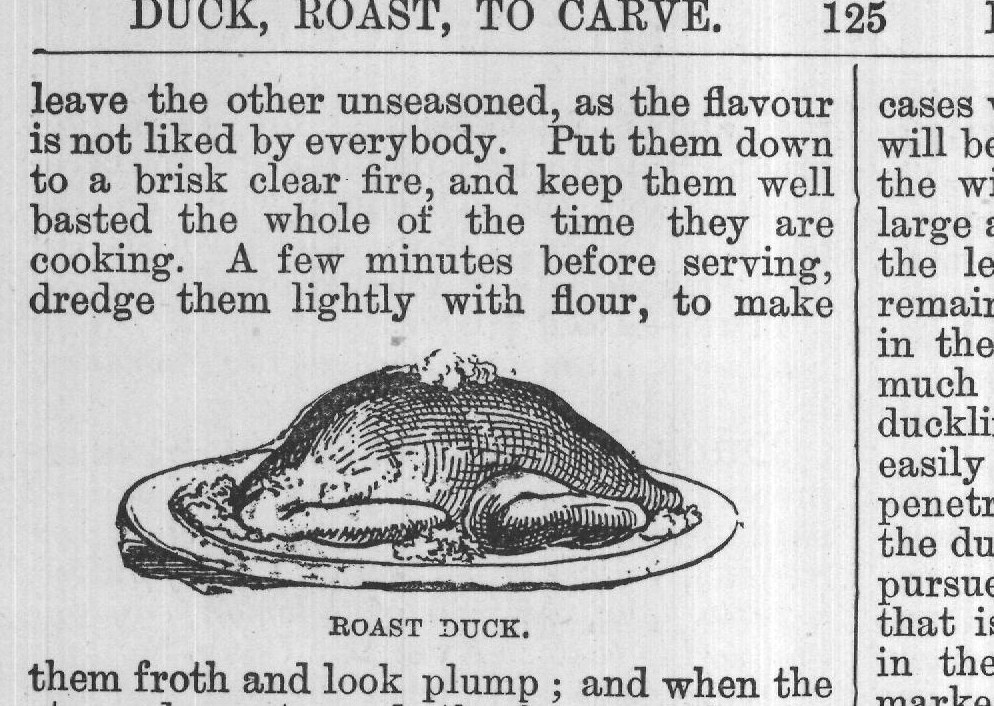
If more should be wanted than can be obtained from both sides of the breast, then the legs and wings must be attacked, in the same way as is described in connection with carving a fowl. ROAST DUCK.
It may be here remarked, that as the legs of a duck are placed far more backward than those of a fowl, their position causing the waddling motion of the bird, the thighbones will be found considerably nearer towards the backbone than in a chicken; this is the only difference worth mentioning. The carver should ask each guest if a portion of stuffing would be agreeable, and in order to get at this, a cut should be made below the breast, as shown by the line from C to D, at the part called the "apron," and the spoon inserted. (As described in the recipe, it is an excellent plan, when a couple of ducks are served, to have one with, and the other without, stuffing.) As to the prime parts of a duck, it has been said that "the wing of a flier and the leg of a swimmer" are severally the best portions. Some persons are fond of the feet of the duck; and, in trussing, these should never be taken off. The leg, wing, and neckbone are here shown; so that it will be easy to see the shape they should be when cut off.
Note. Ducklings are trussed and roasted in the same manner, and served with the same sauces and accompaniments. When in season do not omit apple sauce.
DUCK, STEWED.
Duck, Stewed, with Turnips. (Cold Meat Cookery.) - INGREDIENTS. - The remains of cold duck, 1/24 pint of good gravy, 4 shalots, a few slices of carrot, a small bunch of savoury herbs, 1 blade of pounded mace, 1 lb. of turnips weighed after being peeled, 2 oz. of butter, pepper and salt to taste. AVERAGE COST, exclusive of the cold duck, 9d.
Cut up the duck into joints, fry the shalots, carrots and herbs, and put them, with the duck, into the gravy. vy. Cut about 1 lb. of turnips into -inch squares, put the butter into a stewpan, and stew them till quite tender, which will be in about hour, or rather more; season with pepper and salt, and serve on the centre of the dish, with the duck, &c., laid round.
TIME.-Rather more than 1/2 hour to stew the turnips.
SEASONABLE from November to February.
The carving notes and the stewed-duck recipe both assume a household that roasted birds whole and expected leftovers to reappear the next day. A few of the quantities have lost their fractions, so treat the amounts below as guides.
- The hinge: don't re-cook the duckThe duck is already cooked. It goes into hot gravy only to heat through and take on flavour — five to ten minutes at a bare simmer. Longer and the joints turn stringy and dry.
- Ambiguous liquid quantity"1/24 pint of good gravy" is not a real measure; a fraction has dropped out in printing, most likely a half pint or a quarter. For a duck's worth of joints, roughly 1 to 1 1/4 cups (250–300 ml) of well-flavoured stock or gravy is enough to come partway up the meat.
- Shalots and mace"Shalots" are shallots; four will come to roughly 3–4 oz depending on size. "A blade of pounded mace" is the outer covering of nutmeg, crushed — a scant 1/4 teaspoon of ground mace, or a pinch of grated nutmeg, does the same job.
- Turnip timing and cutThe dice size and the stewing time have both dropped their fractions. Cut the peeled turnips into roughly 1/2-inch squares and stew them covered in the 2 oz butter over low heat, shaking the pan, until tender; the recipe's own time reads "rather more than [—] hour", so allow up to an hour depending on age. There is no added water, so the pan must be covered and the heat gentle or the butter will brown before the turnips soften.
- Average cost"9d." is ninepence, under a shilling, and tells you this was a thrift dish built on a bird already paid for.
- YieldThe remains of one duck with a pound of turnips serves two, or three at a lunch with bread and something green.
- On the carving directionsThe advice still holds: a duckling is jointed like a chicken, while a big bird is sliced from the breast lengthways. The one anatomical point worth remembering is that a duck's thighs sit further back and closer to the backbone than a chicken's, so the hip joint is not where your hand expects it.
- Feet and apronThe "apron" is the flap of skin and fat below the breastbone, cut through to reach the stuffing. The text notes only that some people are fond of the feet and that they should never be taken off in trussing; ducks are rarely sold with the feet attached now, so look for them separately if you want them.
Beeton's carving articles were as much social instruction as cookery — the host carved at table before the company, and the warning about gravy landing in a neighbour's lap is a reminder that a badly jointed goose was a public failure, not a private one. The stewed duck that follows belongs to the book's "Cold Meat Cookery" strand, a running series of entries on turning yesterday's roast into today's dinner; in a house without refrigeration, cooked meat had to be used within a day or two, and these recipes are the systematic answer to that. Duck with turnips is a long-standing pairing in both English and French kitchens, the peppery root cutting the bird's fat.