Fritters, Plain
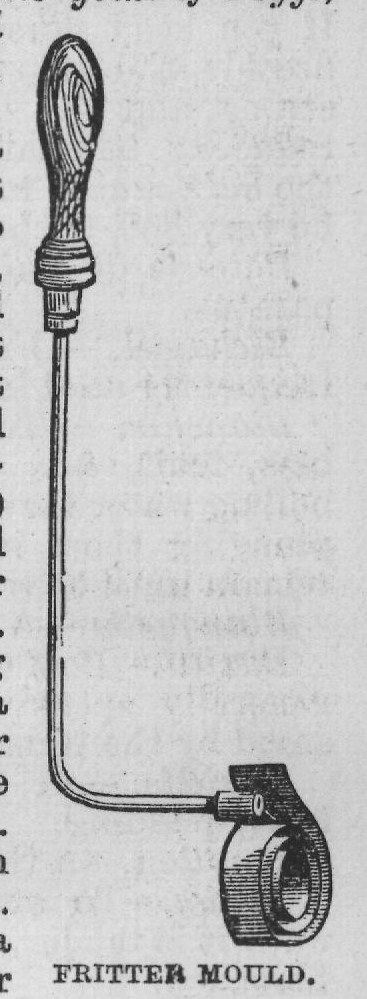
INGREDIENTS for dish for 4 persons.-3 oz. of flour, 3 eggs, pint of milk. AVERAGE COST, 4d.
Mix the flour to a smooth batter with a small quantity of the milk; stir in the eggs, which should be well whisked, and then the remainder of the milk: beat the whole FRITTERS. to a perfectly smooth batter, and should it be found not quite thin enough, add two or three tablespoonfuls more milk. Have ready a frying-pan, with plenty of boiling lard in it; drop in rather more than a tablespoonful at a time of the batter, and fry the fritters a nice brown, turning them when sufficiently cooked on one side. Drain them well from the greasy moisture by FRITTERS, RECIPES FOR. placing them upon a piece of blotting-paper before the fire; dish them on a white d'oyley, sprinkle over them sifted sugar, and send to table with them a cut lemon, and plenty of pounded sugar.
TIME.-From 6 to 8 minutes.
SEASONABLE at any time.
A very plain drop-batter fritter — flour, eggs, milk, fried in deep fat and served with sugar and lemon. The proportions are closer to a pancake batter than a modern fritter batter, so the handling matters more than the ingredient list.
- The quantity of milkThe milk measure has lost its fraction in this text and reads simply "pint". With 3 oz flour and 3 eggs, a full Imperial pint would give something close to a thin crêpe batter; half a pint (about 10 fl oz / 285 ml) gives a batter that will hold its shape when dropped into fat. Treat the amount as uncertain and work to the consistency described — pourable but not watery, thinned with a further tablespoon or two of milk if needed.
- Weights and cost3 oz of flour is about 85 g, roughly two-thirds of a cup. The "average cost, 4d." is fourpence in pre-decimal money and is of historical interest only.
- Frying fatLard fries beautifully and gives a clean flavour, but any fat with a high smoke point will do. "Boiling lard" means hot fat, not literally boiling: 350–360°F (175–180°C) is right. Below that the fritters soak; above, the outside colours before the centre sets.
- Beat the batter smooth, then rest itThe hinge of the recipe is the batter itself. Mix the flour with only a little milk first to a thick paste and beat out every lump before the rest goes in — lumps will not disperse later. A rest of 20–30 minutes relaxes the gluten and makes the fritters lighter, though the original does not call for it.
- Blotting-paperReplace with kitchen paper or a wire rack. Draining before the fire keeps them hot while the grease runs off; a low oven at 250°F (120°C) does the same job.
- TimingThe recipe gives 6 to 8 minutes without saying whether that covers each fritter or the whole panful. A tablespoon of batter in fat at the right temperature browns in about a minute and a half a side.
- Sifted and pounded sugarBoth terms refer to sugar broken down fine and passed through a sieve; caster sugar is the nearest modern equivalent, with icing sugar for dusting.
- Yield and servingStated as a dish for four. The d'oyley is a decorative paper or lace mat under the fritters -- purely for presentation, and a folded napkin serves. Eat them at once, with the lemon squeezed over.
Fritters of this kind -- a loose egg batter dropped straight into hot fat -- are long established in the English kitchen, alongside the fruit-filled and apple-ring fritters. Mrs Beeton's household manuals gave fritter recipes together, moving from this unadorned version to others enriched with fruit or preserve. The dish belongs to the Victorian category of cheap sweet courses: fourpence fed four people, the ingredients were in any house that kept hens and bought milk, and it was marked "seasonable at any time" because nothing in it depended on the calendar. The service -- sifted sugar, a cut lemon, more sugar on the side -- was common for fried sweets of the period.