Grouse, Roast
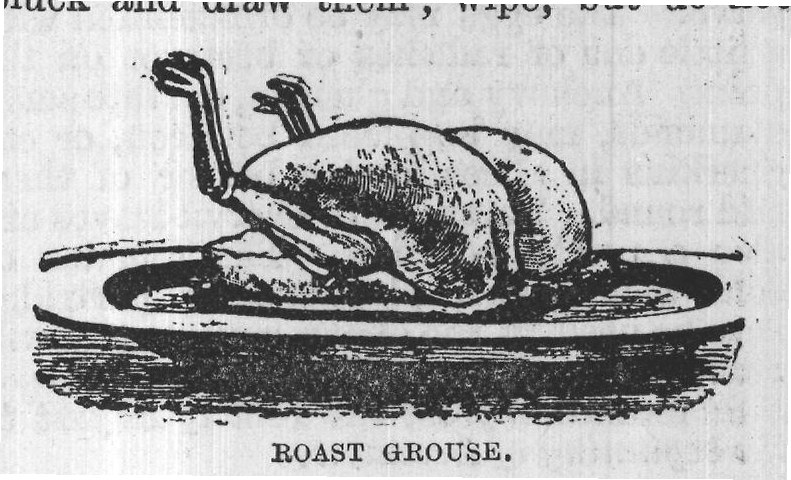
INGREDIENTS. - Grouse, butter, a thick slice of toasted bread.
AVERAGE COST, 4s. a brace.
Let the birds hang as long as possible; pluck and draw them; wipe, but do not ROAST GROUSE. wash them, inside and out, and truss them. See "Grouse, Trussing of." Put them down to a sharp, clear fire; keep them well basted the whole of the time they are cooking, and serve them on buttered toast, soaked in the dripping-pan, with a little melted butter poured over them, or with bread-sauce and gravy.
TIME.- hour; if liked very thoroughly done, 35 minutes.
SEASONABLE from the 12th of August to the beginning of December.
Grouse Salad. (SOYER'S Recipe, Improved.) - INGREDIENTS. - 4 eggs, Montpelier butter, fresh salad, 2 or 3 grouse; for the sauce, 1 tablespoonful of minced shalot, 1 tablespoonful of pounded sugar, the yolks of 2 eggs, 1 teaspoonful of minced parsley, 1/4 oz. of salt, 12 tablespoonfuls of oil, 4 tablespoonfuls of Chili vinegar, 1 gill of cream, 2 tablespoonfuls of chopped tarragon and chervil.
Boil the eggs hard, shell them, throw them into cold water, cut a thin slice off the bottom to facilitate the proper placing of them in the dish, cut each one into four, lengthwise, and make a very thin, flat border of the butter, about one inch from the edge of the dish the salad is to be served on; fix the pieces of egg upright close to each other, the yolk outside, or the yolk and white alternately; lay in the centre a fresh salad of whatever is in season, and, having previously roasted the grouse rather underdone, cut it into eight or ten pieces, and prepare the sauce as follows:-Put the shalots into a basin, with the sugar, the yolk of an egg, the parsley and salt, and GROUSE, TO CARVE.
GUDGEONS. mix in by degrees the oil and vinegar; as grouse, but the latter, being sufficiently when all the ingredients are well mixed, put the sauce on ice or in a cool place.
When ready to serve, whip the cream rather thick, which lightly mix with it; then lay the inferior parts of the grouse on the salad, sauce over so as to cover each piece, then lay over the salad and the remainder of the grouse, pour the rest of the sauce over, and serve. The eggs may be ornamented with a little dot of radishes or beetroot on the point. Anchovy and gherkin, cut into small diamonds, may be placed between, or cut gherkins in slices, and a border of them laid round. Tarragon or chervil-leaves are also a pretty addition. The remains of cold black-game, pheasant or partridge may be used in the above manner and will make a very delicate dish.
SEASONABLE from the 12th of August to the beginning of December.
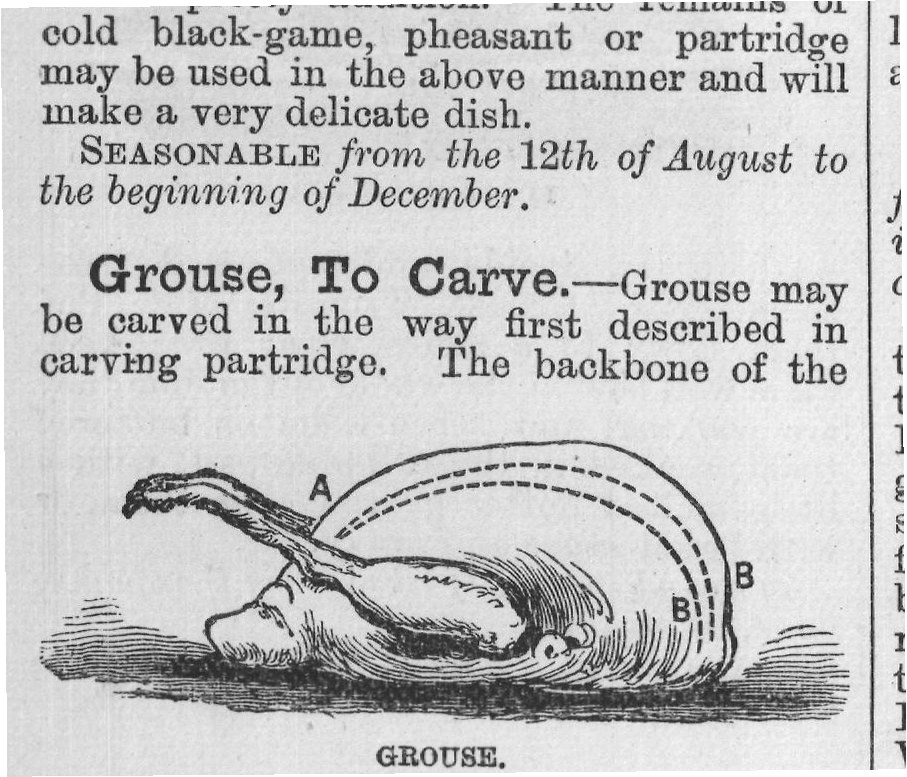
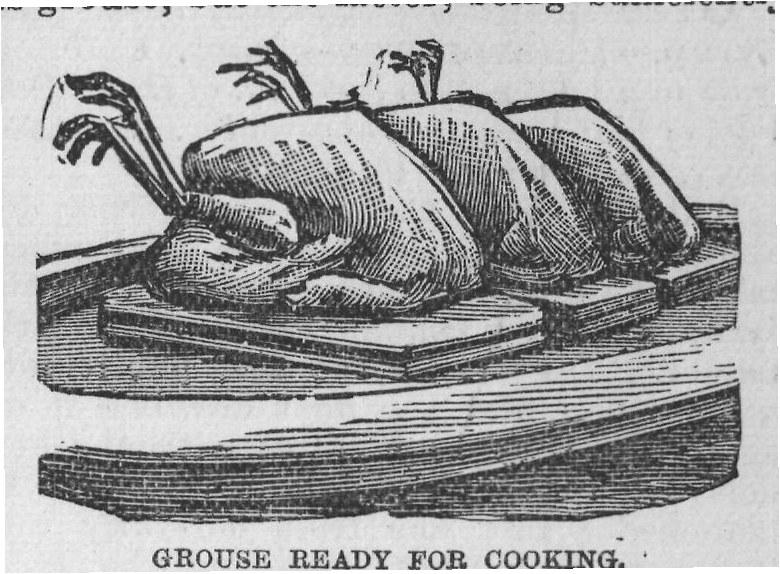
Grouse is very lean, and the whole method here is built around keeping it moist: high heat, constant basting, and a slice of toast underneath to catch the juices. Two recipes sit on this page, the plain roast and Soyer's cold salad made from birds roasted deliberately underdone.
- The hinge: do not overcookRed grouse has almost no fat and turns dry and liverish once the breast passes medium. The book puts the birds down to a "sharp, clear fire" and gives no temperature; in a modern oven a hot setting of about 425-450F is the nearest equivalent. Pull the birds when the breast is still rosy, about 20-25 minutes for a bird of 3/4-1 lb, then rest 10 minutes. The book's alternative of 35 minutes gives the thoroughly cooked, drier result offered for those who like game "very thoroughly done".
- BastingButter the breasts heavily and baste every five minutes, or cover the breast with a sheet of pork fat or streaky bacon and remove it for the last five minutes to colour. Without either, the bird will be dry however short the roast.
- The toastThe slice of toasted bread goes under the bird in the roasting tin so it soaks up the drippings, then is served beneath the bird. It is part of the dish, not a garnish; cut it slightly larger than the bird's base.
- Hanging and drawing"As long as possible" meant days in a cool larder, birds undrawn, until the flavour turned high. Modern practice is a few days at refrigerator temperature, drawn promptly, and no bird kept once it smells sour. Wiping rather than washing still stands, for the sake of the skin.
- Bread sauce and gravyThe traditional accompaniments are bread sauce, a thin roasting-tin gravy, fried breadcrumbs and game chips. Butter melted with the pan juices is the simplest version of the "melted butter" called for.
- Salad measuresA gill of cream is 5 fl oz, a quarter of a pint, so a little over half a US cup. Chili vinegar is vinegar steeped with hot red peppers; a good wine vinegar with a pinch of cayenne stands in. "Shalot" is shallot. Twelve tablespoons of oil to four of vinegar is a three-to-one dressing, thickened with raw egg yolk and lightened with whipped cream.
- Montpelier butterA green compound butter of herbs, anchovy, shallot and sometimes spinach, pounded and chilled, used here piped or spread as a decorative border on the dish. Any firm herb butter serves the same purpose.
- Raw yolks in the sauceThe dressing is never cooked. If it is being served to anyone vulnerable, use pasteurised egg yolks.
- Yield and costOne grouse per person is the usual allowance; "a brace" is two birds, priced here at four shillings. Soyer's salad from two or three roasted birds will serve four to six as a first course.
Grouse is the one game bird whose season is a date in the British calendar: the red grouse season opens on 12 August, the "Glorious Twelfth", a date generally traced to eighteenth-century game legislation and confirmed by the Game Act 1831, and Mrs Beeton's seasonable note follows the letter of the Game Acts. The bird is wild only, never farmed, feeding on heather, which is why nineteenth-century writers treated its flavour as beyond improvement and gave it the plainest of all roasting recipes. The salad is credited to Alexis Soyer, the celebrated chef of the Reform Club, who published elaborate cold constructions of this kind in the 1840s and 50s; the note that the recipe has been "improved" is the editors' own. The salad itself calls for grouse roasted rather underdone for the purpose, not for leftovers; it is only the closing suggestion to use up cold pheasant, partridge or black game the same way that shows the book's steady habit of turning yesterday's roast into a dish worth carrying to the table.