Important: Safety Warning
This page offers rules for telling edible mushrooms from poisonous ones. No such rules are reliable, and these identifications predate modern mycology. Deadly species closely resemble edible ones, and mistakes are regularly fatal. Never eat a wild mushroom on the strength of this text.
In addition, this page gives advice for salvaging or disguising food that has begun to spoil. Spoiled food can carry dangerous bacteria and toxins that no washing, soaking, or seasoning removes; it should be discarded.
This information has been left in for historical purposes but should not be acted upon.
Mushroom Ketchup
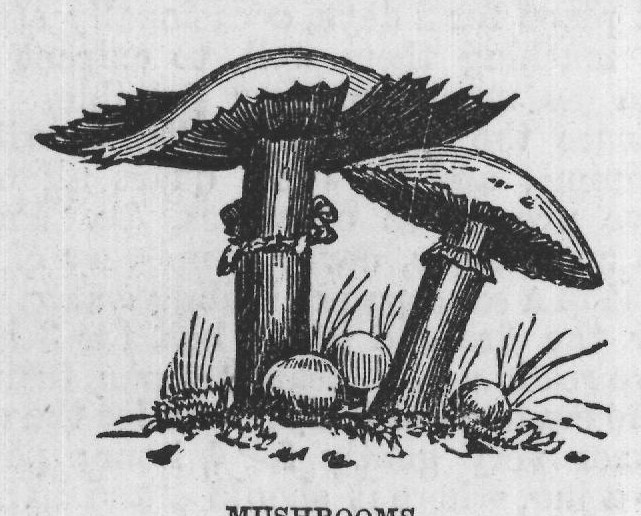
INGREDIENTS.-To each peck of mushrooms 1/2 lb. of salt; to each quart of mushroom-liquor oz. of cayenne, oz. of allspice, oz. of ginger, 2 blades of pounded mace.
Choose full-grown mushroom flaps, and take care they are perfectly fresh gathered when the weather is tolerably dry; for if they are picked during very heavy rain the ketchup from which they are made is liable to get musty, and will not keep long. Put a layer of them in a deep pan, sprinkle salt over them, and then another layer of mushrooms, and so on alternately. Let them remain for a few hours, when break them up with the hand; put them in a nice cool place for 3 days, occasionally stirring and mashing them well, to extract from them as much juice as possible. Now measure the quantity of liquor without straining; and to each quart allow the above proportion of spices, &c. Put all into a stone jar, cover it up very closely, put it in a saucepan an of boiling water, set it over the fire and let it boil for 3 hours.
Have ready a nice clean stewpan, turn into it the contents of the jar, and let the whole simmer very gently for 1/2 hour; pour it into a jug, where it should stand in a cool place till the next day; then pour it off into another jug, and strain it into very dry clean bottles, and do not squeeze the mushrooms. To each pint of ketchup add a few drops of brandy. Be careful not to shake the contents, but leave all the sediment behind in the jug; cork well, and either seal or resin the cork so as perfectly to exclude the air. When a very clear bright ketchup is wanted, the liquor must be strained through a very fine hair sieve, or flannel bag, after it has been very gently poured off; if the operation is not successful it must be repeated until you have quite a clear liquor. It should be examined occasionally, and, if it is spoiling, should be re-boiled with a few peppercorns. SEASONABLE from the beginning of September to the middle of October, when this ketchup should be made.
Note. This flavouring ingredient, if genuine and well prepared, is one of the most useful store sauces to the experienced cook, and no trouble should be spared in its preparation.
Double ketchup is made by reducing the liquor to half the quantity; for example, 1 quart must be boiled down to 1 pint. This goes farther than ordinary ketchup, as so little is required to flavour a good quantity of gravy. The sediment may also be bottled for immediate use, and will be found to answer for flavouring thick soups or gravies, MUSHROOM POWDER.
MUSHROOM SAUCE.
Mushroom Powder. (A valuable Mushroom Sauce, Brown (to Addition to Sauces and Gravies, when fresh serve with Roast Meat, &c.). - INGREDI- Mushrooms are not obtainable.) - INGREDIENTS for sufficient for small joint or steak. ENTS.- peck of large mushrooms, 2 onions, pint of button-mushrooms, pint of 12 cloves, 1/4 oz. of pounded mace, 2 teaspoon- good beef gravy, 1 tablespoonful of mushfuls of white pepper. room ketchup (if at hand), thickening of butter and flour. AVERAGE COST, 6d.
Peel the mushrooms, wipe them perfectly free from grit and dirt, remove the black fur, and reject all those that are at all worm-eaten; put them into a stewpan with the above ingredients, but without water; shake them over a clear fire till all th liquor is dried up, and be careful not to let them burn; arrange them on tins and dry them in a slow oven; pound them to a fine powder, which put into small dry bottles; MUSHROOMS. the cork well, seal the corks and keep it in a dry place. In using this powder add it to the gravy just before serving, when it will merely require one boil-up. The flavour imparted by this means to the gravy ought to be exceedingly good.
SEASONABLE. -This should be made in September or at the beginning of October.
Note. If the bottles in which it is stored away are not perfectly dry, as also the mushroom powder, it will keep good but a very short time.
Mushroom Pudding. (Vegetarian Recipe.) INGREDIENTS for large pudding. -1 quart of mushrooms picked and peeled: pepper and salt, 1 lb. of flour, 6 oz. of butter, 1 teaspoonful of baking-powder, cold water. AVERAGE COST, 2s.
Make a crust with the flour, bakingpowder and butter (omitting 1 oz.) and line a greased basin with it. Put in the mushrooms with the rest of the butter and a good seasoning of pepper and salt and a little water. Cut a round of paste to cover the top, wet the edges and pinch together.
Tie in a cloth and boil 1 hour.
Put the gravy into a saucepan, thicken it and stir over the fire until it boils. Prepare the mushrooms by cutting off the stalks and wiping them free from grit and dirt; the large flap mushrooms cut into small pieces will answer for a brown sauce, when the buttons are not obtainable; put them into the gravy and let them simmer very gently for about 10 minutes; then add the ketchup and serve.
TIME. Rather more than 10 minutes.
SEASONABLE from August to October.
Note. When fresh mushrooms are not obtainable, the powder may be used as a substitute in brown sauce.
Mushroom Sauce, Rich and
This is a nineteenth-century store sauce: a low-acid mushroom extract, bottled and sealed against air, then kept for months at room temperature. That storage method is the problem, and no adjustment of the timings fixes it.
- Why it fails todayMushroom liquor is a low-acid food with no vinegar and no measured acidification. Sealing it into corked bottles, excluding air and holding it at ambient temperature for months is exactly the anaerobic condition in which Clostridium botulinum spores germinate. Boiling does not destroy the spores, and the toxin is undetectable by smell or taste.
- The salt is unquantifiedSalt is the only preservative here, and the proportion given has lost its figure. Even intact, a salt-to-mushroom ratio by volume cannot be relied on to reach the concentration in the finished liquor that would inhibit spore growth. If you want mushroom ketchup, use a current tested recipe with a stated acid level or refrigerated storage.
- The book admits the keeping is uncertainThe direction to examine the bottles occasionally and re-boil with peppercorns if the ketchup is spoiling tells you plainly that failures were expected. Re-boiling a spoiled low-acid preserve is not a remedy.
- Wild-gathered flapsThe recipe assumes field mushrooms picked in dry September weather by someone who knows them. Several toxic species resemble the open flap stage, and drying or boiling does not neutralise their toxins. Cultivated portobellos are a closely related cultivated Agaricus and carry none of the identification risk.
- A peckA dry peck is eight quarts, roughly two gallons of loose mushroom caps -- perhaps 5 to 8 lb, depending how loosely they are packed. It is a market-garden quantity, not a supermarket one, and a reminder that this was made once a year in bulk.
- "A stone jar in a saucepan of boiling water"This is a water bath used for slow extraction, not for sterilising sealed jars. Three hours at just under boiling in a covered stoneware jar draws the flavour out without reducing the liquor.
- Resining the corkCorks were dipped in molten sealing resin or wax to make the seal airtight. It is a hermetic closure without any of the pressure-processing that makes a modern sealed jar safe, and it is the airtightness itself that makes the contents hazardous.
- Double ketchup and the sedimentDouble ketchup is simply the liquor boiled down by half, so a teaspoon flavours as much gravy as two. The sediment left in the jug was bottled separately for immediate use in thick soups -- "immediate" being the operative word.
Ketchup began as a preserved brine sauce rather than anything tomato-based; the word is generally traced to a Hokkien term for a fermented fish or shellfish liquor encountered by English traders in southeast Asia in the seventeenth century. English cooks reproduced the idea with what they had, and salted mushroom liquor became the standard domestic version, joined by walnut, oyster and anchovy ketchups. By Mrs Beeton's day mushroom ketchup was a fixture of the store cupboard, valued as a source of savoury depth in gravies and made-up sauces long before anyone had the word umami for it -- the note here that no trouble should be spared in its preparation reflects how much of a Victorian brown sauce depended on it. The strict September-to-mid-October season points to the field mushroom's autumn flush, gathered in bulk in a single short window and processed to last the year.