Pheasant, to Carve
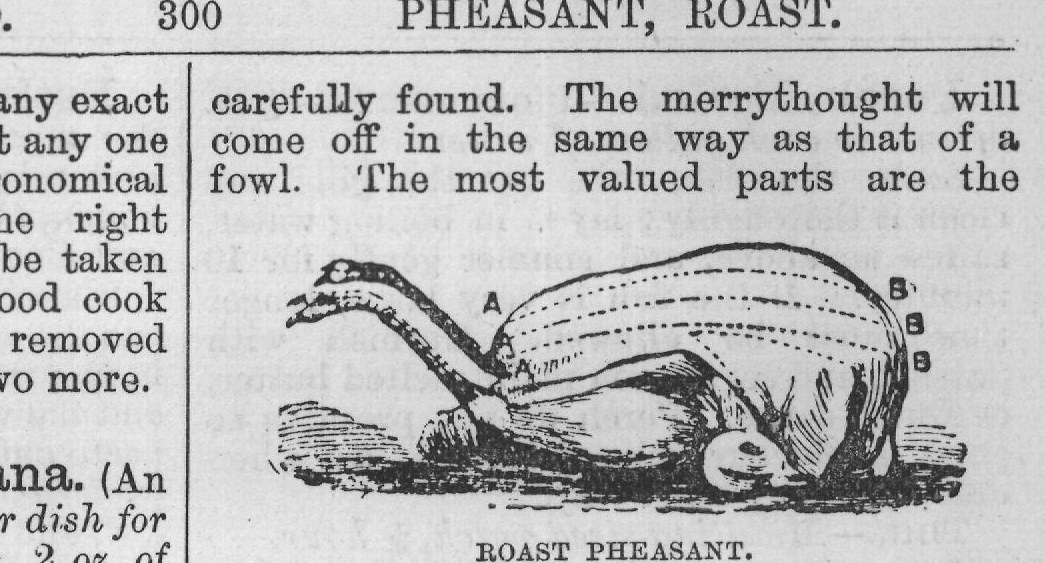
Fixing the fork in the breast, let the carver cut slices from it in the direction of the lines from Bit before a brisk fire, keep it well basted, to A; these are the prime pieces. If there be more guests to satisfy than these slices will serve, then let the legs and wings be disengaged in the same manner as described in carving boiled fowl, the point where the wing joins the neckbone being and flour and froth it nicely. Serve with brown gravy, a little of which should be poured round the bird, and a tureen of bread sauce. 2 or 3 of the pheasant's best tail-feathers are usually stuck in the tail as an ornament.
PHEASANT, ROAST.
TIME. to 1 hour, according to the size.
SEASONABLE from the 1st of October to the beginning of February.
Pheasant, Roast, à la Sainte Alliance. (BRILLAT SAVARIN'S Recipe.) -When the pheasant is in good condition to be cooked, it should be plucked, and not before. The bird should then be stuffed in the following manner: -Take two snipes, and draw them, putting the bodies on one plate, and the livers, &c., on another. Take off the flesh, and mince it finely with a little beef lard, a few truffles, pepper and salt to taste, and stuff the pheasant carefully with this. Cut a slice of bread, larger ROAST PHEASANT. considerably than the bird, and cover it with the liver, &c., and a few truffles; an anchovy and a little fresh butter added to these will do no harm. Put the bread, &c., into the dripping-pan, and, when the bird is roasted, place it on the preparation, and surround it with Florida oranges.
Do not be uneasy, Savarin adds, about your dinner; for a pheasant served in this way is fit for beings better than men. The pheasant itself is a very good bird; and, imbibing the dressing and the flavour of the truffle and snipe, it becomes thrice better.
Two things sit side by side here: fragmentary directions for carving and dishing a plain roast pheasant, and Brillat-Savarin's stuffed pheasant on a bread trencher. The second is the one worth cooking, and it depends almost entirely on the quality of the bird.
- The hinge: hang the bird first"When the pheasant is in good condition to be cooked, it should be plucked, and not before" is the whole point of the recipe. Game dealers hang pheasant in the feather for several days to develop flavour and tenderness; a bird plucked and chilled straight from the field will taste of very little, and no amount of truffle will fix it.
- SnipeSnipe is a legal game bird in some jurisdictions and off-limits in others, and it is effectively never sold in supermarkets. Two woodcock, or four or five chicken livers with a little minced dark poultry meat, give a comparable stuffing; the original wants a strongly flavoured, liver-rich forcemeat rather than that particular species.
- "Beef lard"Ambiguous wording. It most likely means beef fat rather than rendered pork lard, though Brillat-Savarin's French forcemeat is generally read as beef marrow with a little grated bacon fat. Whichever is used, it binds the forcemeat and keeps it moist; cold unsalted butter works if suet is unavailable.
- TrufflesFresh black truffle in a Victorian game recipe was expensive but not exotic. A small quantity of good preserved truffle, or dried porcini soaked and chopped, carries the dish; truffle oil does not survive roasting.
- Florida orangesThe term points to sweet eating oranges rather than bitter Seville, though the book does not explain it. Sweet orange segments, or halved small oranges warmed through, suit the dish.
- The bread trencherThe slice must be cut larger than the bird and set in the dripping-pan beneath it, so it absorbs the fat and juices while the pheasant roasts. Use a thick slab of firm white bread; a soft modern sandwich slice collapses into paste.
- Oven and timeThe book's roasting time has lost its lower figure. In practice a hen pheasant of about 2 lb takes roughly 40 to 50 minutes at 400F, a cock bird longer. Pheasant is very lean, so bard the breast with bacon or butter and baste often; cook to 165F in the thigh and rest it 10 minutes.
- Serving and yieldOne pheasant serves two generously or three modestly. The fragmentary carving note is sound: cut slices along the breast first, as those are the best eating, and only take down the legs and wings if more people must be fed. Brown gravy and a tureen of bread sauce are the conventional accompaniments.
- SeasonThe "1st of October to the beginning of February" reflects the British game season, which still runs 1 October to 1 February for pheasant. Frozen birds are available year-round, and farmed birds are milder and less worth hanging.
Brillat-Savarin's faisan a la Sainte Alliance comes from La Physiologie du gout (1825), and Mrs Beeton's household compendium reprints it more or less as an act of homage: the recipe is as much a piece of gastronomic literature as a set of instructions, complete with its author's assurance that the dish is fit for better beings than men. The name nods to the Holy Alliance of 1815, the post-Napoleonic pact of Russia, Austria and Prussia, and the joke is often said to be that the pheasant, snipe, truffle and toast are similarly allied. The bread set under the roasting bird to catch the drippings is much older than either the recipe or the book, and the tail-feathers stuck into the finished bird belong to the Victorian habit of sending game to table looking like the creature it had been.