Important: Safety Warning
This recipe calls for animal brains or related nervous-system tissue. Cattle brain and spinal tissue can transmit bovine spongiform encephalopathy (BSE), the cause of variant Creutzfeldt-Jakob disease in humans, which is fatal and has no treatment.
This information has been left in for historical purposes but should not be acted upon.
Home › P › Pig, Sucking, Roast
Pig, Sucking, Roast
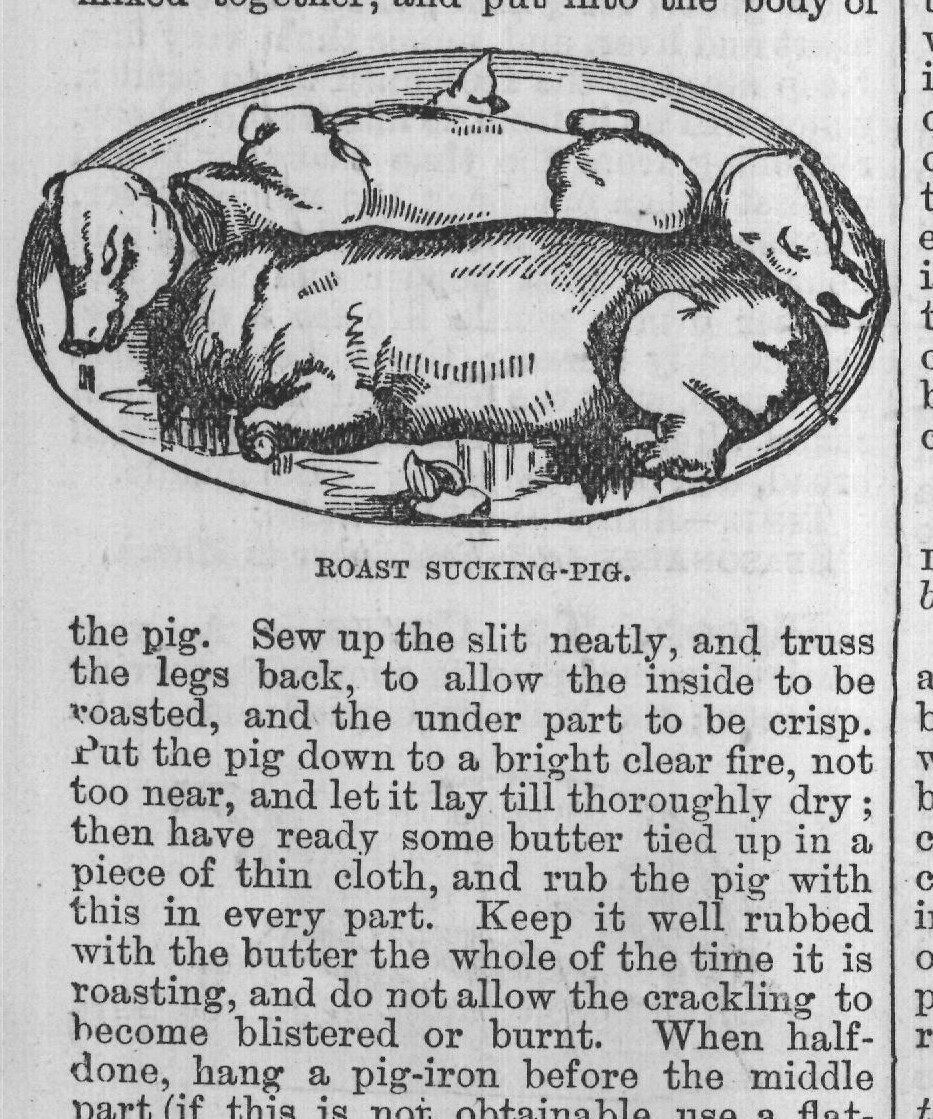
INGREDIENTS for dish for 12 persons. Pig, 6 oz. of bread-crumbs, 16 sage-leaves, pepper and salt to taste, a piece of butter the size of an egg, salad oil or butter to baste with, about pint of gravy, 1 tablespoonful of lemonjuice. AVERAGE COST, 6s. A sucking-pig, to be eaten in perfection, should not be more than three weeks old, and should be dressed the same day that it is killed. After preparing the pig for cooking, as in the following recipe, stuff it with finely-grated bread-crumbs, minced sage, pepper, salt and a piece of butter the size of an egg, all of which should be well mixed together, and put into the body of ROAST SUCKING-PIG. the pig. Sew up the slit neatly, and truss the legs back, to allow the inside to be roasted, and the under part to be crisp.
Put the pig down to a bright clear fire, not too near, and let it lay till thoroughly dry; then have ready some butter tied up in a piece of thin cloth, and rub the pig with this in every part. Keep it well rubbed with the butter the whole of the time it is roasting, and do not allow the crackling to become blistered or burnt. When halfdone, hang a pig-iron before the middle part (if this is not obtainable, use a flatiron), to prevent its being scorched and dried up before the ends are done. Before it is taken from the fire, cut off the head, and part that and the body down the PIGS' CHEEKS, TO DRY. middle. Chop the brains and mix them with the stuffing; add 1/2 pint of good gravy, a tablespoonful of lemon-juice, and the gravy that flowed from the pig; put a little of this on the dish with the pig, and the remainder send to table in a tureen. Place the halves of the pig back to back in the dish, with one half of the head on each side, and one of the ears at each end, and send it to table as hot as possible. Instead of butter, many cooks take salad oil for basting, which makes the crackling crisp ; and as this is one of the principal things to be considered, perhaps it is desirable to use it; but be particular that it is very pure, or it will impart an unpleasant flavour to the meat. The brains and stuffing may be stirred into a tureen of melted butter instead of gravy, when the latter is not liked. Apple sauce and the oldfashioned currant sauce are not yet quite obsolete as an accompaniment to roast pig.
TIME.-1 to 2 hours for a small pig.
SEASONABLE from September to February.
This is hearth cookery written for a spit and an open fire, and most of the instructions are about managing radiant heat rather than an oven. The whole point of the dish is the crackling, so everything else bends to that.
- The hinge: keep the skin greased and unblisteredThe pig is rubbed continuously with butter (or pure oil) tied in a cloth so the skin dries and crisps without scorching. In an oven the equivalent is a dry, well-oiled skin, a shielded middle, and no covering with foil at any point after the first hour; steam is the enemy of crackling.
- Fire to ovenThe book gives no temperature, only "a bright clear fire, not too near"; the nearest oven equivalent is a moderate heat for most of the roasting with a hotter spell at the end to blow the skin. The "pig-iron" or flat-iron set before the middle is a heat shield; in an oven, cover the loin and the ears with a folded piece of foil once they colour, since the recipe's concern is that the middle scorches "before the ends are done".
- Times"1 to 2 hours for a small pig" assumes fierce radiant heat on all sides. A 10-14 lb suckling pig in a domestic oven wants nearer 3 to 4 hours, and the reliable test is a thermometer in the thickest part of the shoulder, not the clock.
- Size and sourcingA three-week pig is roughly 10-14 lb dressed and must be ordered from a butcher; it will not fit most domestic ovens without the head removed, or the pig cut in half along the backbone as the recipe itself does at the end.
- The stuffing6 oz of breadcrumbs and 16 sage leaves is a modest amount for a whole pig, mixed with about 2 oz of butter and seasoned firmly. Sixteen fresh sage leaves is roughly a tablespoon of chopped sage. Sew or truss the cavity closed so the stuffing does not leach into the pan.
- Brains in the sauceThe brains are chopped into the stuffing and let down with gravy. Pig brains are now rarely sold and rarely wanted; the sauce works perfectly well as the pan juices, half a pint of stock and the tablespoon of lemon juice, with the stuffing stirred in.
- Gravy quantityThe ingredient list reads "about pint of gravy" while the method calls for half a pint. Half a pint (10 fl oz) of good stock is the workable figure, thinned with whatever runs from the pig.
- Serving and yieldBeeton costs this for twelve. Presented as directed the pig arrives in two halves, back to back, with a half-head at each side; carve the shoulders and legs first, then the loin, and give each plate a piece of skin. Apple sauce and the currant sauce she mentions are both still right with it.
Roast suckling pig was a festival dish in England long before Mrs Beeton, associated with Christmas, harvest suppers and any occasion grand enough to justify a whole animal on the spit; she gives a season of September to February. By the 1860s it may already have been a slightly old-fashioned centrepiece, though the hint is really her defence of currant sauce as "not yet quite obsolete". The literary monument to the dish is Charles Lamb's A Dissertation upon Roast Pig (1822), an essay in praise of exactly the crackling this recipe fusses over. What the method really records is the decline of the open hearth: the pig-iron, the buttered cloth and the flat-iron substitute are all workarounds for uneven radiant heat.