Home › R › Rabbit, Roast or Baked
Rabbit, Roast or Baked
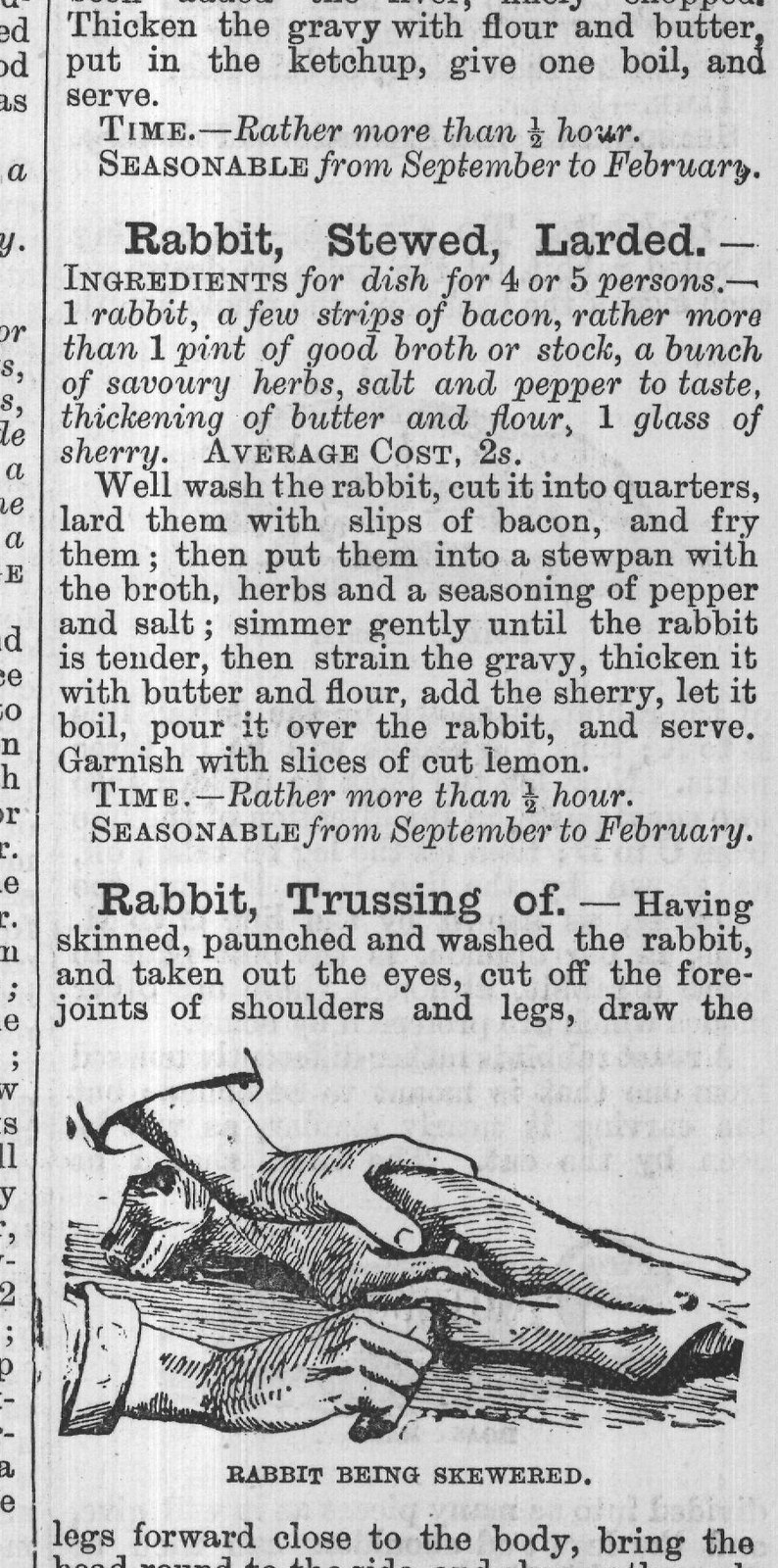
INGREDIENTS for dish for 4 or 5 persons.-1 rabbit, forcemeat, buttered paper, sausagemeat. AVERAGE COST, 1s. 9d. Empty, skin and thoroughly wash the rabbit; wipe it dry, line the inside with sausage-meat and forcemeat, to which has been added the minced liver. Sew the stuffing inside, skewer back the head between the shoulders, cut off the forejoints of the shoulders and legs, bring them RABBIT SOUP. close to the body, and secure them by means of a skewer. Wrap the rabbit in buttered paper, and put it down to a bright, clear fire; keep it well basted, and, a few minutes before it is done, remove the paper, flour and froth it, and let it acquire a nice brown colour. Take out the skewers, ROAST RABBIT. and serve with brown gravy and redcurrant jelly. To bake the rabbit, proceed in the same manner as above; in a good oven, it will take about the same time as roasting.
TIME. A young rabbit, 35 minutes; a large one, about hour.
SEASONABLE from September to February.
The text has come through the scanner with the opening line duplicated and a couple of running heads ("RABBIT SOUP", "ROAST RABBIT") dropped into the middle of it; read past them and the method is straightforward. The main adjustments are the fire, the timing, and the fact that the bird-like trussing described here assumes a whole animal with its head still on.
- The hinge: stuffing changes the timingA cavity packed with sausagemeat and liver forcemeat must reach 74C/165F at its centre, which a 35-minute roast will not achieve in anything but the smallest rabbit. Cook to temperature at the thickest part of the stuffing, not to the clock.
- Oven equivalentThe "bright, clear fire" means an open hearth with the rabbit hung or spitted in front of it; the recipe gives no oven setting. A hot oven of roughly 200C/400F is a reasonable modern stand-in for the browning wanted, and a stuffed farmed rabbit of about 1.5 kg will need considerably longer than the times given here -- upwards of an hour.
- Buttered paperBaking parchment brushed with butter, tied round the animal, does the same job: it stops the very lean flesh drying while the interior comes up to heat. Bacon rashers laid over the saddle and thighs are one common modern substitute and give similar protection.
- "Flour and froth it"Dredge the surface with flour and baste with the hot fat so the flour blisters and browns. It is a finishing step of five to ten minutes with the paper off, done at the end for colour and crispness only.
- ForcemeatIn this book that means a bound stuffing of breadcrumbs, suet or butter, chopped herbs, lemon zest and egg. Here it is combined with sausagemeat and the minced liver, so allow for the sausagemeat's own salt before seasoning.
- Wild versus farmed"Seasonable from September to February" refers to wild rabbit, which is darker, leaner and can be tough unless young. Farmed rabbit is available year round, milder, and more forgiving of a straight roast; a wild adult is better braised.
- TrussingThe instruction to skewer the head back between the shoulders assumes a butcher's whole carcass. A modern rabbit arrives headless and often part-jointed, so simply sew or skewer the belly closed over the stuffing and tie the legs in against the body with kitchen string.
- Cost and yield1s. 9d. is pre-decimal shillings and pence, from a period when rabbit was a cheap meat; the edition this price belongs to is not stated here. The stated four to five servings is optimistic by current portions; three to four is realistic from one rabbit plus stuffing.
- To serveBrown gravy made from the pan drippings and redcurrant jelly are the period accompaniments, the jelly doing for rabbit what it does for game generally. Rest the meat ten minutes before carving so the lean flesh does not shed its juices.
Rabbit was one of the cheapest meats in Victorian and Edwardian Britain, widely sold in markets and treated in the cookery books less as game than as a stand-in for poultry, which is why it is trussed like a chicken here and stuffed with sausagemeat and forcemeat. The distinction that mattered was between the wild rabbit, seasonable in the colder months when the meat was in best condition, and the hutch-reared or "tame" rabbit, considered plumper and whiter but blander. The technique here belongs to the open hearth: the animal put down before a clear fire, wrapped in buttered paper against the fierce direct heat, then unwrapped, floured and basted at the last moment so the surface would froth and brown. The line permitting the reader to bake it instead, in about the same time, reflects the coexistence of hearth and closed range in middle-class kitchens.