Home › S › Sauces, General Remarks upon
Sauces, General Remarks upon
The preparation and appearance of sauces and gravies are of the highest consequence, and in nothing does the talent and taste of the cook more display itself.
Their special adaptability to the various viands they are to accompany cannot be too much studied, in order that they may harmonize and blend with them as perfectly, so to speak, as does a pianoforte accompaniment with the voice of the singer.
The general basis of most gravies and some sauces is the same stock as that used for soups; and, by the employment of these with, perhaps, an additional slice of ham, a little spice, a few herbs and a slight flavouring from some cold sauce or ketchup, very nice gravies may be made for a very small expenditure. A milt SAUCE À L'AURORE. (either of a bullock or sheep), the shankend of mutton that has already been dressed, and the necks and feet of poultry may all be advantageously used for gravy, where much is not required. It may, then, be established as a rule, that there exists no necessity for good gravies to be expensive, and that there is no occasion, as many would have the world believe, to buy ever so many pounds of fresh meat, in order to furnish an ever so little quantity of gravy.
Brown sauces, generally speaking, should scarcely be so thick as white sauces; and it is well to bear in mind, that all those which are intended to mask the various dishes of poultry or meat, should be of a sufficient consistency to slightly adhere to the fowls or joints over which they are poured. For browning and thickening sauces, &c., browned flour may be properly employed.
Sauces should possess a decided character; and, whether sharp or sweet, savoury or plain, they should carry out their names in a distinct manner; although, of course, not so much flavoured as to make them too piquant on the one hand, or too mawkish on the other.
Gravies and sauces should be sent to table very hot; and there is all the more necessity for the cook to see to this point, as, from their being usually served in small quantities, they are more liable to cool quickly than if they were in a larger body.
Those sauces, of which cream or eggs form a component part, should be well stirred as soon as these ingredients are added to them, and must never be allowed to boil; as, in that case, they would instantly curdle.
Sauce à l'Aurore (for Trout, Soles, &c.).-INGREDIENTS for sauce for 2 or 3 soles. The spawn of 1 lobster, 1 oz. of butter, pint of Béchamel, the juice of lemon, a high seasoning of salt and cayenne.
AVERAGE COST, 9d.
Take the spawn and pound it in a mortar with the butter until quite smooth, and work it through a hair sieve. Put the Béchamel into a stewpan, add the pounded spawn, the lemon-juice, which must be strained, and a plentiful seasoning of cayenne and salt; let it just simmer, but do not allow it to boil, or the beautiful red colour of the sauce will be spoiled. A small spoonful of anchovy essence may be added at pleasure.
TIME.-1 minute to simmer.
SEASONABLE at any time.
SAUCE ARISTOCRATIQUE.
Sauce à la Matelote (for Fish).- INGREDIENTS for sauce for good-sized dish of fish. pint of Espagnole, 3 onions, 2 tablespoonfuls of mushroom ketchup, 1/2 glass of port wine, a bunch of sweet herbs, 1/2 bayleaf, salt and pepper to taste, 1 clove, 2 berries of allspice, a little liquor in which the fish has been boiled, lemon-juice and anchovy sauce. AVERAGE COST, 1s. 8d.
Slice and fry the onions of a nice brown colour, and put them into a stewpan with the Espagnole, ketchup, wine and a little liquor in which the fish has been boiled.
Add the seasoning, herbs and spices, and simmer gently for 10 minutes, stirring well the whole time; strain it through a fine hair sieve, put in the lemon-juice and anchovy sauce, and pour it over the fish.
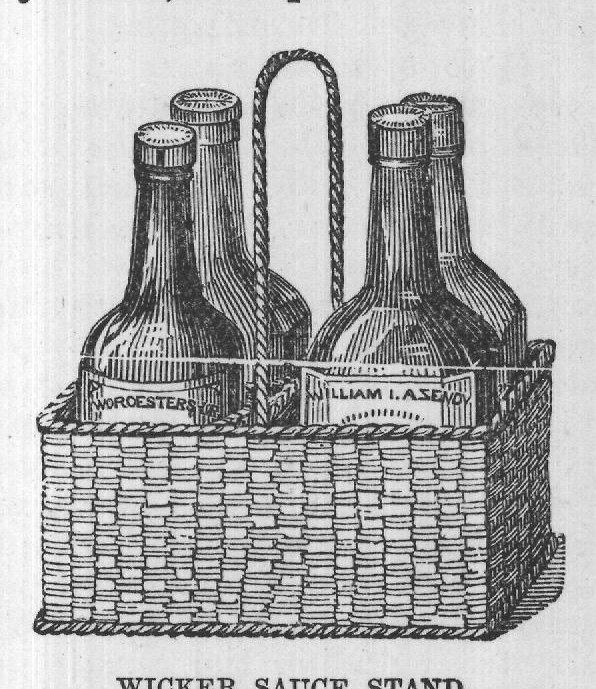
ILLIAM I.ASE DESTER WICKER SAUCE STAND.
This sauce may be very much enriched by putting in a few small quenelles, or forcemeat balls made of fish, and also glazed onions or mushrooms. These, however, should not be added to the matelote till it is dished.
TIME.-10 minutes.
SEASONABLE at any time.
Note. This sauce originally took its name as being similar to that which the French sailor (matelot) employed as a relish to the fish he caught and ate. In some cases cider and perry were substituted for the wine. The Norman matelotes were very celebrated.
Sauce Aristocratique. (A Store Sauce.) - INGREDIENTS. - Green walnuts.
To every pint of juice, 1 lb. of anchovies, 1 drachm of cloves, 1 drachm of mace, 1 drachm of Jamaica ginger, bruised, 8 shalots. To every pint of the boiled liquor, 1/2 pint of vinegar, 1/4 pint of port wine, 2 tablespoonfuls of soy. AVERAGE COST, 3s. 6d. per quart.
SAUCE, MANGO CHETNEY.
Pound the walnuts in a mortar, squeeze out the juice through a strainer, and let it stand to settle. Pour off the clear juice, and to every pint of it add anchovies, spices and cloves in the above proportion.
Boil all these together till the anchovies are dissolved, then strain the juice again, put in the shalots (8 to every pint) and boil again. To every pint of the boiled liquor add vinegar, wine and soy in the above quantities, and bottle off for use. Cork well and seal the corks.
SEASONABLE.--Make this sauce from the beginning to the middle of July, when walnuts are in perfection for sauces and pickling.
Three distinct sauces sit inside this general essay: a lobster-coral sauce for fish, a red-wine matelote, and a bottled green-walnut store sauce. The essay's own advice — that a sauce should be thick enough to cling, and that anything containing cream or egg must never boil — still holds.
- Ambiguous quantitiesSeveral fractions have dropped out of the ingredient lists as printed here: the Béchamel and Espagnole quantities and the lemon juice for the Aurore (the matelote's "good-sized dish of fish" is missing only an article). Treat the numbers as needing your own judgement rather than guessing a printed figure.
- DrachmAn apothecaries' drachm is one eighth of an ounce, roughly 3.5-4 g of ground spice.
- Espagnole and BéchamelBoth are mother sauces made in advance, not shortcuts. Espagnole is a brown stock sauce thickened with browned roux; Béchamel in Beeton is closer to a rich white sauce built on veal stock and cream than the plain milk version taught today. Without one of them made ahead, neither the Aurore nor the matelote can be started.
- Lobster spawn "Spawn" means the dark roe of a hen lobster, which turns coral-red on heating and is what colours the sauce. It is rarely sold separately; you will need to buy a whole hen lobster, and the roe from one gives only a few tablespoons of pounded butter. Pounding and sieving can be done in a small food processor, then pushed through a fine sieve to remove membrane.
- The hinge: no boilingBoiling spoils the Aurore; the recipe is explicit that the beautiful red colour goes if it boils. Let it just simmer for the minute given, no more. The same applies to any of Beeton's cream- or egg-finished sauces.
- Mushroom ketchup and soyVictorian mushroom ketchup is a thin, dark, salty mushroom extract, not a tomato product; it is still made and sold, and a good dark soy plus a little mushroom stock approximates it. The "soy" of the store sauce is imported soy sauce; add it cautiously and taste.
- Storing the AristocratiqueGreen walnut juice, vinegar, port and dissolved anchovy make a strongly acid, strongly salt liquid, which is why it kept. Use bottles washed and heat-dried, fill hot, and keep it in the refrigerator once opened.
- Green walnutsThey must be picked while the shell inside is still soft enough for a skewer to pass through, which the recipe puts at the beginning to the middle of July. Handle them with gloves -- the juice stains skin brown for a week.
- YieldEach of the Aurore and the matelote makes enough for one dish of fish, though the exact volume cannot be recovered because the Béchamel and Espagnole quantities are missing. The store sauce yield depends entirely on how much juice your walnuts give.
The note on the matelote is broadly right: matelote comes from matelot, sailor, and the name attached to the freshwater-fish stews of the Loire, the Seine and above all Normandy, where the river-boatmen's dish of eel, carp and pike in wine or cider became a restaurant fixture. The substitution of cider and perry for wine is not a rustic corruption but simple geography — Normandy drinks what it grows. The Sauce Aristocratique belongs to a different tradition entirely: the Victorian household's store sauces, bottled condiments kept for months and spooned into gravies to give them, as the essay puts it, a decided character. Green-walnut liquor, anchovy, spice and soy is essentially the family recipe behind the innumerable "Harvey's" sauces sold in the same decades. The essay's insistence that good gravy need not be expensive — use a milt, a dressed mutton shank, poultry necks and feet — is the frugal core of Beeton's whole project, addressed to a middle-class reader anxious to serve French-sounding food on an English budget.