Turbot Boiled
INGREDIENTS. - 6 oz. of salt to each gallon of water. AVERAGE COST, from 3s. to 12s. each.
Choose a middling-sized turbot; for they are invariably the most valuable; if very large, the meat will be tough and thready.
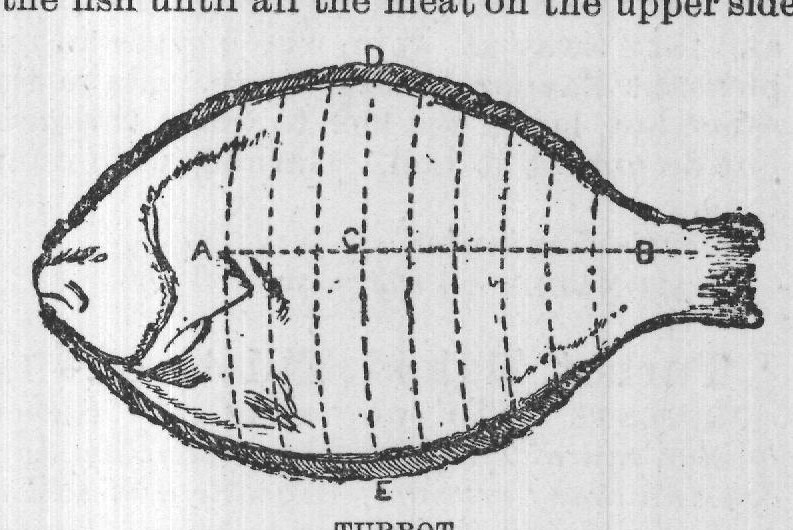
Three or four hours before dressing, soak the fish in salt water to take off the slime; then thoroughly cleanse it, and with a knife make an incision down the middle of the back, to prevent the skin of the belly from cracking. Rub it over with lemon, and be particular not to cut off the fins. Lay the fish in a very clean turbot-kettle, with sufficient cold water to cover it, and salt in the above proportion. Let it gradually come BOILED TURBOT. to a boil, and skim very carefully; keep it gently simmering, and on no account let it boil fast, as the fish would have a very unsightly appearance. When the meat separates easily from the bone, it is done; then take it out, let it drain well, and dish it on a hot napkin. Rub a little lobster spawn through a sieve, sprinkle it over the fish, and garnish with tufts of parsley and cut lemon. Lobster or shrimp sauce, andplain melted butter, should be sent to table with it.
TIME.-After the water boils, aboat 1/2 hour A E TURBOT. is helped. When the carver has removed all the meat from the upper side of the fish, the backbone should be raised, put on one side of the dish, and the under side helped as the upper.
Turbot à la Crême. - INGREDIENTS. The remains of cold turbot. For sauce, 2 oz. of butter, 4 tablespoonfuls of cream; salt, cayenne and pounded mace to taste.
Clear away all skin and bone from the flesh of the turbot, which should be done when it comes from table, as it causes less waste when trimmed hot. Cut the flesh into nice square pieces, as equally as possible; put into a stewpan the butter, let it melt, and add the cream and seasoning; let it just simmer for one minute, but not boil. Lay in the fish to warm, and serve it garnished with croûtons or a paste border.
TIME.-10 minutes.
SEASONABLE at any time.
Note. The remains of cold salmon may be dressed in this way, and the above mixture may be served in a vol-au-vent.
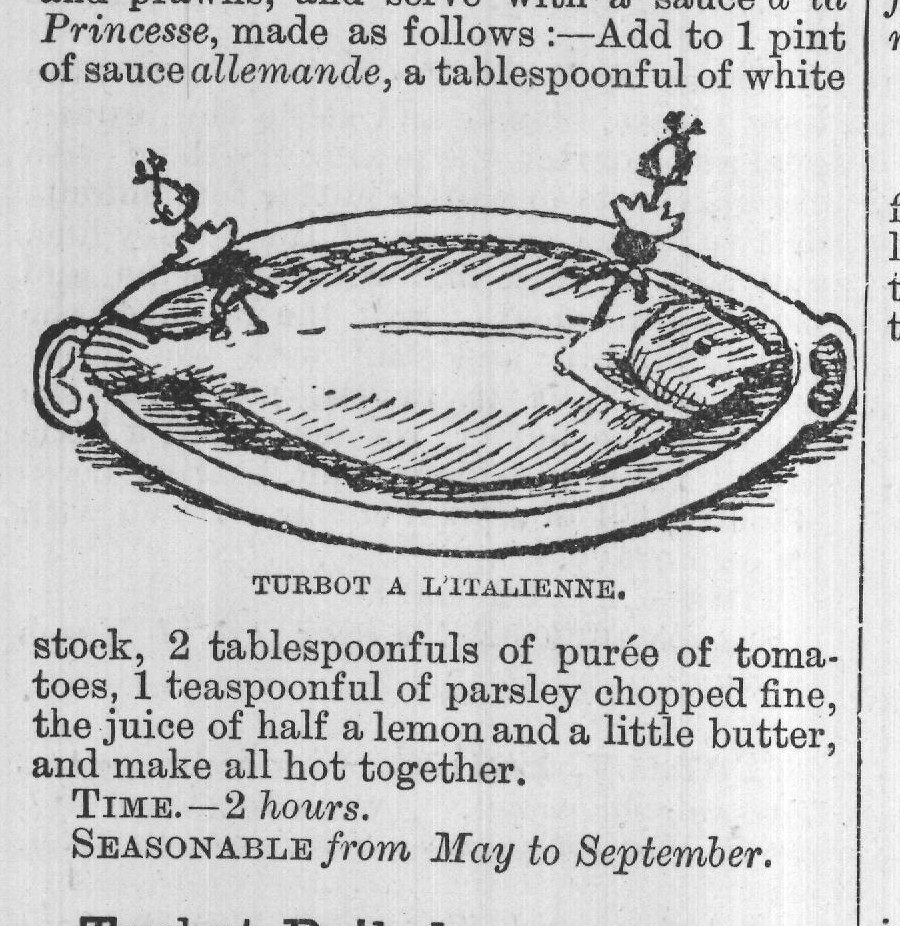
A whole poached flatfish, handled gently from cold water. The method is sound; only the equipment and the vocabulary need translating.
- The hinge: never let it boilBring the water up slowly and hold it at a bare shiver, with barely a bubble breaking. Turbot at a rolling boil sheds its skin, splits along the flanks and comes out ragged, which is the "unsightly appearance" being warned against.
- The brine6 oz of salt to the gallon is roughly 170 g to an imperial gallon of about 4.5 litres, or about 37 g per litre — near the salinity of seawater. It seasons the flesh and helps it stay white.
- Turbot-kettleA long oval or diamond-shaped fish kettle with a lifting trivet. A deep roasting tin set over two burners, or a large braising pan, will serve; line it with muslin or a doubled tea towel so you can lift the fish out without breaking it.
- TimingThe original time has not survived intact. Reckon on about 10 minutes per pound from the moment the water reaches a simmer, and rely on the test given: the flesh should part cleanly from the backbone at the thickest point. On that reckoning a 4–5 lb fish takes roughly 40–50 minutes.
- The cut down the backScoring along the backbone is not decorative. Turbot skin shrinks faster than the flesh as it heats, and the slit gives it somewhere to go instead of tearing across the belly.
- Lobster spawnThe dark roe from a hen lobster, which turns coral-red on cooking; sieved, it makes a bright dusting. Sieved cooked lobster or brown crab roe does the same job, and the garnish can simply be left off.
- "Dish it on a hot napkin"A folded linen cloth laid on the warmed platter, to soak up poaching liquor so the fish does not sit in a puddle. A folded clean tea towel works, or drain the fish thoroughly on the trivet instead.
- ServingA 4–5 lb turbot serves six to eight. Carve the upper fillets off the bone, lift the backbone away to one side of the dish as directed, then serve the underside — the sequence assumes the whole fish stays on the platter throughout.
Turbot was the grand fish of the Victorian table, a broad North Sea flatfish sold by the each rather than the pound and priced accordingly — the range of three to twelve shillings quoted here spans a considerable part of a servant's weekly wage. Its status is why households of any pretension owned a turbot-kettle, a wide diamond-shaped vessel useless for anything else, and why the carving instructions are given as carefully as the cooking. Beeton's insistence on a middling fish rather than a monster reflects standard fishmonger's wisdom that very large flatfish coarsen; the same is said of halibut and brill. Wild turbot is now scarce and expensive, and most of what reaches European markets is farmed, which has made the dish possible again for cooks who would never have met one in the 1860s.