Home › V › Veal, Stewed Knuckle of, and Rice
Veal, Stewed Knuckle of, and Rice
INGREDIENTS. -Knuckle of veal, 1 onion, 2 blades of mace, 1 teaspoonful of salt, 1/21 lb. of rice. AVERAGE COST, 6d. per lb.
Have the knuckle cut small, or cut some cutlets from it, that it may be just large KNUCKLE OF VEAL. from A to B, sufficiently indicates the direction which should be given to the KNUCKLE OF VEAL. enough to be eaten the same day it is dressed, as cold boiled veal is not a particularly tempting dish. Break the shankbone, wash it clean, and put the meat into a stewpan with sufficient water to cover it.
Let it gradually come to a boil, put in the salt, and remove the scum as fast as it rises.
When it has simmered gently for about VEAL, LOIN OF. hour, add the remaining ingredients, and stew the whole gently for 2¼ hours. Put the meat into a deep dish, pour over it the rice, &c., and send boiled bacon and a tureen of parsley-and-butter to table with it.
TIME.-A knuckle of veal weighing 6 lbs., 3 hours' gentle stewing.
SEASONABLE from March to October.
Note.-Macaroni, instead of rice, boiled with the veal, will be found good; or the rice and macaroni may be omitted, and the veal sent to table smothered in parsley-and-butter.
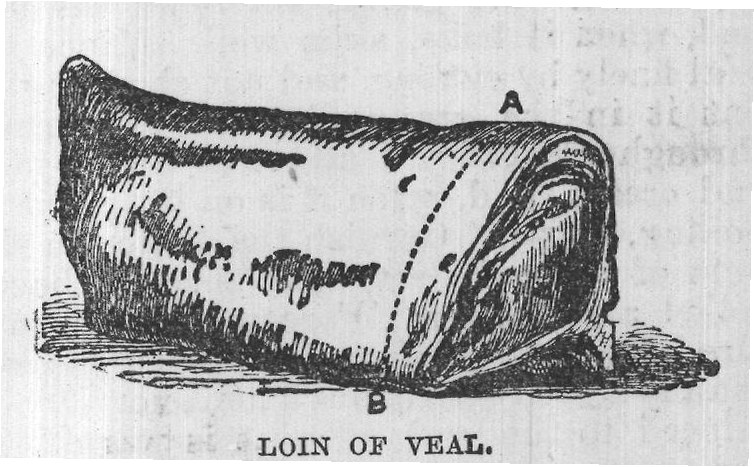
Veal, Roast Loin of. ; melted butter. AVERAGE COST, 10d. per lb.
INGREDI- AVERAGE Paper the kidney fat; roll in and skewer the flap, which makes the joint a good shape; dredge it well with flour, and put LOIN OF VEAL. it down to a bright fire. Should the loin be very large, skewer the kidney back for a time to roast thoroughly. Keep it well basted, and, a short time before serving, remove the paper from the kidney, and allow it to acquire a nice brown colour, but it should not be burnt. Have ready some over the veal, and serve. it melted butter, put it into the dripping-pan after it is emptied of its contents, pour Garnish the dish with slices of lemon and forcemeat balls, and send to table with it boiled bacon, ham, pickled pork, or pig's cheek.
TIME. A large loin, 3 hours.
SEASONABLE from March to October.
Note. A piece of toast should be placed under the kidney when the veal is dished.
Veal, Loin of, au Béchamel. (Cold Meat Cookery.) - INGREDIENTS.- Loin of veal, 1/2 teaspoonful of minced lemonpeel, rather more than 1/2 pint of béchamel or white sauce. AVERAGE COST, 10d. per lb.
A loin of veal which has come from table with very little taken off, answers well for this dish. Cut off the meat from the inside, mince it, and mix with it some minced lemon-peel; put it into sufficient béchamel to warm it through. In the mean time, wrap the joint in buttered paper, and place it in the oven to warm. When thoroughly hot, dish the mince, place the loin above VEAL, LOIN OF. it, and pour over the remainder of the béchamel.
TIME.-1 hour to warm the meat in the SEASONABLE from March to October. oven.
Veal, Loin of, à la Daube.- INGREDIENTS. - The chump end of a loin of veal, forcemeat, a few slices of bacon, a bunch of savour savoury herbs, 2 blades of mace, teaspoonful of whole white pepper, 1 pint of veal stock or water, 5 or 6 green onions.
AVERAGE COST, 10d. per lb.
Cut off the chump from a loin of veal, and take out the bone; fill the cavity with forcemeat, tie it up tightly, and lay it in a stewpan with the bones and trimmings, and cover the veal with a few slices of bacon. Add the herbs, mace, pepper and onions, and stock or water; cover the pan with a closely-fitting lid, and simmer for 2 hours, shaking the stewpan occasionally.
Take out the bacon, herbs and onions; reduce the gravy, if not already thick enough, to a glaze, with which glaze the meat, and serve with tomato, mushroom , or sorrel sauce.
TIME.-2 hours.
SEASONABLE from March to October.
A plain Victorian pot of veal shank simmered with rice until both are tender, served with boiled bacon and parsley sauce. Most of what needs translating is vocabulary and timing.
- The cutA knuckle of veal is the shank, the same cut sold today for osso buco. Ask for it sawn into rounds rather than left whole; the marrow and the gelatine from the bone are what give the broth its body.
- Break the shankboneThis is the hinge of the dish. Cracking the bone lets the marrow and gelatine out into the liquid, which is what thickens the rice and makes the broth worth eating. A butcher will do it with a saw in seconds.
- Stewing timeThe governing figure is the one in the TIME line: about 3 hours of gentle simmering for a 6 lb knuckle. The instruction should be read as an initial hour of simmering before the onion, mace and rice go in, then the remainder of the cooking. Never let it boil hard, or the meat shreds and the broth clouds.
- Rice quantityThe amount given is garbled in the printing and cannot be reconstructed with confidence. For a 6 lb knuckle, half a pound of long-grain rice added for the last 30-40 minutes will absorb the broth without turning to paste; add it later than the original implies, so that it does not cook down to paste over the full stewing time.
- Blades of maceMace is the outer covering of the nutmeg, sold either as whole "blades" or ground. Two blades is very roughly a quarter to half a teaspoonful of the ground spice; if you substitute ground mace, add it towards the end, as it gives up its flavour quickly.
- Parsley-and-butterNot simply butter melted and poured over, but the old English "melted butter" sauce: a butter-and-flour base loosened with water, milk, or some of the veal broth, finished with a generous handful of chopped parsley. A tureen of it does much of the seasoning, the veal itself being cooked with only salt, onion and mace.
- Boiled baconThe accompaniment is a piece of gammon or bacon joint, simmered separately and sliced. It supplies the salt (and, if a smoked cure is used, the smoke) that the veal lacks.
- Yield and servingA 6 lb knuckle with rice feeds six to eight. The advice to eat it the day it is made still holds, though the leftover broth and shredded meat make a good soup the following day.
Veal knuckle was one of the cheapest joints on the Victorian butcher's block, and the costing of sixpence a pound against tenpence for the loin on the same page shows exactly why it earned a place in a book aimed at managing a household budget. The technique here is the familiar "veal broth" method that also underlies barley broth and rice soup: a gelatinous bone joint set to simmer, skimmed carefully, then a grain added to swallow the liquor and stretch the meat across more plates. The seasonable window of March to October is usually explained by the calving year rather than by any culinary preference, veal being a by-product of dairying. The note offering macaroni as an alternative to rice shows that dried pasta was familiar enough to English cooks to be treated as simply another starch to boil in broth rather than as a dish in its own right.