Venison, Hashed
INGREDIENTS. -The remains of roast venison, its own or mutton gravy, thickening of butter and flour.
Cut the meat from the bones in neat slices, and, if there be sufficient of its own gravy left, put the meat into this, as it is preferable to any other. Should there not be enough, put the bones and trimmings into to a stewpan, with about a pint of mutton gravy; let them stew gently for an hour, and strain the gravy. Put a little flour and butter into the stewpan, keep stirring until brown, then add the strained gravy, and give it a boil up; skim and strain again, and, when a little cool, put in the slices of venison. Place the stewpan by the side of the fire, and, when on the point of simmering, serve; do not allow it to boil, or the meat will be hard. Send red-currant jelly to table with it.
TIME.-Altogether 1½ hour.
SEASONABLE.-Buck venison, from June to Michaelmas; doe venison, from November to the end of January.
Note. A small quantity of Harvey's sauce, ketchup, or port wine, may be added to enrich the gravy: these ingredients must, however, be used very sparingly, or they will overpower the flavour of the venison.
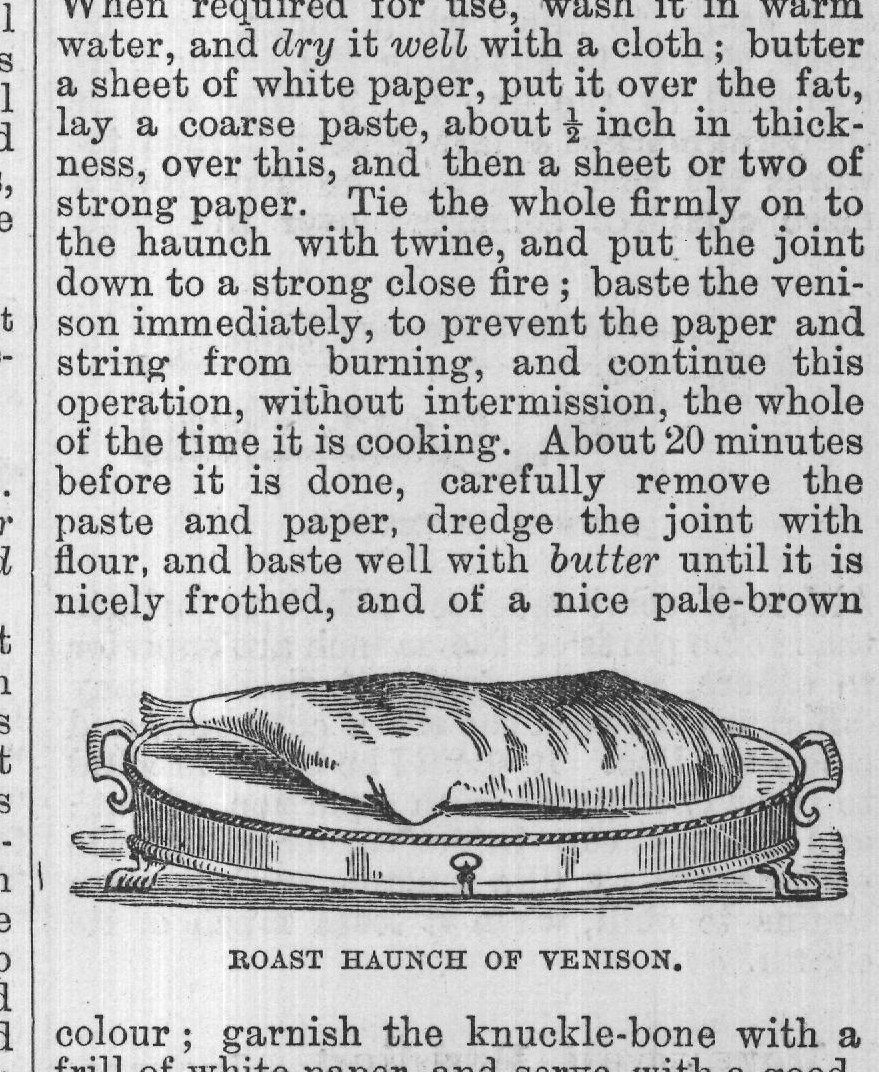
VENISON, HAUNCH OF.
A reheating dish rather than a cooking one: the venison is already roast, and the whole point is to warm it through without cooking it a second time.
- The hingeThe gravy must never reach a boil once the meat is in; the recipe says only to set the pan by the fire and serve when it is on the point of simmering. Lean venison seizes and turns dry and stringy quickly, so hold the pan well below a boil until the slices are hot through.
- Slice coldRoast venison carves into neat thin slices far more easily straight from the refrigerator. Cut across the grain and keep the slices no thicker than a coin so they heat quickly.
- A pint of gravyAn imperial pint is 20 fl oz, so about 2½ US cups. Mutton gravy can be replaced with a good lamb or beef stock; the bones and trimmings simmered in it for an hour will carry most of the venison flavour.
- Thickening of butter and flourA brown roux made in the pan: the recipe specifies only 'a little' flour and butter, stirred until brown. Equal weights of each, on the order of 1 oz apiece to the pint, is the conventional proportion.
- Strain twiceThe recipe strains the stock, then skims and strains the finished sauce again. Worth doing -- reheated venison sauce clouds easily, and a clean glossy gravy is most of the effect.
- TimingMost of the stated 1½ hours is the stock simmering. Once that is done the dish is finished quickly.
- Harvey's sauceA commercial Victorian bottled sauce, anchovy-based and no longer sold. Worcestershire sauce is the nearest survivor; a teaspoon is plenty, and the warning about overpowering the venison is sound.
- Yield and accompanimentReckon on 4-5 oz of sliced meat per person. Red-currant jelly is not optional in the Victorian scheme -- the sharp sweetness is what balances the gaminess.
Hashes of this kind were the backbone of the Victorian second-day table, and Mrs Beeton's book gives them: cold roast meat re-dressed in its own gravy, warmed but not recooked, and sent up as a distinct dish rather than as leftovers. Venison made the practice almost obligatory, since a haunch or saddle from a deer park was far too large for one meal. The seasons given -- buck from June to Michaelmas, doe from November to January -- reflect English deer-management practice of the period, when venison was still largely an estate product passed between households rather than something bought in a shop. Red-currant jelly with game is a pairing older than the Victorian period, and it has outlasted almost everything else in the recipe.