Home › Some Useful Recipes › Baked Eggs
Baked Eggs
Break the eggs carefully into a dish, so the yelks will not be broken. Turn them into a granite-ware pan well buttered, season with pepper and salt, and drop a small piece of butter on each egg. Set in a hot oven and bake until the whites are set.
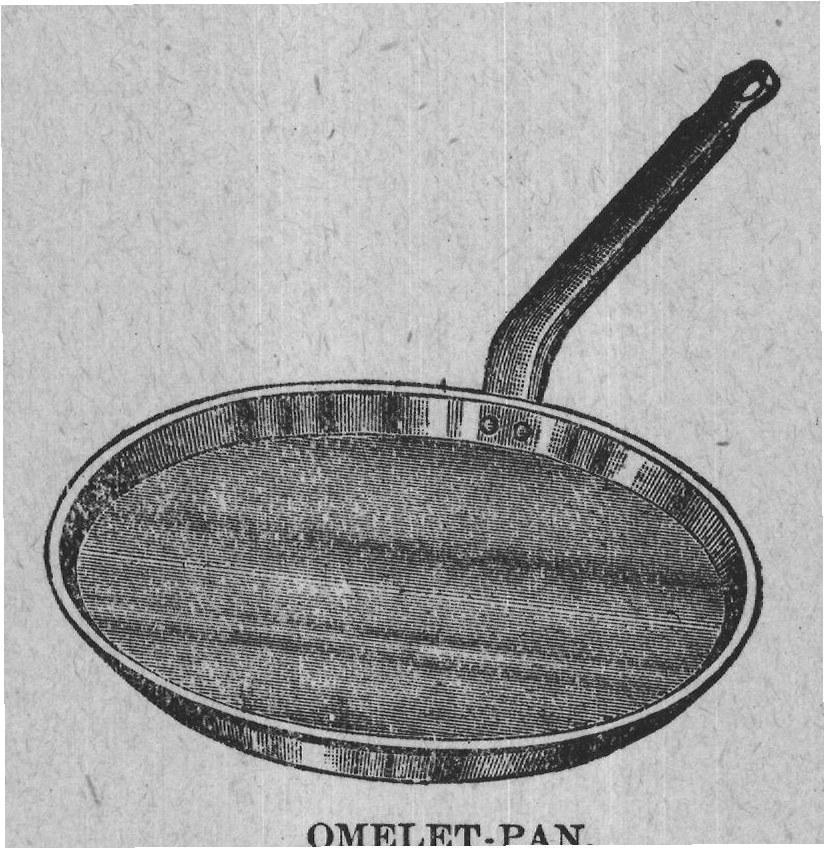
Omelettes. Eggs are not to be beaten for an omelette. If a soufflé is desired, they are beaten. For an omelette, they are stirred until the yolks and whites are properly mixed, one teaspoonful of cold water being used to each egg. The omelette takes its name from the flavoring used, parsley, ham, cheese, etc., either of which must be chopped fine; the material in which they are fried must be the sweetest butter. The butter being hot, pour the stirred eggs, and other material if used. into the omelette-pan, shaking the pan occasionally, as the mass sets, so it will not burn. If desired browned on both sides, turn; or when done, if fried only on one side, fold or roll together lightly, and garnish the top with bits of parsley. XXII. Steamed Dishes.
OYSTERS, many vegetables, especially potatoes, puddings and various prepared dishes are steamed. This is simply utilizing the action of steam instead of hot water to break down the tissue and render the substance palatable. The articles are placed in a vessel with a perforated bottom, and fitting tight upon a pot. The lid must also be tight so as to allow some pressure of steam. An excellent form of steamer wherein the cover fits down upon a projection instead of over the side is shown in the illustration.
N
Two related methods run together here: eggs baked whole in a buttered pan, and a plain French-style omelette. The transcription trails off into the book's next chapter on steaming and a stray line of advertising, which can be ignored.
- "A hot oven"The book gives no temperature; period guides generally put a hot oven somewhere around 400-450F, though usage varied. For baked eggs a moderate 375F is easier to control; at the hotter end the bottoms set and toughen before the whites above them are opaque.
- Granite-wareEnamelled sheet steel, speckled grey, standard in turn-of-the-century kitchens. Any shallow ovenproof dish or a well-buttered cast-iron skillet does the same job; enamelled or glass dishes conduct less fiercely than bare metal.
- The hinge: stop at set whitesBake only until the whites turn opaque and no longer jiggle, about 10-14 minutes depending on dish and depth. The yolks should still be liquid; residual heat keeps cooking them after the dish leaves the oven, so pull them a shade early.
- Breaking eggs into a dish firstThe recipe's stated reason is simply to keep the yolks whole. In practice, cracking each egg into a cup or saucer before sliding it into the buttered pan also keeps a broken yolk or a bad egg out of the whole batch and lets you space the eggs without crowding.
- Soft yolksThe yolks here will not reach a pasteurising temperature. Fine for most cooks with fresh eggs, but if you are serving someone pregnant, elderly, very young or immunocompromised, use pasteurised-in-shell eggs or cook the yolks through.
- A teaspoonful of water per eggCorrect and worth keeping. The water turns to steam in the pan and lightens the omelette slightly; milk or cream, by contrast, makes it heavier and more prone to weeping.
- "Sweetest butter"Unsalted, fresh butter. Nineteenth-century butter was often heavily salted for keeping and could taste rancid; the instruction is about flavour, not chemistry. Season the eggs themselves instead.
- Not beatenThe distinction the book draws still holds. Stir the eggs only until yolk and white are combined, with no foam; beating aerates them into a soufflé-style puff that collapses. Fillings go in chopped fine and, for cheese or ham, warmed first.
- YieldReckon two eggs per person for either method. An omelette of more than three eggs is difficult to fold in a domestic pan; make two rather than one large one.
The two techniques sit side by side here because both were understood as ways of cooking eggs quickly without water, at a time when eggs were a cheap, everyday protein and cookbooks devoted whole chapters to them. The insistence that omelette eggs are stirred rather than beaten reflects the French tradition, filtered into American household manuals through the late nineteenth century, in which the omelette is set gently in butter rather than puffed; the beaten version was kept for what the book calls a soufflé. The omelette taking its name from the flavouring, so a parsley omelette, a ham omelette, a cheese omelette -- appears to follow menu conventions of the period. Granite-ware, the mottled enamelled steel said to be named for its resemblance to polished stone, is generally described as having been promoted from the 1870s onward as a clean, non-reactive alternative to tinned copper and cast iron; since it stayed in production for decades, its appearance in a recipe like this dates the text only loosely.