Home › Some Useful Recipes › Scrambled Eggs
Scrambled Eggs
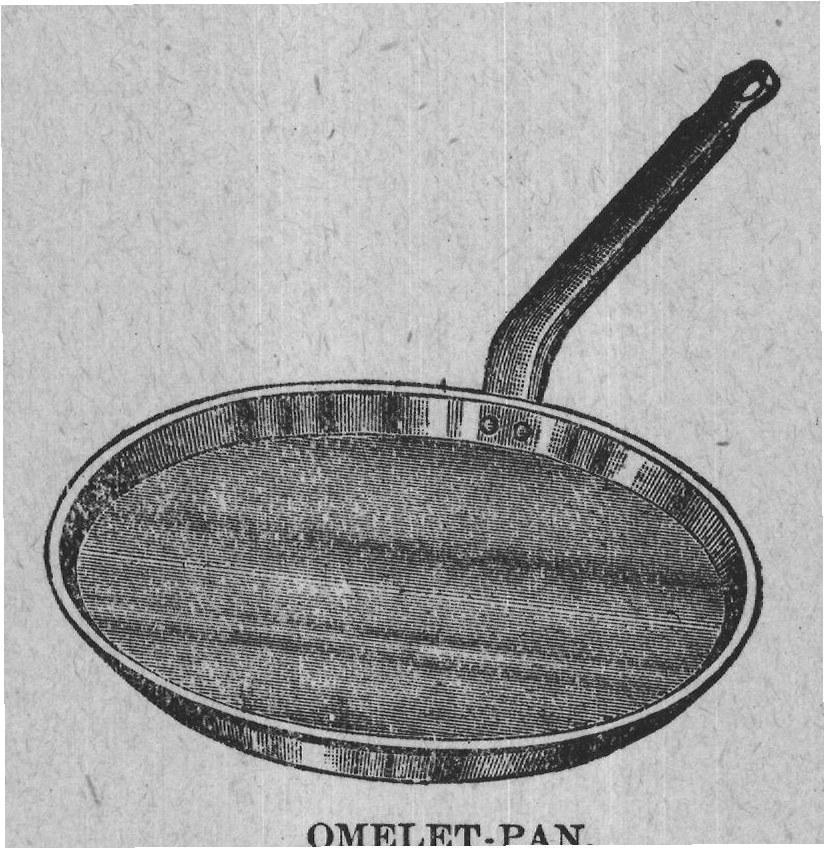
They are scrambled by breaking them into a hot frying-pan, containing only enough butter to thoroughly grease it, and constantly stirring the eggs until done. Of course, whatever the way of cooking, they must be properly seasoned with pepper and salt.
This is a fragment from a longer entry on cooking eggs, and it assumes a heavy iron pan over a coal range. The method still works, but two details in it run against current practice.
- The hot pan is the riskA pan hot enough to set the eggs on contact gives you curds that are tough on the outside and weeping on the inside. Melt the butter over medium-low heat and add the eggs before the pan is fiercely hot; low and slow is what produces soft curds.
- More butter than "enough to grease it"The original is sparing with butter. On modern stainless or enamelled pans allow about 1 tablespoon of butter for every 4 eggs, both for flavour and to keep the protein from gripping the metal.
- Break them into a bowl firstCracking eggs directly into the pan, as written, means no shell check and no even mixing. Beat them in a bowl with a fork until the whites are no longer visible in streaks.
- Omelet-panTraditionally a shallow pan with sloping sides and a long handle, often reserved for eggs. A nonstick or well-seasoned carbon steel skillet of 8 to 10 inches is the nearest modern equivalent.
- DonenessThe recipe says only "until done", with no further guidance. Pull the pan off the heat while the eggs still look slightly underset and glossy; residual heat finishes them in the pan. Eggs cooked past that point turn granular and release water.
- Salt timingThe recipe does not say when to season, only that the eggs must be. Salting the beaten eggs some minutes before cooking is often said to give a more tender result; pepper is better added off the heat.
- YieldNo quantity is given. Reckon 2 to 3 eggs per person, and do not cook more than about 8 at a time in one pan or the mass cools the surface and stews rather than sets.
Scrambled eggs are old enough that no one owns them, but the confident brevity of this entry is characteristic of household manuals, which treated eggs as a subject of general knowledge requiring only a reminder. The preference here for a hot pan and constant stirring suits cooking over a fire whose heat could not simply be turned down: speed was a virtue because control was limited. The insistence that eggs be "properly seasoned with pepper and salt" is a small period tell as well, since nineteenth-century cookery writing returns again and again to seasoning as a matter of household discipline. The slow-cooked, custardy scrambled egg familiar from later French-influenced writing has its own long history in English-language cooking.