Important: Safety Warning
This page offers rules for telling edible mushrooms from poisonous ones. No such rules are reliable, and these identifications predate modern mycology. Deadly species closely resemble edible ones, and mistakes are regularly fatal. Never eat a wild mushroom on the strength of this text.
In addition, this page gives first-aid or emergency advice that predates modern medicine and can make an emergency worse. Do not follow it. In any medical emergency, call emergency services and follow current first-aid guidance.
In addition, this page describes additives or treatments for food or drink that are now known to be toxic and are prohibited in food today.
This information has been left in for historical purposes but should not be acted upon.
Home › Sauces, Salads, Pickles and Condiments › Testing and Cooking Mushrooms
Testing and Cooking Mushrooms
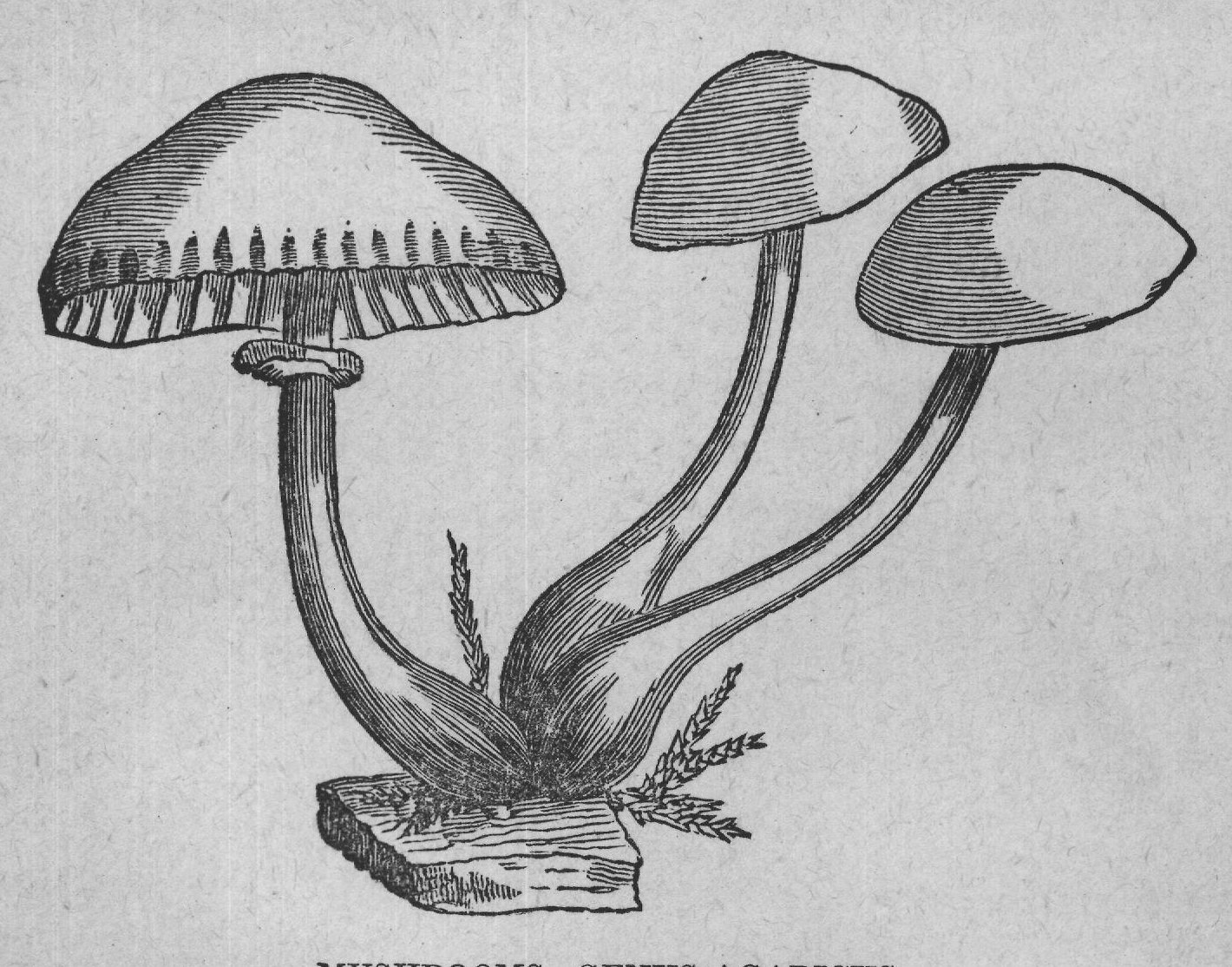
Peel off the outer skin, break out the stem, and set the cap, top down, on a hot stove. In the spot where the stem formerly stood put a little salt, and, if desired, a small bit of butter. Scatter some salt over the gills. When the butter or salt melts, the cooking is done; and as soon as it is cool enough the fungus should be eaten, carefully saving the juice. Some fungi that do not seem particularly delicious when thus cooked, will, when slowly stewed with a little butter, and flour dredged in, with salt and pepper, make most delicious stews. Agaricus campestris is the one generally raised, but all the mushrooms, cantharellus, marisimus, boletus, indeed all of the edible fungi named, will stew together, and form a dish that, alone or as an entrée, cannot be surpassed in delicacy of flavor and gastronomic satisfaction.
In testing new fungi, one eats a little of the cap with common salt to ascertain whether it tastes good, and whether it affects the fauces of the throat disagreeably; when a burning or stinging sensation accompanies or follows the swallowing, eat no more but take a copious dose of common salt, which generally neutralizes the poison. Some species, unpleasant or slightly injurious when raw, lose their harsh qualities in cooking; but as there are so many that are delicious, it is well to give up the doubtful kinds.
IV. Pickles, Catsup and Condiments.
PICKLES are any vegetables, fruits or other substance preserved in vinegar. Sweet pickles are preserved with vinegar, sugar and spices. Catsups are, in some sense, liquid pickles. The juices of the vegetables and vinegar compose the catsup with the addition of spices. A condiment is something to give zest to dishes, or to add to, or bring out flavor. Leaves are useful in flavoring; those of herbs are well known; many common varieties should be better known. Peach leaves and those of the laurel contain the virtue of bitter almonds, itself a form of prussic acid, a deadly poison when concentrated, but harmless in small quantities. V. Leaves for Flavoring.
ONE of the most useful and harmless of all leaves for flavoring is that of the common syringa. When cucumbers are scarce these are a perfect substitute in salads or anything in which that flavor is desired. The taste is not only like that of cucumbers, but identical-a curious instance of the correlation of flavors in widely different families. Again, the young leaves of cucumbers have a striking likeness, in the way of flavor, to that of fruit. The same may be affirmed of carrot tops, which are as like carrots in taste as may be. In most gardens there is a waste of celery flavor in the sacrifice of the outside leaves and their partially blanched footstalks. Blanched celery is cut up into soup, when the outside leaves would flavor it equally well or better. The young leaves of gooseberries added to bottled fruit give a fresher flavor and greener color to pies and tarts. The leaves of the flowering currant give a sort of intermediate flavor between that of black currants and red. Orange, citron and lemon leaves impart a flavoring equal to that of the fruit and rind combined, and somewhat different from both. A few leaves added to pies, or boiled in the milk used to bake with rice, or formed into crusts or paste, impart an excellent flavor. In fact, leaves are not half so much used for seasoning purposes as they might be. VI. Sour Pickles-Cucumbers.
As the cucumbers are gathered, pack them down in any suitable vessel with salt enough to make a strong brine, for which the cucumbers will usually furnish moisture enough; keep them under by placing over them a follower, fitting the inside of the barrel and weighted sufficiently to press firmly upon them. They may remain thus until wanted for the table. Then soak them in water until fresh, changing it as often as necessary. Pack them in jars, and pour over them scalding vinegar, seasoned to suit the taste with cloves and other spices, but if it is desired to have them of the fashionable and deleterious green color, they should be just scalded in a brass kettle, with water and a little alum to harden them. The verdigris which is formed during the act of scalding imparts the fashionable tint and the process is continued until the desired green color is reached; after which, pack as before directed, with hot vinegar. If this greening process is carried too far, the pickles become absolutely poisonoussometimes fatally so. Sensible persons generally take their pickled cucumbers without this poison, and if not exposed to the light, ungreened pickles do not fade much. Cucumbers for pickles should never exceed over three inches in length. The smaller they are the better.
The cooking method here — a peeled cap set gill-side up on the stove top with salt and butter in the stem hollow — is sound enough in itself. Everything around it is not: this page instructs the reader to identify edible fungi by tasting them and offers table salt as an antidote to mushroom poisoning. That advice is wrong in ways that kill people.
- The taste test does not workThe most lethal fungi in the northern hemisphere, the death cap and destroying angel (Amanita phalloides and relatives), are repeatedly described by survivors as pleasant-tasting and cause no burning, stinging or irritation of the throat at all. Nothing in the mouth signals the presence of amatoxins.
- The delay is the dangerAmatoxin poisoning typically produces no symptoms for six to twenty-four hours after eating. By the time anything is felt, the toxin has been absorbed and liver damage is under way. A test that relies on immediate sensation cannot detect it.
- Salt is not an antidote"A copious dose of common salt" neutralizes no mushroom toxin. A large forced dose of salt is itself dangerous, and induced vomiting is no longer recommended as first aid. Suspected mushroom poisoning is a hospital matter, and the remains of the meal should go with the patient.
- The names have all moved"Genus Agaricus" in this book covers hundreds of species now spread across dozens of genera; Agaricus campestris is the field mushroom and the only clear identification on the page. "Marisimus" is Marasmius, and Boletus and Cantharellus have both been extensively split. Nineteenth-century field descriptions cannot be relied on for identification today.
- Peeling and stove-top cookingPeeling the cap was common practice in this period, partly a hedge against grit and possibly reflecting the old folk rule that edible mushrooms peel readily. It does nothing to detoxify anything. Cooking likewise does not destroy amatoxins.
- The pickle instructions that followThe greening method deliberately produces verdigris — copper salts — by scalding cucumbers in a brass kettle. The text admits it is poisonous, sometimes fatally so. This is not a technique to reproduce under any circumstances, and the alum hardening step belongs to the same abandoned tradition.
- Peach and laurel leavesThe book is correct that these carry the flavour of bitter almond because they are cyanogenic, and wrong to treat the quantity as self-regulating. Cherry laurel and peach leaves are not in general use as flavourings today.
- If you want wild mushroomsUse a current regional field guide and, better, a local mycological society that will look at your basket. For the stew described at the end of the mushroom passage, cultivated mushrooms, chestnut mushrooms and shop-bought chanterelles or porcini give exactly the dish intended with none of the risk.
Books of this era were written into the tail of a genuine Anglo-American enthusiasm for wild fungi, promoted from the 1840s onward by clerical naturalists and popular mycologists who argued that Britain and America were throwing away tons of good food out of superstition. Their tracts pushed the notion — appealing, tidy and false — that edibility could be settled by simple bedside rules: peel it, taste it, watch whether silver tarnishes, avoid anything brightly coloured. Household compilers copied these rules from one another for decades without testing them, which is how a passage recommending that the cook nibble unknown fungi came to sit in the condiments chapter of a general cookbook, sandwiched between advice on flavouring leaves and instructions for poisoning cucumbers with verdigris. The same pages also record the period's habit of pickling: brining cucumbers down in barrels under a weighted follower was the ordinary way a household carried summer produce to the winter table, and the demand for a bright green pickle was strong enough that cooks knowingly courted copper poisoning to get it.