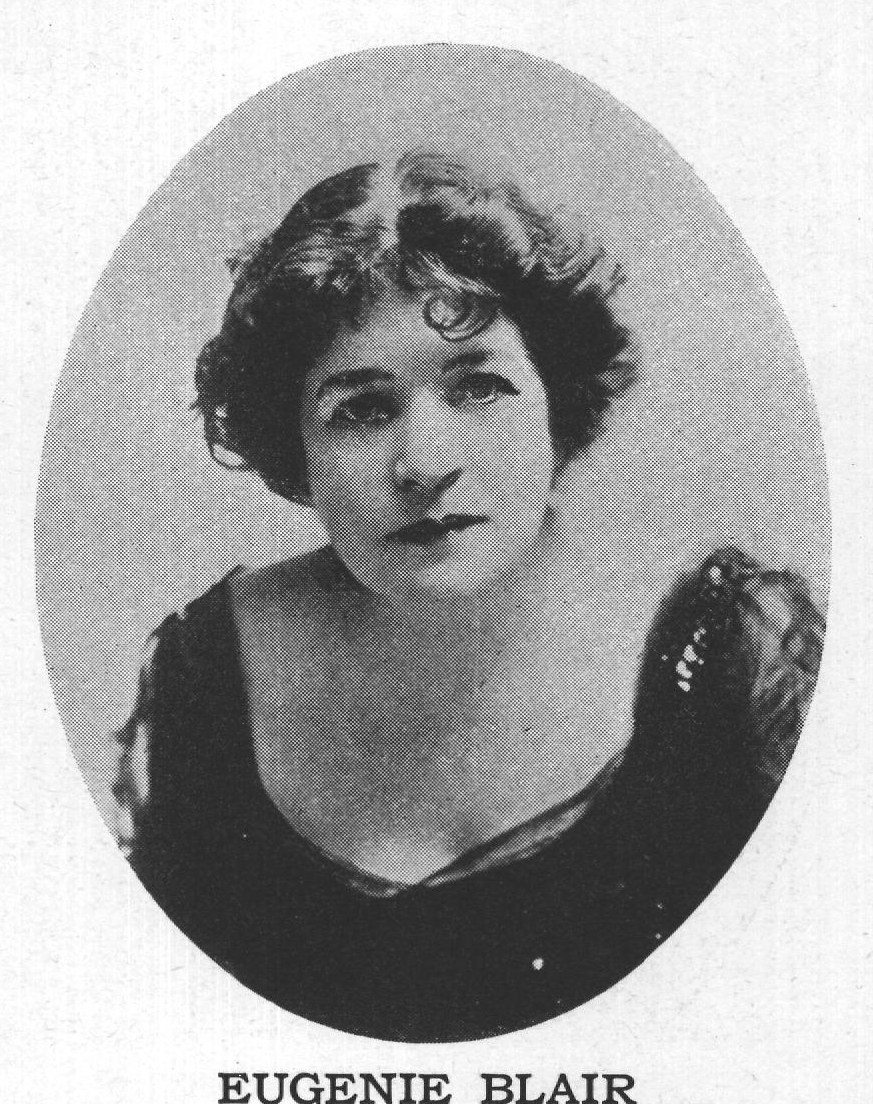
Eugenie Blair

GRILL-EUGENIE BLAIR
One large sweet potato cut in half, lengthwise. Take out enough of the potato to put in two large oysters (on one side), on the other side put three reed birds. Place two strips of bacon one on top of oysters and the other on top of the birds, season with salt and pepper, place the two halves together and bind with string. Place in oven and bake, when done serve with butter sauce.
Neque Blair
THE THREE HULSMANNS
BABY CONSTANCE says that since she is only allowed to eat one kind of salad, and as she "likes salad better than candy" here is the recipe:
Crisp lettuce leaves with slices of bananas and grated peanuts, covered with French dressing. "But," adds Constance, "I'd rather MAKE mud pies than salad-it's more fun."
SISTER HELEN likes
COCOANUT FRAPPE
French toast buttered and covered with vanilla ice cream, crushed strawberries and shredded cocoanut.
Their mother dotes on a
SPANISH CREAM
One package Knox gelatine dissolved in a quart of milk. Yolks of three eggs and a tablespoonful of sugar whipped together. Put these on fire and bring to boiling point, remove and add the whites of the eggs and three tablespoonfuls of sugar, whipped stiffly. Stir through the rest of the mixture, adding vanilla to flavor it. Pour into a wet jelly mold and when cold turn out and cover with whipped cream.
From the way this dessert disappears whenever I make it, it would seem to be a "favorite" with the rest of the family, despite their salads and fra ppés.
Eu Suleman Celebrity
BAKED SPANISH MACKEREL
1 medium-sized mackerel ½ teaspoonful minced green 2 cupfuls bread crumbs, mepepper dium stale 1/4 teaspoonful summer savory 1½ small onion, minced 3 slices bacon 1 tablespoonful bacon, minced 1/½ teaspoonful salt Few grains pepper Mix together the bread crumbs, onion, chopped bacon, pepper, and seasonings and lay on the fish, which should be dressed for broiling. Place a slice of bacon on this and fold over the fish so that the dressing shows. Place on a fish-rack in a baking pan, lay the remaining bacon on top of the fish, and bake thirty minutes in a moderate oven, basting frequently with the fat in the pan. Serve on a platter decorated with alternating rings of green pepper and sliced lemon.

This page carries several dishes from the Blair and Hulsmann households, and the headline one cannot be reproduced: reed birds are bobolinks, and killing or possessing them is now illegal. Notes on the rest of the page follow.
- Reed birds are protected"Reed bird" was the market name for the bobolink, netted by the thousands in Atlantic marshes in late summer when the birds fattened on wild rice and reed grass. They are protected under the Migratory Bird Treaty Act of 1918 and its counterparts in Canada and Mexico; taking, buying, selling or possessing them is a federal offence. There is no substitute that makes this grill the dish it was.
- The oysters, separatelyEven setting the birds aside, two large oysters buried in a sweet potato and baked until the potato is done will have cooked far past the point where oysters stay tender. Oysters need only brief heat and toughen quickly once past done.
- "Bind with string"The two potato halves are tied back together so the filling steams inside the shell. Butcher's twine, two or three turns crosswise; the string is removed before serving. No oven temperature is given, but a large sweet potato needs roughly an hour at 375-400F.
- Butter sauceIn American cookery of this period this means drawn butter -- melted butter thickened with a little flour and hot water or fish stock, seasoned with lemon -- not a modern beurre blanc.
- Spanish cream: the whites are not cookedThe custard base is brought to a boil, then stiffly beaten raw whites are folded through and the mould is chilled. Nothing after that stage reaches a safe temperature. Use pasteurised whites, or a current recipe that cooks them.
- A package of Knox gelatineA modern envelope is about a tablespoon, roughly 7 g, reckoned to set two cups firmly; period packages were not necessarily identical. Setting a full quart of milk with a single envelope gives a very soft, spoonable cream rather than a mould that stands up cleanly; two envelopes is closer to what "turn out" implies.
- Mackerel: some quantities still oddThe green pepper measure reads half a teaspoonful, as printed. "1½ small onion" and "1/½ teaspoonful salt" still look like fractions run together, and are probably half a small onion and half a teaspoon of salt. Two cups of stale crumbs is a great deal of stuffing for one medium fish; one cup is nearer the mark.
- Moderate oven350F. Thirty minutes suits a fish of two to three pounds split for broiling; check that the flesh flakes at the backbone rather than trusting the clock.
- Summer savoryStill sold dried, though less common than it was. It is peppery and slightly thyme-like; thyme with a pinch of marjoram is the usual stand-in.
Books of this kind -- recipes solicited from stage people -- were a small industry in the 1910s, and the appeal was the signature facsimile as much as the cooking. Eugenie Blair was a touring dramatic actress of the period, and her contribution is a Chesapeake and Philadelphia idea: reed birds, oysters and bacon were the autumn luxuries of the mid-Atlantic, and reed birds in particular were a September fixture on Baltimore and Philadelphia menus, sold by the dozen and usually spitted or wrapped in bacon because they were tiny and lean everywhere but the breast. The bobolink's collapse in the market-gunning era is sometimes mentioned in accounts of the campaign that produced the Migratory Bird Treaty Act, signed with Great Britain on behalf of Canada in 1916 and given effect by Congress in 1918. The Hulsmann children's contributions, meanwhile, catch a different moment: banana-and-peanut salad under French dressing, and ice cream on French toast, are pure early-century American fashion, when "salad" had drifted a long way from greens.