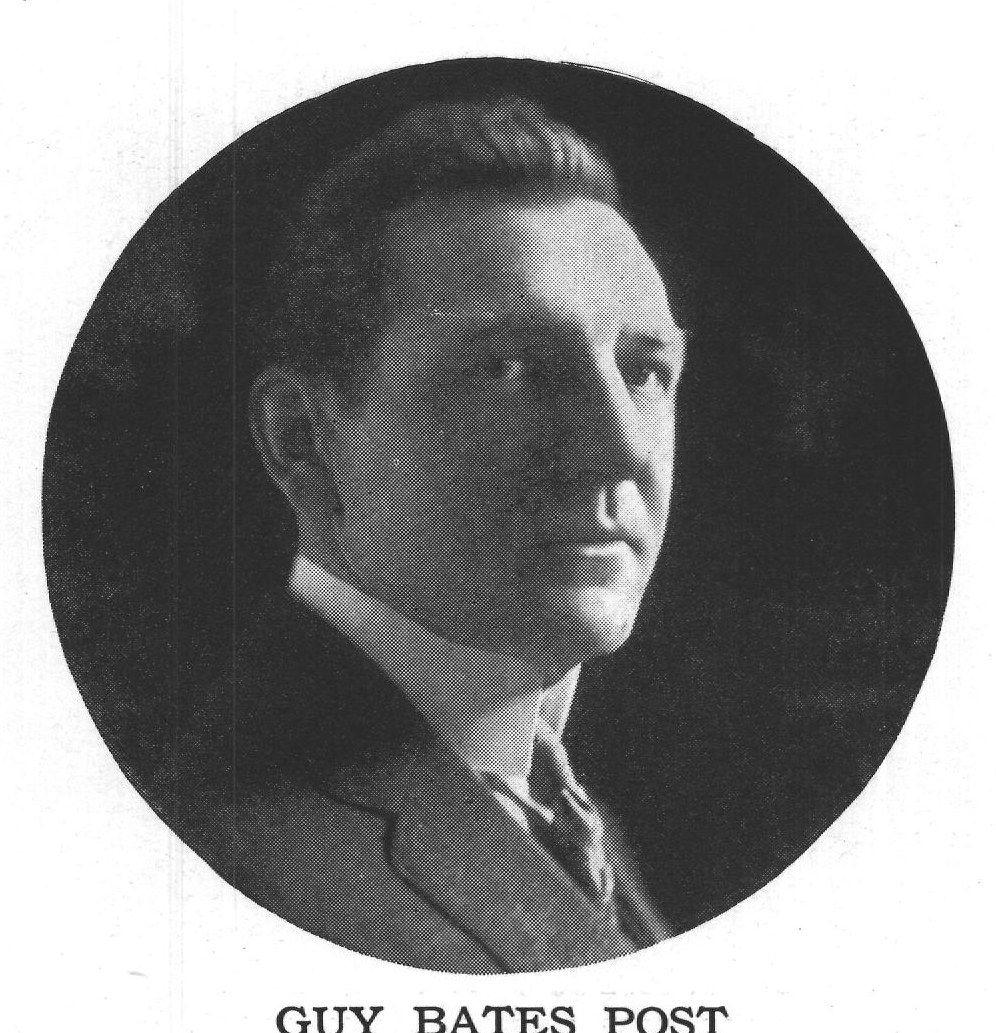
Guy Bates Post

BROILED STEAK WITH BLANKET OF CLAMS
NE steak, one and one-half inches thick.
Broil ten minutes, turning all the time under hot flame. Allow to finish under lower flame, six minutes. Place in metal platter. Cover with two and a half dozen little neck clams. Place in oven until clams are plumped. Spread with Maitre d'Hotel butter.
Garnish with shredded French fried potatoes.
Now you have what I think is pretty good to eat.
STUFFED SQUABS
EN CASSEROLE
Clean and dress 4 jumbo squabs 1 pint oysters (finely chopped) 1/2 loaf bread ½ teaspoon salt I ½ teaspoon pepper ½ teaspoon paprika 1 small onion (chopped)
Two dishes appear here: a complete steak recipe and the opening of a stuffed squab dish whose instructions were cut off in the original printing. Only the steak can be cooked from what is on the page.
- "NE steak"Almost certainly a typesetting casualty for "One steak" — a single steak an inch and a half thick. The page gives no weight, no cut and no number of servings.
- The broiler, not the grill"Under a hot flame" indicates an overhead gas broiler, an arrangement common in hotel and chophouse kitchens of the period. A modern broiler on high with the rack 3 to 4 inches from the element is the equivalent; a very hot cast-iron pan gets you a similar crust if your broiler is weak.
- "Turning all the time"Ten minutes of near-constant turning under fierce heat, then six minutes further from the flame, is a deliberate two-stage method: hard sear, then gentle finish. Sixteen minutes total on a 1 1/2-inch steak lands around medium. Judge by an instant-read thermometer rather than the clock — 130F at the center for medium-rare, and let it rest.
- The metal platterAn oval metal service platter, put straight under heat and brought to the table sizzling. Any broiler-safe metal dish or a small cast-iron pan does the job; glass in particular can crack under a broiler, and ceramic should be checked as broiler-safe.
- Two and a half dozen little-necksThirty clams in the shell, scrubbed. "Until clams are plumped" means until the shells gape and the meat firms — a few minutes in a hot oven; the recipe gives no temperature. Discard any that stay shut, and stop as soon as they open; clams held longer shrink and toughen.
- Maître d'hôtel butterSoftened butter beaten with chopped parsley, lemon juice, salt and pepper — no cooking involved. Make it ahead, roll it in paper and chill so it can be sliced onto the hot steak.
- Shredded French fried potatoesShoestrings, cut about 1/8 inch square, fried in deep fat until crisp. "French fried" in this period simply means deep-fried; the shredding is what makes them the garnish rather than the side.
- The squab recipe is incompleteThe page gives four jumbo squabs cleaned and dressed, a pint of finely chopped oysters, half a loaf of bread and seasonings, then breaks off before any method. There is no oven temperature, no cooking time and no liquid quantity, so it cannot be reconstructed from what survives. "En casserole" in this period usually implies cooking in a covered pot rather than a modern open baking dish, though the page itself says nothing either way.
Celebrity cookbooks of the 1920s and 1930s traded on the idea that a famous face had a favorite dish, and stage stars were frequent contributors. This steak is pure New York theater-district supper: a thick cut under a hotel broiler, maître d'hôtel butter, shoestring potatoes, and clams piled on top as a display of abundance rather than a considered pairing. Guy Bates Post (1875–1968) played The Masquerader for years on both sides of the Atlantic, and the flat closing line — "Now you have what I think is pretty good to eat" — reads like the sort of dictated aside these books seem to preserve, since the value of the page was the voice as much as the food. Little-neck clams are generally said to have been cheap and plentiful on the Atlantic coast then, which may be why thirty of them could be treated as a garnish.