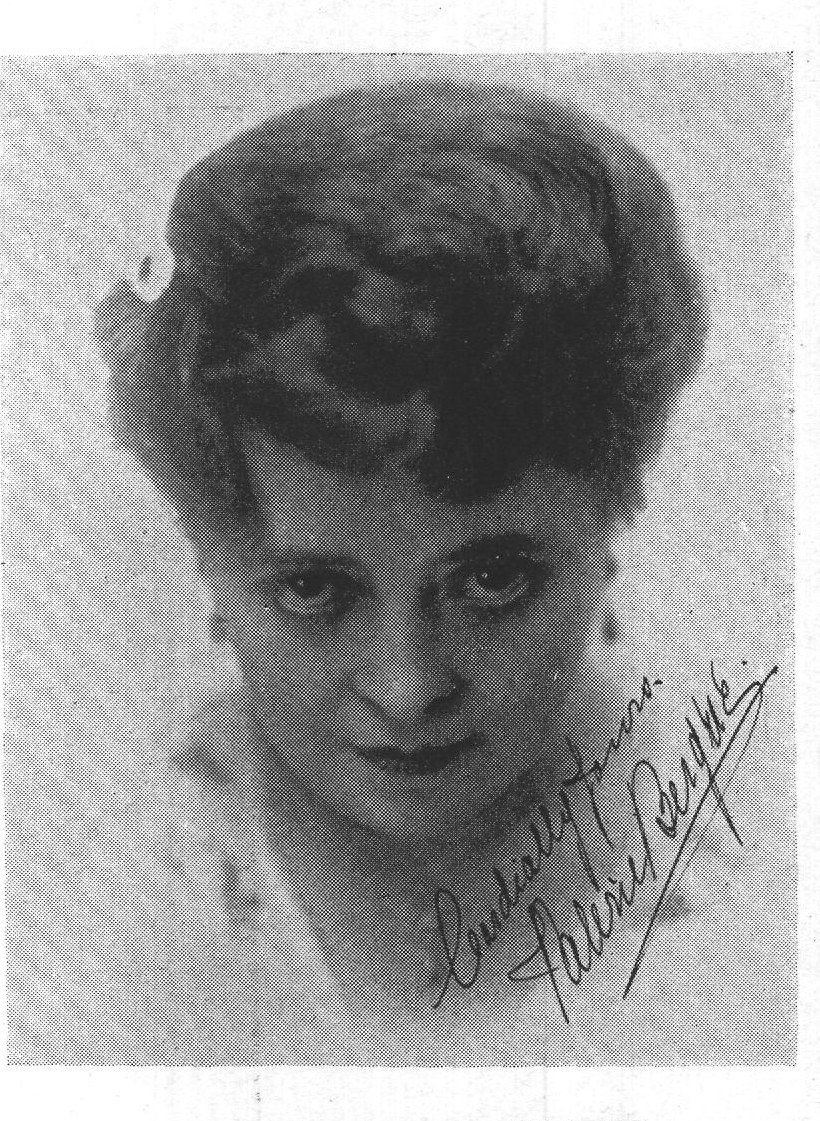
Valerie Bergere

Break walnuts fine and cut dates in fine pieces.
Add sugar and last of all, beaten whites of eggs.
Enough flour with the baking powder to make a pudding consistency. This is my favorite dessert. I hope you can make it out. Curdially to unw
AN UNUSUAL FISH DISH
N unusual dish is made from one cupful each of any cold flaked fish and rice.
These are put into a double boiler to get very hot. Then one tablespoonful of butter, one egg and seasoning of salt and pepper are added. Stir well until the whole is well blended, then serve.
Two fragments printed together: an autograph date-and-walnut pudding sent in by the actress, and an editorial filler recipe for hot fish and rice. Neither is complete by modern standards, and the pudding in particular is a sketch rather than a formula.
- The missing quantitiesThe pudding gives no amounts at all for dates, walnuts, sugar, eggs, flour or baking powder — Bergère knew it and clearly expected the reader to guess ("I hope you can make it out"). Any figures given elsewhere for this dish are reconstruction, not her recipe.
- What kind of pudding this isThe method — chopped dates and nuts, sugar, stiffly beaten whites, and just enough flour and baking powder to bind — is the standard early twentieth-century date-nut torte, a batter that is nearly all fruit and nut with flour as mortar. Comparable published versions of the period run to roughly a cup each of dates and walnuts, a cup of sugar, three or four egg whites, and only three or four tablespoons of flour with a teaspoon of baking powder.
- No baking instruction is given"Pudding consistency" and baking powder together imply a baked pudding, but the original never says to bake it, at what heat, or for how long. Published tortes of this type were generally baked in a moderate oven in a shallow pan; the recipe as printed leaves all of that to the cook.
- Beaten whites are the leaveningWith so little flour, the structure comes from the whites. Fold them in last, as directed, and stop as soon as no streaks remain — deflating them leaves a dense, sticky slab.
- Flour the fruit and nutsChopped dates clump badly. Tossing them with a spoonful of the measured flour before mixing keeps them dispersed rather than sinking into a layer.
- ServingMade to the reconstructed proportions above, a torte of this kind would serve six to eight, cut in squares. Desserts of the type were commonly served barely warm or cold with whipped cream.
- The fish dish, timingCold cooked fish is already cooked; the double boiler is there only to heat it through and set the egg. Once the egg is stirred in, a minute or two of gentle stirring is enough. Held longer, the fish shreds to paste and the egg curdles.
- What the fish dish actually isOne cup fish, one cup cooked rice, a tablespoon of butter and one egg makes about two servings — a Victorian and Edwardian way of using up the remains of a boiled cod or haddock, closer to a soft kedgeree than to a croquette mixture.
Valerie Bergère (1872–1938) was a French-born actress who built an American career in vaudeville playlets, most famously in Japanese-themed one-acts, and she was one of the many stage names solicited for Celebrated Actor Folks' Cookeries, a 1916 collection of recipes contributed in the performers' own hands. That origin explains the shape of the page: the charm of such books lay in the facsimile signature and the offhand note ("This is my favorite dessert. I hope you can make it out"), not in tested proportions, and the compilers padded thin contributions with anonymous fillers like the fish-and-rice dish that follows. The dessert itself belongs to a family of date-and-nut tortes that spread widely in American cookbooks in this period — a dessert that is mostly fruit and nut held together by a spoonful of flour, and a reminder of how much period recipes relied on a cook already knowing the type.