Hopping John (Uncle John's way)
"Uncle John," S. C.
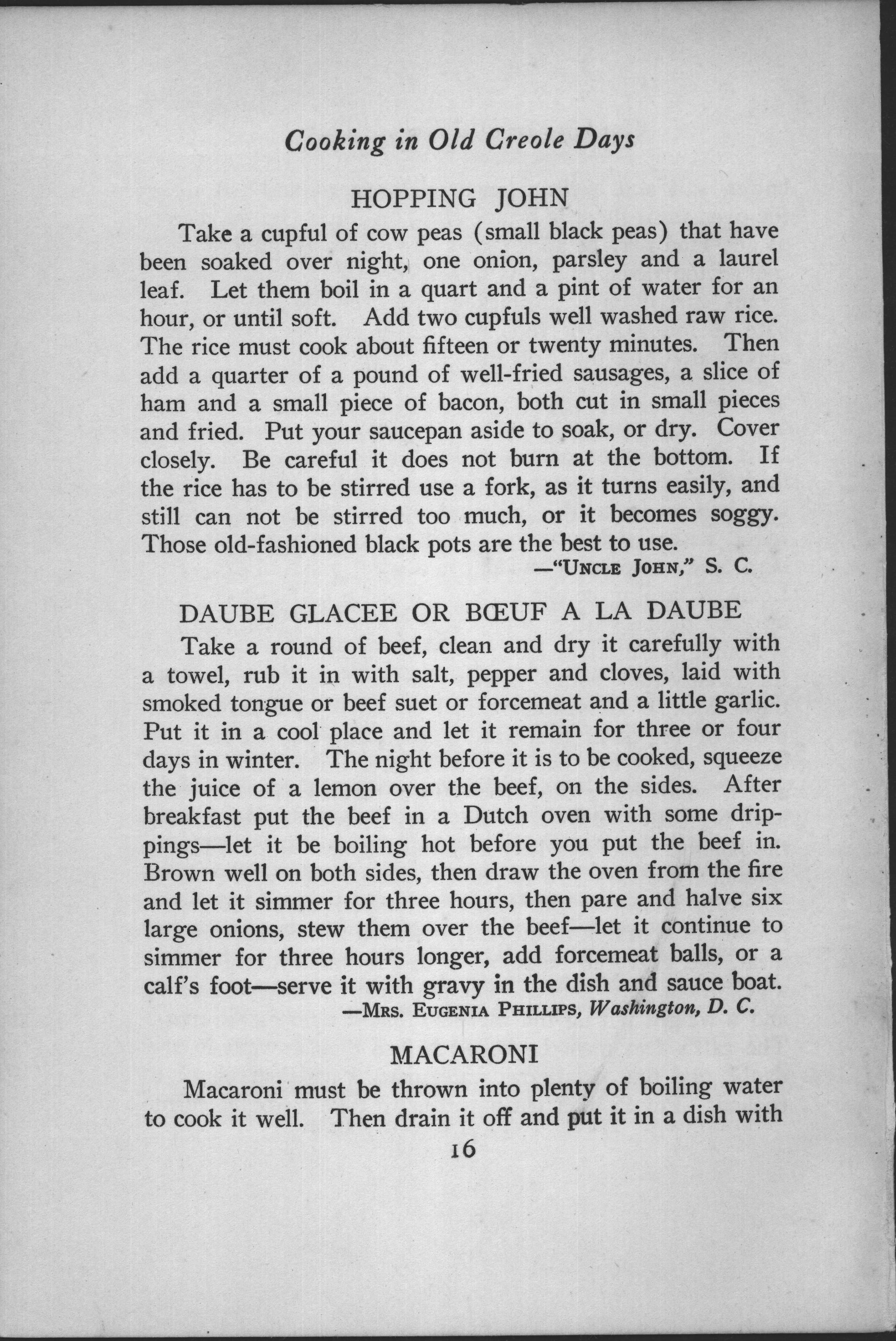
Take a cupful of cow peas (small black peas) that have been soaked over night, one onion, parsley and a laurel leaf. Let them boil in a quart and a pint of water for an hour, or until soft. Add two cupfuls well washed raw rice. The rice must cook about fifteen or twenty minutes. Then add a quarter of a pound of well-fried sausages, a slice of ham and a small piece of bacon, both cut in small pieces and fried. Put your saucepan aside to soak, or dry. Cover closely. Be careful it does not burn at the bottom. If the rice has to be stirred use a fork, as it turns easily, and still can not be stirred too much, or it becomes soggy. Those old-fashioned black pots are the best to use.
A heartier, aromatic Hopping John — peas simmered with onion, parsley, and bay, then rice and three kinds of fried pork folded in.
- “Cow peas (small black peas)”Dried field peas — here a small black-seeded cowpea. Soaking overnight, as directed, is what lets them cook tender in about an hour.
- “Laurel leaf”A bay leaf — laurel is its older name. It perfumes the pot with the onion and parsley; fish it out before serving.
- “Quart and a pint of water”6 cups (4 + 2) — enough to cook the peas and then the rice that goes in after.
- The ratio and the pork1 cup peas to 2 cups rice, enriched with fried sausage, ham, and bacon — fry them first, then fold in.
- “Old-fashioned black pots”A heavy cast-iron pot or Dutch oven; it holds gentle, even heat so the rice steams dry without scorching. Stir with a fork, not a spoon.
The little pea at the heart of Hopping John is the cowpea (Vigna unguiculata), and it is African through and through — domesticated on that continent thousands of years ago and carried to the Americas on slave ships, where it took root across the South. The black-eyed pea is its most famous cultivar, but there are dozens, including the small dark “black peas” called for here. “Uncle John’s” version, scented with bay, onion, and parsley and loaded with pork, shows how a humble dish of rice and field peas became a cornerstone of Lowcountry and Creole cooking.
From page 16 of the 1904 edition.
Original page from the book