Cereals
General Instructions ATMEAL and cereals of all kinds are best cooked by the fireless method. A much enjoyed feature of the Fireless Cookstove is the "over-night" cooking. Cereals and food placed in the cooker at night "cook while you sleep" and are ready to be eaten at breakfast. All the health-giving substance, all the delightful flavor, is there waiting for a hungry breakfast appetite. Should the cooked cereal not be warm enough to serve, a few minutes over the flame of any stove will give it the temperature desired.
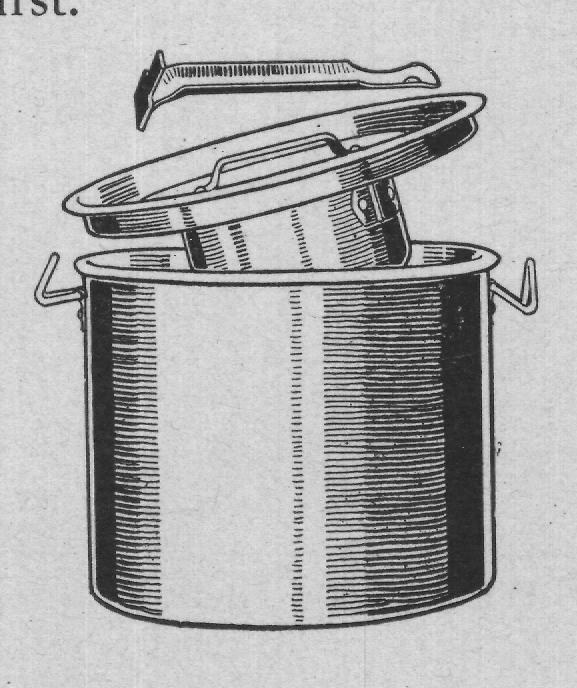
The double-boiler method is the most satisfactory way of cooking cereals in the fireless. Place one of the triplicate pails or special cereal cooker in 8-qt. pail attached to the cover provided with cooker with clamps on same. When cooked in this way boiling water is added to cereal and also water is boiling in 8-qt. kettle (about half full), but it is not necessary to cook cereal on stove. Use one radiator heated 475-500 degrees for all cereals. Oat Meal 1 cup oatmeal 1 teaspoon salt 2½ cups boiling water Place oatmeal in triplicate pail (or special cereal cooker) with boiling water and salt. Fill 8-qt. pail half full of boiling water. Fasten pail with oatmeal on cover of 8-qt. and immerse in boiling water over night.
Cracked Wheat or Oats 1 cup cracked wheat 1 teaspoon salt 4 cups water Soak cracked wheat in 2 cups of water for 2 hours. Heat remaining water to boiling point, add salt and cracked wheat and water in which it has been soaked. Cook in fireless over night. Use one radiator.
Corn Meal Mush 1 cup cornmeal 1 teaspoon salt 3½ cups water Slowly stir the meal into the boiling salted water, being careful not to lump. Cook in fireless 8 to 10 hours or over night. Use one radiator.
Graham Mush 1 cup graham flour 1 teaspoon salt 3 cups water Stir flour slowly into boiling water, being careful not to allow it to lump.
Cook in fireless over night. Use one radiator.
Barley Mush 1 cup barley meal 5 cups water 2 teaspoons salt Stir meal slowly into boiling salted water, being careful not to let it lump. Cook in fireless over night.
Use one radiator.
Postum Cereal Put the Postum in a cheese-cloth bag. For every pint of water use 4 not heat rice first. heaping teaspoons of Postum. Place in utensil and pour over it boiling water. In the morning strain and heat to boiling point. No radiator used.
Barley Water Clean 1/4 cup of barley and add 1 quart of water, and soak over night.
Boil gently for five minutes in same water in which it was soaked. Place in fireless four hours. Strain, season with salt, sugar and lemon juice. It may be served either hot or cold.
Use one radiator.
Cream of Wheat 1 cup Cream of Wheat 2½ cups boiling water 1 teaspoon salt Should remain in fireless 3 hours, or more if desired. Use one radiator.
Boiled Rice 1 cup rice 1 teaspoon salt 1½ cups cold water Wash and clean rice. Add cold water and salt. Heat one radiator 450 degrees and place rice on radiator in fireless for one hour or longer. Do Equipment for Cooking Cereals This is the double boiler inset referred to on page 13. The lower section is the 8-quart utensil. The inside part is the double boiler. Manufactured exclusively for Toledo Fireless Cookstoves.
F
These are instructions for a specific piece of vanished equipment: an insulated wooden or metal chest in which pre-heated soapstone or iron discs, called radiators, sat under nested pails. Nothing here is cooked over a flame for more than a moment, so the translation to a modern kitchen is mostly a translation of the vessel.
- What a radiator wasThe "radiator" is a soapstone or cast-iron disc heated on the range to the stated temperature (475-500F, or 450F for rice) and then dropped into the bottom of the insulated well. It is the only heat source; the box merely keeps it from escaping. There is no modern appliance that behaves quite the same way, since a slow cooker adds heat continuously rather than losing it slowly.
- The double-boiler insetThe "triplicate pail" or "special cereal cooker" is an inner pail that clamps to the lid of the 8-quart outer pail, which is filled half full of boiling water. The grain never touches the hot metal directly, which is why it does not scorch over eight hours. A wide-mouth vacuum flask reproduces the same principle at breakfast scale.
- What "oatmeal" meantOatmeal at this date may well mean steel-cut or coarse-cut oats rather than rolled, which would suit a whole night in the cooker; rolled oats were also widely sold by then, and the 2½ cups of water per cup of grain would suit them. Quick oats given the same ratio and the same time will collapse into paste.
- Graham flour and barley mealGraham flour is coarse whole wheat flour; ordinary stone-ground whole wheat is the nearest substitute. Barley meal is coarsely ground hulled barley, sold today mainly in health-food shops and sometimes labelled barley grits.
- PostumPostum is a caffeine-free beverage of roasted wheat bran and molasses, sold as a coffee substitute since the 1890s. It has gone in and out of production and is not a cereal to eat; four heaping teaspoons steeped in a cloth bag per pint of water makes a drink, which is why no radiator is called for.
- Barley waterStrained barley water was a sickroom and nursery drink, not a breakfast. A quarter cup of barley to a quart of water gives a thin, faintly starchy liquid; the salt, sugar and lemon are doing most of the work on the palate.
- Rice, and the warning at the topThe fragment "Do not heat rice first" is the hinge of the rice recipe. Rice goes into the cooker with cold water and 1.5 cups per cup of grain, so the grain absorbs slowly as the radiator gives up its heat. Pre-boiling it, or starting it with boiling water as the other cereals do, would presumably give a softer, mushier result, which appears to be what the instruction is guarding against.
- Overnight holding and safetyCooked grains, and rice in particular, are a known medium for Bacillus cereus, whose spores survive cooking and whose toxin survives reheating. A fireless cooker spends most of the night drifting down through warm temperatures, which is the condition the organism likes. Cook cereals the morning of, or refrigerate promptly and reheat, rather than holding cooked grain warm for eight hours.
- YieldOne cup of dry cereal as given here makes roughly three modest breakfast servings. Cornmeal mush sets firm as it cools and was often sliced and fried the next day.
Fireless cookstoves were sold in the United States from roughly 1900 into the 1920s by firms such as the Toledo Cooker Company, whose double-boiler inset is advertised at the foot of this page. The principle is retained heat: soapstone discs were brought to temperature on a range or over a gas ring, then sealed into a thickly insulated box with the food, where the residual heat finished the cooking over hours. The appeal was economy of fuel in an age of coal ranges, and freedom from tending a fire in hot weather. Breakfast cereals were the showpiece application, and not by accident: coarse-cut oats, cracked wheat, graham and barley meal all want long, low, moist cooking, and the American breakfast table of this period was widely held to have been shaped by the health-reform movement and the young cereal industry that grew out of it in Battle Creek. Postum, appearing here among the grains, belongs to the same current, having been introduced in the 1890s as a grain-based alternative to coffee.