COD
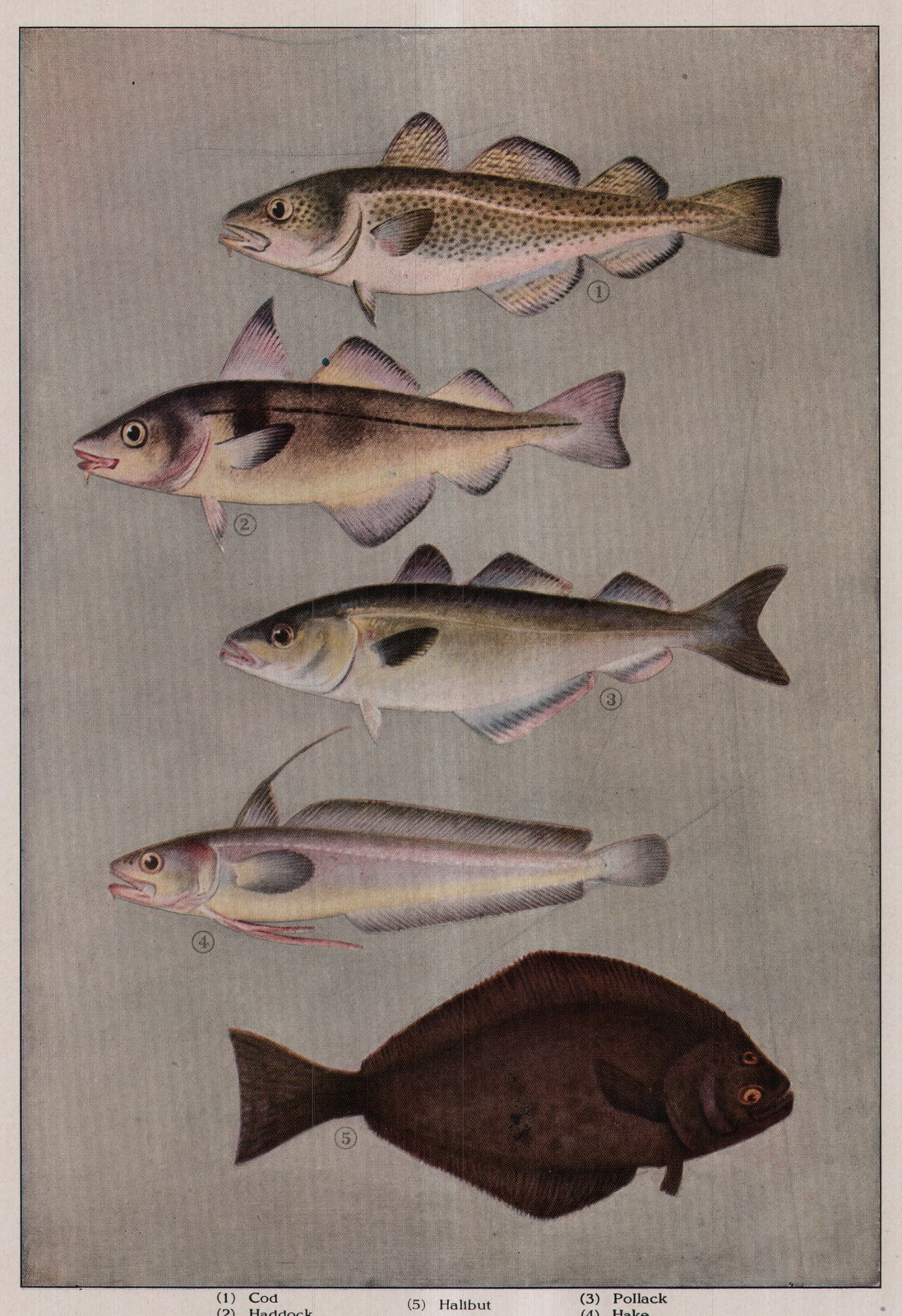
one of the most abundant of food fishes, found in all northern temperate seas and taken in large quantities by both nets and lines along the North Atlantic and Arctic coasts of both America and Europe. It ranges in size up to a hundred pounds, the average market weight though being less than ten pounds. It is a very voracious fish, all the small ocean inhabitants serving it for food, and extraordinary prolific, the roe often containing from two to eight million eggs and sometimes constituting a full half of the weight of the female. See Color page facing page 250.
Cod is marketed in various forms, fresh, salted and dried, in the latter state being generally sold by the quintal (112 pounds). In addition to the large consumption in North America, great quantities of the dried fish are carried from Newfoundland to the West Indies, South America and Europe, especially to the Catholic countries of the latter continent.
Fresh cod is at its best during the winter months. The head and shoulders, the choicest portions, are preferably boiled, the remainder being usually sliced for frying, etc.
In Norway, cows are frequently fed on cod heads and seaweed in order to increase their supply of milk. In Iceland, the waste parts, bones, etc., are utilized as cattle food.
Salt Cod of all kinds is, when possible, cured immediately after catching. The fish are first split from head to tail and next thoroughly cleaned of all traces of blood by repeated washings in salt water. Part of the backbone is next cut out and the fish, after being drained as nearly dry as practicable, are then placed in vats or similar receptacles and covered with salt, remaining thus until sufficiently cured.
When the curing process has been completed, they are taken out of the vats, washed and brushed to remove superfluous salt and placed to dry in the sun, spread out on wooden racks, on the beach or elsewhere. They are considered fit for market when they show "bloom"-a whitish appearance on the surface. They are sold in many forms, popular types being Boneless Cod and Flaked Cod, put up in small boxes; Shredded Cod, in papers and cans, etc.
Dunfish is one of several names for dried cod. The title is traced to two different sources-(1) as applied to the fish dried on open "downs" or "hills," from the Gaelic "Duin," a hill; (2) as descriptive of the color of cod cured by being salted and piled below salt grass in a dark room for several months, being turned once or more during that time.
Rock-Cod, or Klipp-fish, is applied to the fish dried on the rocks.
"Scrod" is a term which was originally applied to any fish, particularly cod, "scrodded" or "shredded," but it now generally signifies a young cod split and slightly salted.
Cod Sounds, or Swim-bladders, and Cod tongues are popular delicacies, both separately and mixed. They are eaten fresh, being then in season from October to May, and salted or pickled. The dried Sounds also furnish an isinglass very little inferior to that from the Sturgeon.
Code Roe is a favorite table delicacy and is also important commercially as a bait for fish, large quantities being used in the French sardine fisheries.