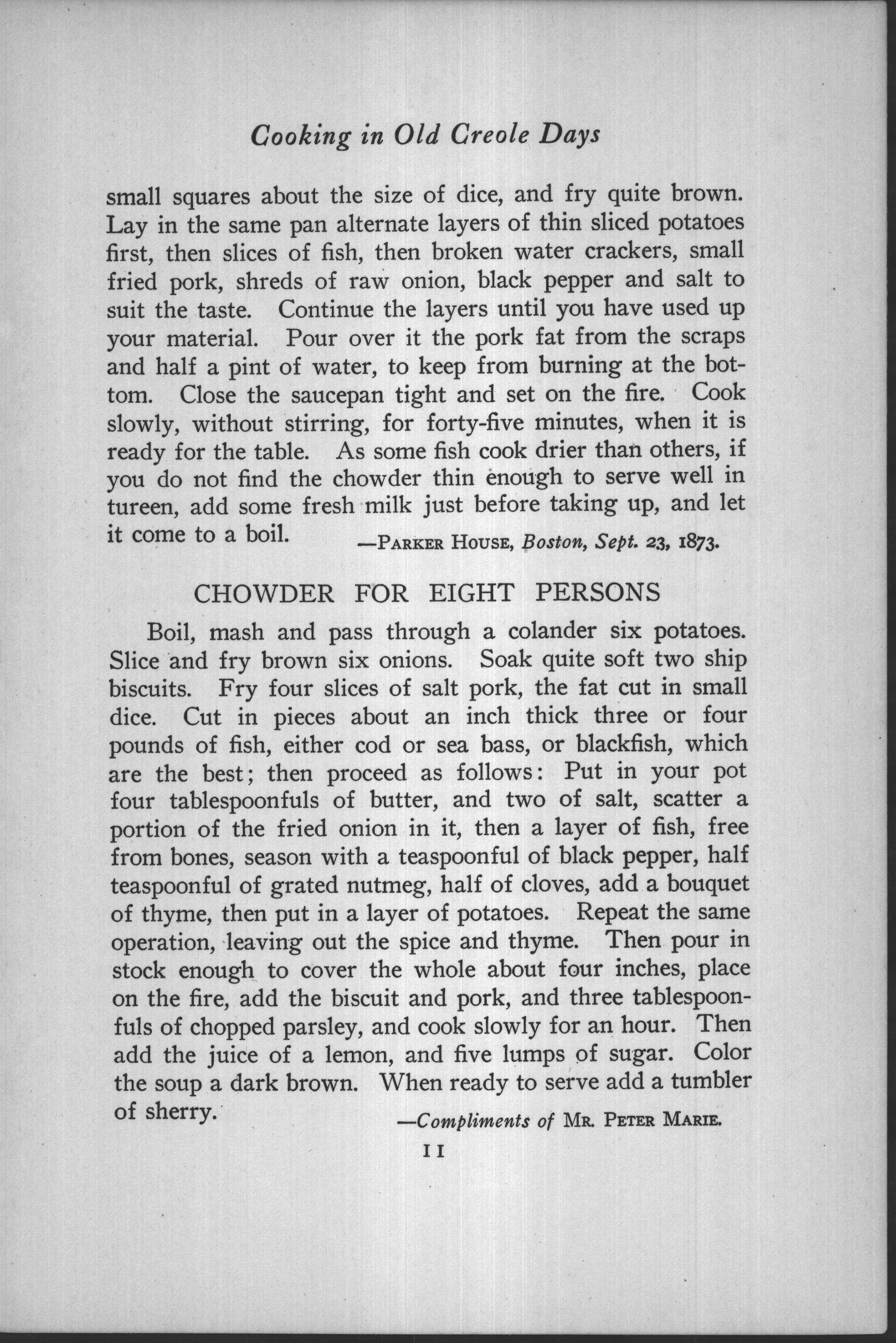
Chowder for Eight Persons
Compliments of Mr. Peter Marie
Boil, mash and pass through a colander six potatoes. Slice and fry brown six onions. Soak quite soft two ship biscuits. Fry four slices of salt pork, the fat cut in small dice. Cut in pieces about an inch thick three or four pounds of fish, either cod or sea bass, or blackfish, which are the best; then proceed as follows: Put in your pot four tablespoonfuls of butter, and two of salt, scatter a portion of the fried onion in it, then a layer of fish, free from bones, season with a teaspoonful of black pepper, half teaspoonful of grated nutmeg, half of cloves, add a bouquet of thyme, then put in a layer of potatoes. Repeat the same operation, leaving out the spice and thyme. Then pour in stock enough to cover the whole about four inches, place on the fire, add the biscuit and pork, and three tablespoonfuls of chopped parsley, and cook slowly for an hour. Then add the juice of a lemon, and five lumps of sugar. Color the soup a dark brown. When ready to serve add a tumbler of sherry.
A second, party-sized chowder — helpfully scaled “for eight persons” — with a puréed-potato base that makes it especially smooth.
- Choose a firm fishCod, sea bass, or blackfish (tautog) are recommended; any firm white fish works. Figure 3–4 lb for eight.
- “Ship biscuits”Hardtack — the durable sailor’s cracker — soaked soft and stirred in to thicken. Substitute common crackers or saltines soaked in a little milk.
- The smooth baseBoiling, mashing, and sieving the potatoes (rather than just slicing them) gives this chowder a creamier body than the layered New England style.
- Salt pork and onionsRendered pork and browned onions build the savory foundation; layer everything and simmer gently.
Two chowders in a row — and a thoughtful note that this one serves eight — hint at chowder’s role as convivial, crowd-feeding food. The recurring “ship biscuit” is a reminder of the dish’s seafaring roots: chowder began as a way for fishermen and sailors to turn the catch, salt pork, and hard biscuit into a hot one-pot meal, the word itself likely from the French chaudière, the cauldron it was cooked in.
From page 11 of the 1904 edition.
Original page from the book