Eels, Stewed
INGREDIENTS for dish for 6 persons.-2 lbs. of middling-sized eels, 1 pint of medium stock, 1/4 pint of port EELS À LA TARTARE. wine; salt, cayenne and mace to taste: 1 teaspoonful of anchovy sauce, the juice of a lemon. AVERAGE COST, 2s. 6d.
Skin, wash and clean the eels thoroughly; cut them into pieces 3 inches long, and put them into strong salt-and-water for 1 hour; dry them well with a cloth, and fry them brown. Put the stock on, with the heads and tails of the eels, and simmer for 1/2 hour strain it, and add all the other ingredients. Put in the eels, and stew gently for 1/2 hour, when serve.
TIME.-2 hours.
SEASONABLE from June to March.
Eels à la Tartare. - INGREDIENTS for dish for 6 persons.-2 lbs. of eels, 1 carrot, 1 onion, a little flour, 1 glass of sherry; salt, pepper and nutmeg to taste; bread-crumbs, 1 egg, 2 tablespoonfuls of vinegar. AVERAGE COST, exclusive of the sauce, 2s. 3d.
Rub the butter on the bottom of the stewpan; cut up the carrot and onion, and stir them over the fire for 5 minutes; dredge in a little flour, add the wine and seasoning, and boil for an hour. Skin and wash the eels, cut them into pieces, put them to the other ingredients, and simmer till tender. When they are done, take them out, let them get cold, cover them with egg and bread-crumbs, and fry them a nice brown. Put them on a dish, pour sauce piquante over, and serve them hot.
TIME.-1 hour.
SEASONABLE from August to March.
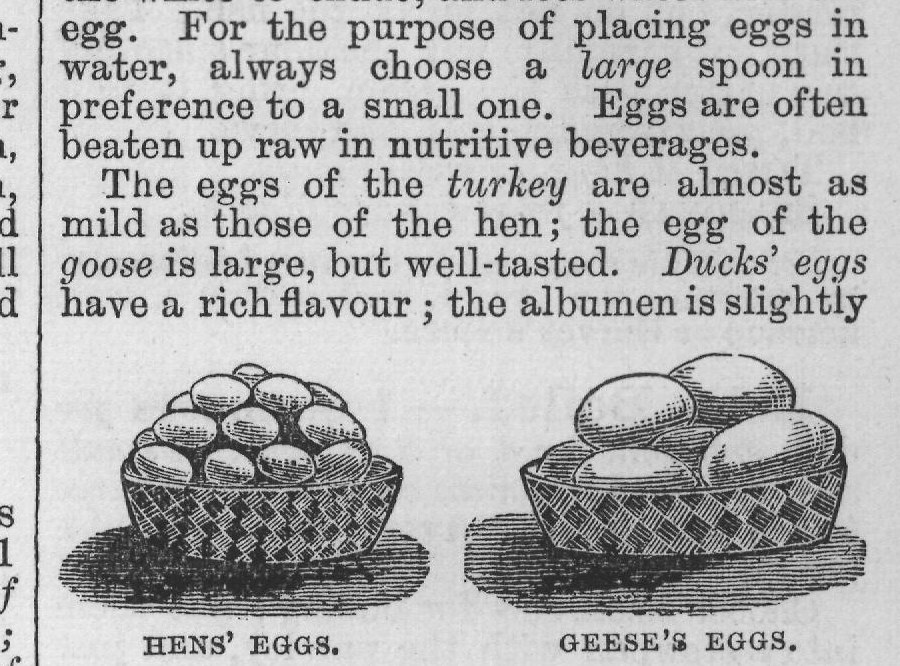
Eggs. There is only one opinion as to the nutritive properties of eggs, although the qualities of those belonging to different birds vary somewhat. Those of the common hen are most esteemed as delicate food, particularly when "new-laid." The quality of eggs depends much upon the food given to the hen. Eggs in general are considered most easily digestible when little subjected to the art of cookery. The lightest way of dressing them is by poaching, which is is effected by putting them for a minute or two into brisk boiling water: this coagulates the external white, without doing the inner part too much. Eggs are much better when new-laid than a day or two afterwards. The usual time allotted for boiling hens' eggs in the shell is 3 to 3 minutes: less time than that in boiling water will not be sufficient to solidify the white, and more will make the yolk hard and less digestible; it is very difficult to guess accurately as to the time. Great care should be employed in putting them EGG BALLS. into the water, to prevent cracking the shell, which inevitably causes a portion of the white to exude, and lets water into the egg. For the purpose of placing eggs in water, always choose a large spoon in preference to a small one. Eggs are often beaten up raw in nutritive beverages.
The eggs of the turkey are almost as mild as those of the hen; the egg of the goose is large, but well-tasted. Ducks' eggs have a rich flavour; the albumen is slightly HENS' EGGS.
GEESE'S EGGS. transparent, or bluish, when set, or coagulated by boiling, which requires less time than hens' eggs. Guinea-fowl eggs are smaller and more delicate than those of the hen. Eggs of wild fowl are generally coloured, often spotted; and the taste generally partakes somewhat of the bird they belong to. Those of land birds that are eaten, as the plover, almost invariably boiled a long time and eaten cold, lapwing, ruff, &c., are in general much esteemed; but those of sea-fowl have, more or less, a strong fishy taste. The eggs of the turtle are very numerous: they consist of yolk only, without shell, and are delicious.
When fresh eggs are dropped into a vessel full of boiling water, they crack, because the eggs being well filled, the DUCKS' EGGS.
TURKEYS' EGGS. shells give way to the efforts of the interior fluids, dilated by heat. If the volume of hot water be small, the shells do not crack, because its temperature is reduced by the eggs before the interior dilatation can take place. Stale eggs, again, do not crack, because the air inside is easily compressed.
Two eel dishes run together here, both built on the same principle: firm the flesh in brine, cook it twice. The stewed version is the more straightforward of the pair.
- Buying eelEel is sold skinned and cut, fresh or frozen, at fishmongers and Asian markets; European eel is now a protected species subject to trade restrictions, so ask about the source and expect farmed Japanese or American eel instead. Have the fishmonger skin and gut it — it is unpleasant work at home.
- Never eat it raw or underdoneFresh eel blood contains a protein toxin that irritates the gut and eyes; it is destroyed by heat, which is why every traditional eel recipe cooks the fish thoroughly. Both dishes here do so, and the flesh should reach at least 63C/145F.
- The salt-and-water hourAn hour in strong brine is not seasoning but texture: eel is soft and gelatinous, and the salt firms the flesh so the pieces hold together through frying and stewing. Do not skip it, and do dry the pieces hard before they meet the fat or they will not brown.
- Medium stockIn Beeton's system this is a stock made from beef and veal with vegetables, roughly what a modern cook would call a light beef or veal stock. Unsalted commercial beef stock works; the eel heads and tails simmered in it for half an hour are what give it the necessary body.
- Butter and flourThe ingredient list for the stew has lost the quantities. For 1 pint of stock, about 1 oz each of butter and flour, cooked to a pale roux, gives the consistency the method implies.
- Port and anchovyA quarter of an imperial pint is about 5 fl oz, roughly 150 ml, of port. The teaspoon of anchovy sauce is the period's all-purpose savoury note — anchovy paste or a mashed salted anchovy stands in, and Worcestershire sauce is a reasonable substitute.
- MaceBlade mace, the lacy covering of the nutmeg, was common in Victorian fish cookery. Ground mace works; use a scant quarter teaspoon so it does not dominate the port.
- TimingsHalf an hour of gentle stewing after frying is generous for pieces three inches long, and the flesh will begin to fall from the bone toward the end. Twenty minutes at a bare simmer is usually enough; the total "2 hours" includes the brining.
- Sauce piquante for the à la TartareThe second dish sends the fried pieces to table under a sauce piquante — a reduction of vinegar, shallot and stock finished with gherkins and herbs — which is why the cost is quoted "exclusive of the sauce." The two tablespoons of vinegar in its list are never used in the method, so they most likely belong to that sauce rather than the braise.
- YieldTwo pounds of eel serves six as a course in a longer Victorian meal. As a main dish with potatoes it will feed three or four.
Eel was cheap, abundant and unfashionable in Beeton's London: the Thames and the Essex marshes supplied it, Dutch eel schuyts moored at Billingsgate to sell live fish from wells in their hulls, and stewed eel with parsley liquor was the food of eel-and-pie shops in the East End. What distinguishes this stew from that street version is the money spent on it — port wine, a made stock, anchovy and mace turn a poor man's fish into something for a dinner table, which is exactly the sort of translation Beeton's book performed over and over for its middle-class readers. The à la Tartare treatment here, egg-and-crumbing already-cooked fish and refrying it, follows a French practice for cold cooked meat and fish. The seasonal notes are worth reading: the stew is marked seasonable from June to March and the second dish from August to March, so both avoid the spring months, when the flesh was reckoned poor.