Hare, Trussing of
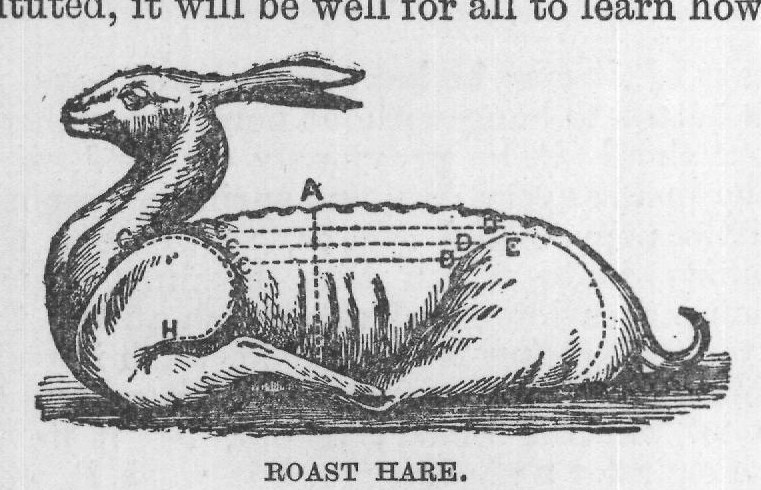
To skin a hare, first cut off the fore feet at the first joint, and the belly open lengthwise. Raise the skin of the back, and draw it over the hind legs, being careful to leave the tail whole; then draw it over the back (see illustration), and slip out the fore legs, easing it, if necessary, with a knife over the neck and head, to assist at the carving of this dish, which, if not the most elegant in appearance, is a very general favourite. The hare, having its head to the left, as shown in the woodcut, should be first served by cutting slices from each side of the backbone, in the direction of the lines from C to D. After these prime parts are disposed of, the leg should next be disengaged by cutting round the line | being careful not to injure the ears, as in HARE, TRUSSING OF.
HARICOT BEANS. a roast haro they should be intact. It is better, where a hook is obtainable, to hang sinews of the legs, and after bringing them well forward against the body, run in two skewers, right through, one fixing the fore, m SKEWERING OF LEGS. the other the hind legs; next put the head well back, and passing a skewer through HARE BEING SKINNED. the hare upon one, thus leaving both hands free for skinning it.
Having cut open the hare, in the way PAUNCHING OF HARE. shown in illustration, and paunching it, wash and wipe it inside, then cut the SKEWERING OF HEAD. the right shoulder (see illustration), skewer it firmly in place. Put the ears in buttered papers before roasting. - IN- Haricot Beans, To Boil.
GREDIENTS for dish for 4 or 5 persons.-1 quart of beans, 2 quarts of soft water, 1 oz. of butter, 1 tablespoonful of salt. AVERAGE COST, 5d.
Put the beans in cold water and, according to their age, let them soak from 2 to 4 hours. The older they are the longer time they require. Put them into fresh water (2 quarts of soft) with the salt, bring to the boil, then let them simmer very gently until tender; pour off the water, but leave the pan with the lid partially off by the side of the fire for the beans to dry. Put in the butter and the seasoning of pepper and salt, and shake the pan for a moment or two while the butter melts; then serve very hot.
TIME.-2 to 2 hours after the water boils.
SEASONABLE in winter.
HARICOT BEANS.
Haricot Beans and Tomatoes. -INGREDIENTS for small dish. -Baked or boiled haricot beans, about 1½ pint, 1/24 pint of the water in which they were cooked, 2 tablespoonfuls of tomato sauce, 1 oz. of flour, 1/2 oz. of butter. AVERAGE COST, 6d.
Having boiled the beans till quite tender, strain off the liquor, and to pint of it add the thickening of flour and butter, then the sauce, and let it boil. Put in the beans and serve hot. Haricot beans are also good served with fried onions, and when other vegetables are scarce they are useful and very nice when well and thoroughly cooked.
TIME.-2 to 24 hours to boil the beans.
SEASONABLE at any time.
Herb Powder (for Flavouring when
Two quite different jobs sit on this page: dressing and trussing a hare for roasting, and boiling dried haricot beans. Both assume knowledge a Victorian kitchen took for granted.
- Buying the hareButchers rarely sell a hare in its skin now, and in Britain wild hare is generally sold oven-ready or at least paunched. If you do buy one whole, hanging it from a hook, as the text advises, genuinely does free both hands and is worth the trouble.
- PaunchingPaunching means removing the entrails through a lengthwise cut in the belly. The blood collected in the body cavity was traditionally saved for the gravy; if you are not using it, wipe the cavity dry with cloth rather than washing and soaking, which waterlogs the meat.
- SkewersTwo long metal trussing skewers, one through the forelegs and one through the hind, plus a third through the shoulder to hold the head back. Butcher's string tied around the skewer ends stops them working loose in the oven. Wooden skewers will scorch.
- Buttered papers on the earsThe ears were left on for presentation and burn quickly under high heat. Buttered greaseproof paper or foil over them is the simplest way to keep them intact. The tail is likewise kept whole when skinning.
- CarvingThe prime meat is the long fillets either side of the backbone, taken off in slices before the legs are disengaged. Hare is lean and dark; it wants to be carved hot and served on hot plates or the fat sets.
- A quart of beansA quart of dried haricots is roughly 2 lb and will swell to feed considerably more than four or five people by modern appetites. Half that quantity is a more realistic dinner for four.
- Soft waterHard water slows softening. If your tap water is very hard, a pinch of bicarbonate of soda in the soaking water helps, though too much turns the beans to mush and dulls the flavour.
- Salt and cooking timeWell-soaked modern dried beans will often be tender in 1 to 1½ hours rather than the two-plus hours given. Salting from the start, as here, is no longer thought to toughen the skins; taste for tenderness rather than watching the clock.
- The tomato dishThe thickening is flour and butter (twice as much flour as butter here) let down with bean cooking liquor, then tomato sauce stirred in. Bean liquor is starchy and already salted, so keep some back whatever recipe you finish the beans with.
Mrs Beeton's readers treated hare as ordinary winter game rather than a luxury: it was cheap, plentiful and, until the Ground Game Act of 1880, tightly bound up with poaching law and landowners' shooting rights. The elaborate trussing described here, with the head held back and the ears preserved in paper, belongs to a service style in which the whole animal came to the table recognisable and the master of the house carved it. Haricot beans sit on the same page only by alphabetical accident, but they tell their own story: dried pulses were the reliable winter vegetable in a country with no refrigeration and little imported produce, and the note that they are 'useful and very nice when other vegetables are scarce' is a plain statement of the Victorian February larder.