Partridges, Stewed
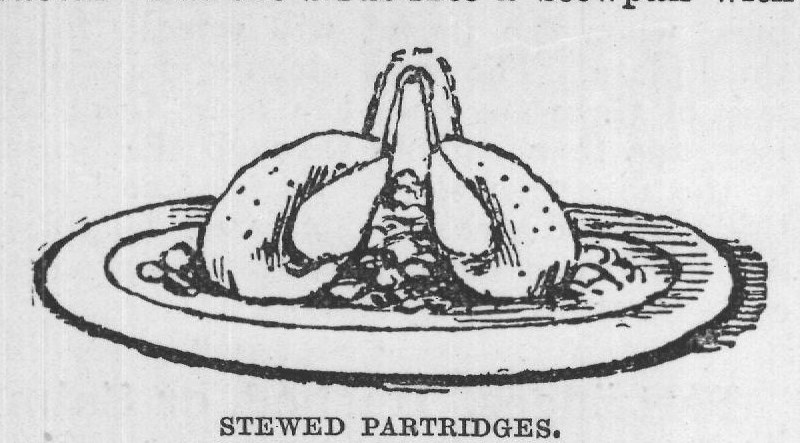
INGREDIENTS for dish for 4 persons.-2 partridges, 1 lemon, a little fat bacon, 2 onions, 2 carrots, sliced, 1 onion stuck with 2 or 3 cloves, a little thyme, parsley, 2 bay-leaves, a glass of white wine, 1/2 pint of stock, butter, salt and pepper. AVERAGE COST, 4s.
Truss the birds with a small lump of butter inside, skewering the skin of the neck over it; place two slices of lemon on the breast of each, and cover with slices of bacon. Put the birds into a stewpan with STEWED PARTRIDGES. the other ingredients, and simmer for an hour, then drain, and take off the fat and the lemon just before serving. Strain the gravy, take off all the fat, and thicken with a little butter and flour; pour this sauce in an entrée dish, lay in the birds and garnish with some stewed mushrooms or a purée of green peas.
TIME.-1 hour to stew the birds.
SEASONABLE from September to March.
Paste, Common, for Family Pies. INGREDIENTS for paste for 2 pies of moderate size. -1¼ lb. of flour, lb. f butter or lard, rather more than pint of water.
AVERAGE COST, with lard, 6d., with, utter, 9d.
Rub the butter lightly into the flour, and mix it to a smooth paste with the water; PASTE, PUFF. roll it out 2 or 3 times, and it will be ready for use. This paste may be converted into an excellent short crust for sweet tart by adding to the flour, after the butter is rubbed in, 2 tablespoonfuls of fine sifted sugar.
Paste, Puff, French; or, Feuilletage. (Founded on M. UDE's Recipe). - INGREDIENTS. - Equal quantities of flour and butter-say 1 lb. of each ; 1/2 saltspoonful of salt, the yolks of 2 eggs, rather more than ¼ pint of water. AVERAGE COST, 9d. per lb.
Weigh the flour; ascertain that it is perfectly dry, and sift it; squeeze all the water from the butter, and wring it in a clean cloth till there is no moisture remaining.
Put the flour on the paste-board, work lightly into it 2 oz. of the butter, and then make a hole in the centre; into this well put the yolks of 2 eggs, the salt and about 1/4 pint of water (the quantity of this latter ingredient must be regulated by the cook, as it is impossible to give the exact proportion of it); knead up the paste quickly and lightly, and, when quite smooth, roll it out square to the thickness of about 1/2 an inch.
Take care that the butter is perfectly free from moisture, and as cool as possible, roll it into a ball, and place this ball of butter on the paste; fold the paste over the butter all round, and secure it by wrapping it well all over. Flatten the paste by rolling it lightly with the rolling-pin until it is quite thin, but not thin enough to allow the butter to break through, and keep the board and paste dredged lightly with flour during the process of making it. This rolling gives it the first turn. Now fold the paste in three, and roll out again, and, should the weather be very warm, put it in a cold place on the ground to cool between the several turns; for, unless this is particularly attended to, the paste will be spoiled. Roll out the paste again twice, put it by to cool, then ro roll it out twice more, which will make six turnings in all. Now fold the paste in two, and it will be ready for use. If properly baked and well made, this crust will be delicious, and should rise in the oven about 4 or 5 inches. The paste should be made rather firm in the first instance, as the ball of butter is liable to break through. Great attention must also be paid to keeping the butter very cool, as, if this is in a liquid or soft state, the paste will not answer at all.
Should the cook be dexterous enough to succeed in making this, the paste will have a much better appearance than that made by the process of dividing the butter into 4 parts, and placing it over the rolled-out PASTE, PUFF. paste; but, until experienco has been acquired, we recommend puff-paste made by recipe. The above paste is used for volsau-vent, small articles of pastry, and, in fact, everything that requires very light crust.
A straightforward braise of two birds in wine and stock, with the aromatics doing most of the work. The technique is barding and gentle simmering; the only real risk is overcooking.
- Cooking timeAn hour of simmering suits an older, tougher bird. A young bird is dry and stringy after that long; 25-35 minutes at a bare simmer is enough, and the breast should still be faintly pink at the bone.
- Liquid measuresA "glass of white wine" in Beeton is usually reckoned as a wineglassful, on the order of 2 fl oz, though the term is loose. Half an imperial pint of stock is 10 fl oz, or a generous cup and a quarter. The birds should not be submerged; the liquid becomes the sauce.
- StewpanA wide, heavy pan with a close lid, or a small casserole. The birds need to sit in one layer so the bacon stays in contact with the breast.
- Trussing and bardingThe butter inside and the bacon over the breast are the point of the dish -- partridge has almost no fat of its own. The recipe skewers the neck skin over the butter; the bacon can be tied on with kitchen string, and removed, along with the lemon slices, before the birds go to the table.
- LemonTwo slices per bird, on the breast under the bacon, are there for perfume rather than acidity. The recipe has you lift them out before serving; left in, they can turn the sauce bitter.
- Thickening"A little butter and flour" can be handled as a beurre manié: equal weights mashed to a paste, roughly 15 g of each for this quantity, whisked into the strained and degreased gravy off the boil, then simmered a minute to lose the raw flour taste.
- ShotWild-shot birds frequently carry pellets. Feel the breast before cooking and warn anyone at the table.
- YieldThe heading claims four servings, which is optimistic for two partridges unless there is a substantial first course. Two birds comfortably feed two, or four with the pea purée and plenty of potatoes.
- SeasonThe British partridge season runs from 1 September to 1 February, which is close to the range given. Outside it, farmed birds are sold frozen year round and behave the same way in the pan.
Partridge was the everyday game bird of the English table -- small, and quoted by Beeton at four shillings the pair, where pheasant or grouse carried more ceremony. Two species were on offer: the native grey partridge and the red-legged or "Frenchman", introduced in the eighteenth century and generally considered the coarser eating of the two. Roasting was the default treatment for young birds; stewing, as here, was the sensible answer to an older one, or to a brace that had hung a little long. The finish is thoroughly mid-Victorian: a strained and thickened gravy, the birds laid in an entrée dish, and a garnish of mushrooms or pea purée to signal that this is a served course rather than plain family cooking.