Home › P › Paste, Puff, Medium
Paste, Puff, Medium
INGREDIENTS.-To every lb. of flour allow 1/2 lb. of butter, 3 oz. of lard, not quite 1/2 pint of water.
AVERAGE COST, 7d.
This paste may be made by the directions in the preceding recipe, only using less butter, and substituting lard for a portion of it. Mix the flour to a smooth paste with not quite 1/2 pint of water then roll it out 3 forming a square; place it with the ends, top and bottom before you, shaking a little flour both under and over, and repeat the rolls and turns twice again, as before. Flour a baking sheet, put the paste on this, and let it remain on ice or in some cool place for 1/2 hour; then roll twice more, turning it as before; place it again upon the ice for 1 hour, give it 2 more rolls, making 7 in all, and it is ready for use when required.
Pastry and Puddings, Directions in connection with the making of. -A few general remarks respecting the various ingredients of which puddings and pastry are composed may be acceptable in addition to the recipes given in this book.
Flour should be of the best quality and perfectly dry, and sifted before being used; least damp, the paste made from it will certainly be heavy.
Butter, unless fresh is used, should be washed from the salt and well squeezed and wrung in a cloth, to get out all the water and buttermilk, which, if left in, assists to make the paste heavy.
Lard should be perfectly sweet, which may be ascertained by cutting the bladder through, and if the knife smells sweet, the lard is good.
Suet should be finely chopped, perfectly free from skin, and quite sweet; during the process of chopping, it should be lightly dredged with flour, which prevents PASTRY AND PUDDINGS. 292 the pieces from sticking together. Beef suet is considered the best; but veal suet, or the outside fat of a loin or neck of mutton, makes good crusts; as also the skimmings in which a joint of mutton has been boiled, but without vegetables.
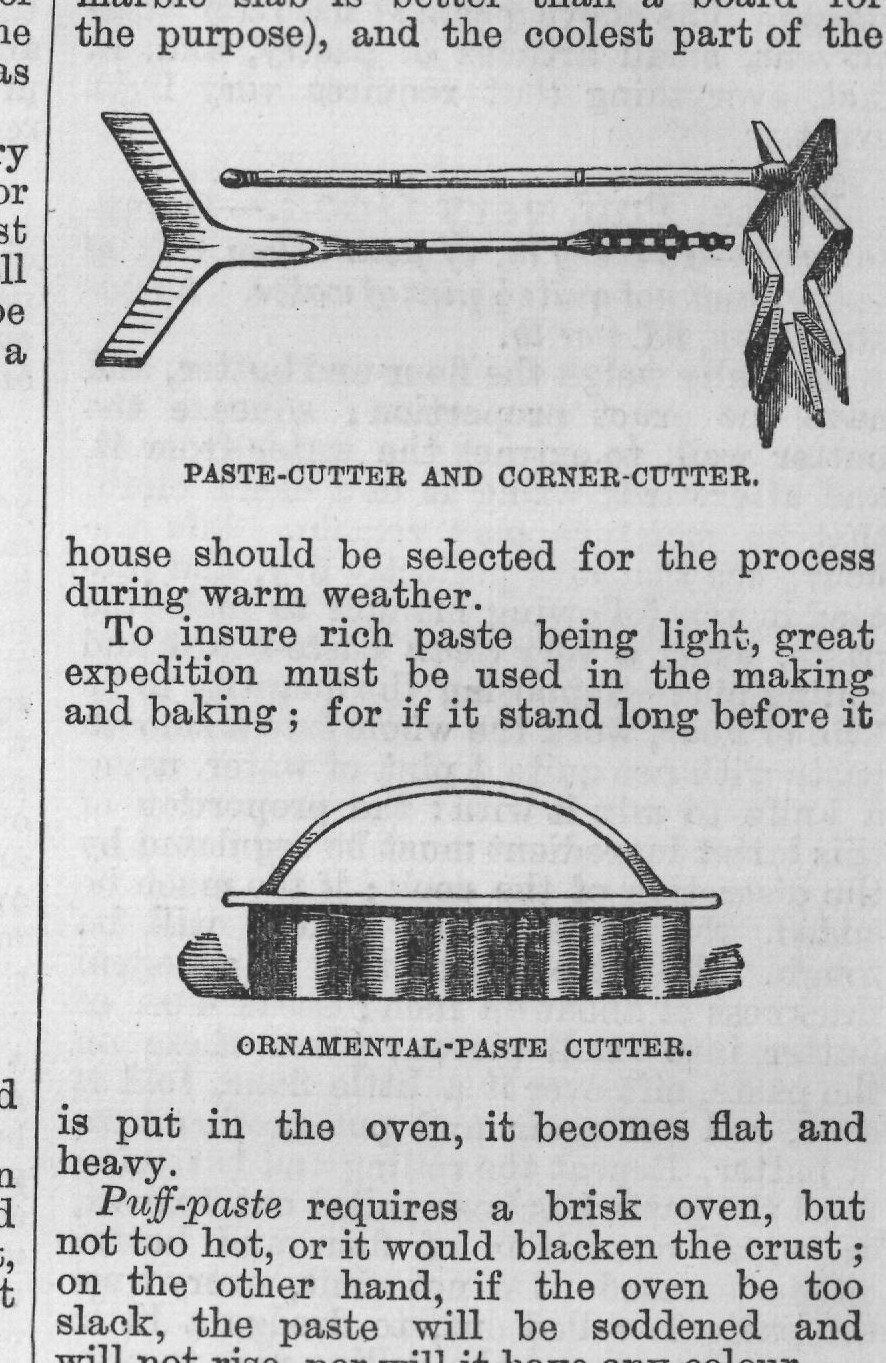
Clarified Beef Dripping answers very well for kitchen pies, puddings, cakes, or for family use. A very good short crust may be made by mixing with it a small quantity of moist sugar; but care must be taken to use the dripping sparingly, or a PASTRY AND PUDDINGS. be touched as lightly as possible, made with cool hands and in a cool place (a marble slab is better than a board for the purpose), and the coolest part of the PASTE-CUTTER AND CORNER-CUTTER. house should be selected for the process during warm weather.
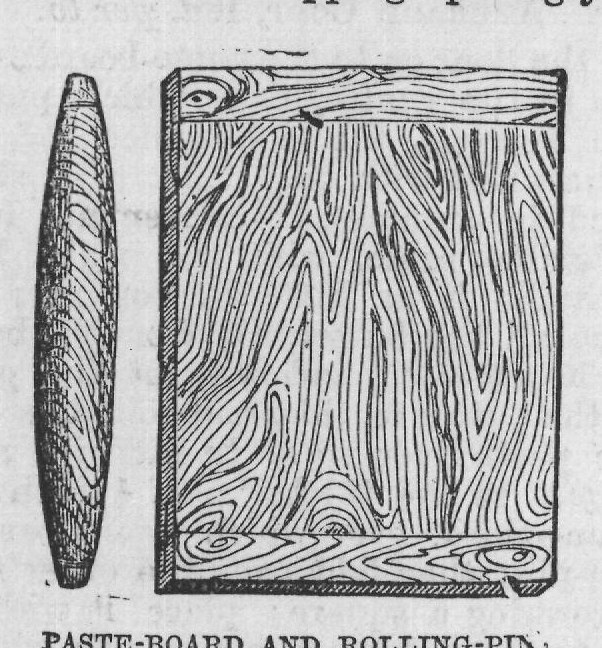
To insure rich paste being light, great expedition must be used in the making and baking; for if it stand long before it PASTE-BOARD AND ROLLING-PIN very disagreeable flavour will be imparted to the paste.
Strict cleanliness must be observed in pastry-making; all the utensils used should be perfectly free from dust and dirt, and the things required for pastry kept entirely for that purpose.
In mixing paste, add the water very gradually, work the whole together with the knife-blade, and knead it until perfectly smooth. Those who are inexperienced in pastry-making should work the butter in by breaking it in small pieces, and covering the paste rolled out. It should then be dredged with flour, and ORNAMENTAL-PASTE CUTTER. is put in the oven, it becomes flat and heavy.
Puff-paste requires a brisk oven, but not too hot, or it would blacken the crust; on the other hand, if the oven be too slack, the paste will be soddened and will not rise, nor will it have any colour.
PATTY-PANS, PLAIN AND FLUTED.
Paste and all cakes made with bakingpowder should be put in the oven directly they are made.
Tart-tins, cake-moulds, dishes for baked puddings, patty-pans, &c., should all be PASTE-PINCERS AND JAGGER, FOR ORNAMENTING THE EDGES OF PIE-CRUSTS. the ends folded over and rolled out very thin again; this process must be repeated until all the butter is used.
The art of making paste requires much practice, dexterity and skill: it should PIE-DISH. buttered before the article intended to be baked is put in them. Things to be baked on sheets should be placed on buttered paper. Raised-pie paste should PASTRY AND PUDDINGS. have a soaking heat, and paste glazed must have rather a slack oven, that the icing be not scorched. It is better to ice tarts, &c., when they are three-parts baked.
To ascertain when the oven is heated to the proper degree for puff-paste, put a RAISED-PIE MOULD. small piece of the paste in previous to baking the whole, and then the heat can thus be judged of.
The freshness of all pudding ingredients is of much importance, as one bad article will taint the whole mixture.
When the freshness of eggs is doubtful, break each one separately in a cup, before mixing them all together. Should there be a bad one amongst them it can be thrown away; whereas, if mixed with the good ones, the entire quantity would be spoiled. The yolks and whites beaten separately make the articles they are put into much lighter.
Raisins and dried fruits for puddings RAISED-PIE MOULD, OPEN. should be carefully picked, and in many cases stoned. Currants should be well washed, pressed in a cloth, and placed on a dish before the fire to get thoroughly dry; they should then be picked carefully over, and every piece of grit or stone removed from amongst them. To plump them, some cooks pour boiling water over them, and then dry them before the fire.
Batter pudding should be smoothly mixed and free from lumps. To insure this, first mix the flour with a very small proportion of milk, and add the remainder by degrees. Should the pudding be very lumpy, it may be strained through a hair sieve.
PASTRY AND PUDDINGS.
All boiled puddings should be put on in boiling water, which must not be allowed to stop simmering, and the pudding must always be covered with the water; if requisite, the saucepan should be kept filled up.
BOILED-PUDDING MOULD.
To prevent a pudding boiled in a cloth from sticking to the bottom of the saucepan, place a small plate or saucer underneath it, and set the pan on a trivet over the fire. If a mould is used, this precaution is not necessary; but care must be taken to keep the pudding well-covered with water.
For dishing a boiled pudding, as soon as it comes out of the pot dip it into a basin BOILED-PUDDING MOULD. of cold water, and the cloth will then not adhere to it. Great expedition is necessary in sending puddings to table, as by standing they quickly become heavy, batter puddings particularly.
For baked or boiled puddings, the moulds, cups, or basins should be always buttered before the mixture is put in them, and they should be put into the saucepan directly they are filled.
Scrupulous attention should be paid to the cleanliness of pudding-cloths, as from neglect in this particular the outsides of boiled puddings frequently taste very PUDDING BASIN. disagreeably. As soon as possible after it is taken off the pudding, it should be soaked in water, and then well washed, without soap, unless it be very greasy. It should be dried out-of-doors, then folded up and kept in a dry place. When wanted PASTRY, TO ICE. for use, dip it in boiling water and dredge it slightly with flour.
The dry ingredients for puddings are better for being mixed some time before they are wanted; the liquid portion should only be added just before the pudding is put into the saucepan.
A pinch of salt is an improvement to the generality of puddings; but this ingredient should be added very sparingly, as the flavour should not be detected.
When baked puddings are sufficiently solid, turn them out of the dish they were baked in, bottom uppermost, and strew over them fine-sifted sugar.
When pastry or baked puddings are not done through, and yet the outside is sufficiently brown, cover them over with a piece of white paper until thoroughly cooked: this prevents them from getting burnt.
Pastry, To Ice or Glaze. To glaze pastry, which is the usual method adopted for meat or raised pies, break an egg, separate the yolk from the white, and beat the former for a short time. Then when the pastry is nearly baked, take it out of the oven, brush it over with this beaten yolk of an egg, and put it back in the oven to set the glaze.
To ice pastry, which is the usual method adopted for fruit tarts and sweet dishes of pastry, put the white of an egg on a plate, and with the blade of a knife beat it to a stiff froth. When the pastry is nearly baked, brush it over with this, and sift over some pounded sugar; put it back into the oven to set the glaze, and, in a few minutes, it will be done. Great care should be taken that the paste does not catch or burn in the oven, which it is very liable to do after the icing is laid on.
Allow 1 egg and 1½ oz. of sugar to glaze 3 tarts.
A medium puff paste " richer than short crust, cheaper than full butter puff " built on seven turns with rests on ice. The surrounding text is Beeton's general essay on pastry and pudding making, plus her method for icing and glazing.
- The butter quantity is missingThe ingredient line reads "to every lb. of flour allow lb. of butter" " the fraction has dropped out. A medium or rough puff of this type usually runs between 8 and 12 oz butter to the pound of flour, with the 3 oz lard on top, but the original figure cannot be recovered from the text as printed.
- MeasuresAn imperial pint is 20 fl oz, so "not quite ½ pint of water" is a little under 10 fl oz, roughly 1 to 1¼ US cups. Add it gradually " flour absorbency varies far more than Victorian recipes admit.
- Seven turns, with real restsThe hinge of the method is the chilling. Three turns, half an hour cold, two turns, a full hour cold, two more turns. If the butter softens and merges into the dough the layers are gone and no amount of extra rolling brings them back. In a warm kitchen chill after every second turn.
- "Roll it out 3" The instruction to "roll it out 3, forming a square" means three rolls and folds, turning the block a quarter turn each time so the open ends face you. Beeton's "as before" refers back to the full puff paste entry that precedes this one in the book.
- Oven heatBeeton gives no temperatures, only her terms "brisk oven, but not too hot" for puff paste, a "slack" oven for glazed work, and a "soaking heat" for raised pies. Modern equivalents are only approximate: brisk is usually taken as a hot oven, slack as a cool one. Too slack and you get the sodden, unrisen result she warns of; glazed pastry needs the cooler heat so the sugar does not scorch.
- Lard and drippingThe lard is there for shortness and economy; she judges lard by smelling the knife after cutting the bladder through. Modern block lard works; chill it hard before use. Her clarified beef dripping crust is still good for savoury pies if you have dripping, and her warning about using it sparingly is sound -- too much and the flavour dominates.
- Icing and glazingEgg yolk brushed on and returned to the oven for the glaze on meat and raised pies; stiffly beaten egg white plus sifted sugar for fruit tarts, applied when the pastry is three-quarters baked. Her allowance is 1 egg and 1½ oz sugar to three tarts. Watch it closely " sugared white catches quickly.
- Testing the ovenHer trick of baking a scrap of the paste first to judge the heat is still the most reliable test if your oven runs untrue. An oven thermometer on the shelf does the same job with less waste.
Cookery writers of Beeton's day graded pastry much as she does here: a full puff of equal butter and flour for the grandest work, a "medium" or rough puff cut with lard for everyday pies, and plain short crust below that. The substitution of lard for part of the butter was as much about cost as texture -- the "average cost, 7d." she notes is the sort of figure that made her books useful to households running to a budget. The long directions that follow are characteristic of the Book of Household Management tradition: an anxious insistence on cool hands, a marble slab, clean cloths and sweet fat, all of which would have mattered enormously in a kitchen with a coal range, whatever cooling was to hand, and butter that might be rancid or heavily salted. The advice to break each egg separately into a cup before mixing survives in professional kitchens for exactly the reason she gives.