Home › P › Plum Pudding for Children
Plum Pudding for Children
3/4 lb. of raisins, 3/4 lb. of suet, 1/2 lb. of sugar, INGREDIENTS.-1 lb. of flour, 1 lb. of breadcrumbs, lb. of raisins, lb. of currants, lb. of suet, 3 eggs, lb. of sugar, milk, 2 oz. of candied peel, 1 teaspoonful of powdered allspice, 1/2 saltspoonful of salt. AVERAGE COST, 2s.
Let the suet be finely chopped, the raisins stoned, and the currants well washed, picked and dried. Mix these with the other dry ingredients, and stir all well together; beat and strain the eggs to the pudding, stir these in, and add just sufficient milk to make it mix properly. Tie it up in a well-floured cloth, put it into boiling water, and boil for at least 5 hours. Serve with a sprig of holly placed in the PLUM PUDDING. middle of the pudding, and a little pounded sugar sprinkled over it.
TIME.-5 hours.
SEASONABLE at Christmas.
Plum Pudding, Christmas. (Very Good.) - INGREDIENTS.-1 lb. of raisins, lb. of currants, lb. of mixed peel, 3/4 lb. of bread-crumbs, 3/4 lb. of suet, 8 eggs, 1 wineglassful of brandy, 1 lb. of sugar. AVERAGE COST, 3s. 6d.
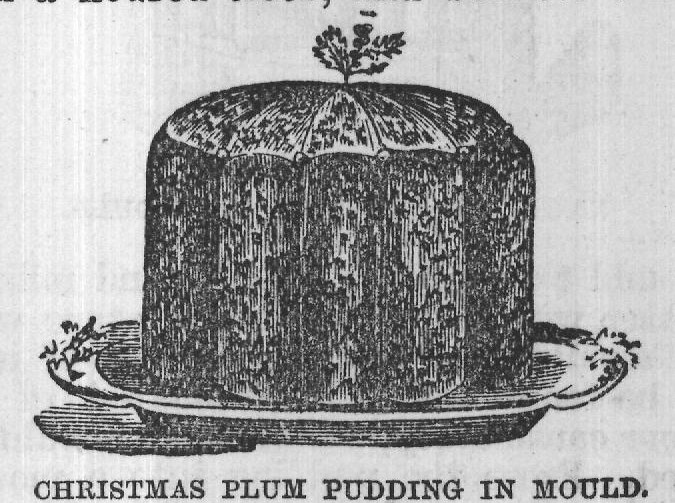
Stone and cut the raisins in halves, but do not chop them; wash, pick and dry the currants, and mince the suet finely; cut the candied peel into thin slices, and grate down the bread into fine crumbs. When all these dry ingredients are prepared, mix them well together with the sugar; then moisten the mixture with the eggs, which should be well beaten, and the brandy; stir well, that everything may be very thoroughly blended, and press the pudding into a buttered mould; tie it down tightly with a floured cloth, and boil for 5 or 6 CHRISTMAS PLUM PUDDING IN MOULD. hours. It may be boiled in a cloth without a mould, and will require the same time allowed for cooking. As Christmas puddings are usually made a few days before they are required for table, when the pudding is taken out of the pot, hang it up immediately, and put a plate or saucer underneath to catch the water that may drain from it. The day it is to be eaten, plunge it into boiling water, and keep it boiling for at least 2 hours; then turn it out of the mould, and serve with brandysauce. On Christmas-day a sprig of holly. is usually placed in the middle of the pudding, and about a wineglassful of brandy poured round it, which, at the moment of serving, is lighted, and the pudding thus brought to table encircled in flame.
TIME.-5 or 6 hours the first time of boiling; 2 hours the day it is to be served. SEASONABLE on the 25th of December, and on various festive occasions till March.
Note. Five or six of these puddings should be made at one time, as they will keep good for PLUM PUDDING. many weeks, and in cases where unexpected guests arrive, will be found an acceptable and, as it only requires warming through, a quicklyprepared dish. Moulds of every shape and size are manufactured for these puddings, and may be purchased of Messrs. R. & J. Slack, 336, Strand.
Two puddings run together here, and the transcription has lost most of the fractional quantities — the repeated bare "lb." almost certainly stood for ½ lb. or ¼ lb. in the original printing. Treat the ingredient lists as proportions to be judged rather than exact figures.
- The missing fractionsWhere the text reads " lb. of raisins" or " lb. of suet", a fraction has dropped out and cannot be recovered from this page. Treat the lists as proportions to be judged and scale from the quantities that did survive rather than guessing at the printed text.
- Old measuresA saltspoonful is ¼ teaspoon. A wineglassful in Victorian cookery books is about 2 fl oz (¼ cup), not a modern wine glass. The "average cost" of 2s. and 3s. 6d. is shillings and pence, a genuinely significant household outlay for one pudding.
- SuetBeef suet is the hinge ingredient: it melts at a higher temperature than butter, so it holds the crumb open and gives the light, spongy set. Packaged shredded suet works directly; fresh suet from a butcher must be stripped of membrane and chopped or grated very fine. Vegetable suet behaves similarly. Butter is generally reckoned a poor swap here — puddings made with it tend to come out denser and greasier.
- Basin instead of clothBoiling a naked pudding in a floured cloth works but is fiddly and waterlogs the surface if the tie is loose. A greased pudding basin covered with pleated parchment and foil, tied under the rim, gives the same result with less risk. Stand it on a trivet or folded cloth in the pan so the base is not against the metal.
- Keeping the water upFive hours of boiling means five hours of topping up with water already at a boil. If the level drops below the pudding or the pan goes off the boil, the pudding stops rising and sets heavy. Steaming in a covered pan over simmering water is the modern equivalent and needs the same attention.
- Maturing and reboilingThe instruction to hang the cooked pudding and reboil on the day is sound: the sugar, dried fruit and brandy make it a poor environment for spoilage, and the second two hours both reheats and improves it. Cool it completely before storing, keep it cold and dry, and discard any pudding showing mould rather than cutting round it.
- The flaming brandyBrandy will only light if it is warm. Heat the 2 fl oz gently, pour it over the pudding away from the flame, then ignite. Do it clear of curtains and low ceilings, and keep the bottle off the table.
"Plum" here means dried fruit, chiefly raisins — a usage fixed in English before prunes and plums parted company in the kitchen, and preserved in plum pudding, plum cake and sugar-plum long after it had gone out of ordinary speech. The dish is generally traced to plum porridge, a spiced meat broth thickened with breadcrumbs, fruit and wine that was eaten at the start of a Christmas dinner in the seventeenth century; over the eighteenth century the meat fell away, the suet stayed, and the whole thing stiffened into something that could be boiled in a cloth. The pudding's association with Christmas predates the Victorians, who popularised rather than invented the observance: what they did much to fix was the ritual around it — the date, the holly sprig, the flaming brandy, and the notion that five or six puddings should be laid down at once against unexpected guests. The closing plug for Messrs. R. & J. Slack of 336 Strand, ironmongers and suppliers of moulds, is a reminder that Beeton's book sat squarely inside a commercial world of new household hardware — decorative pudding moulds among it — being sold to a middle class that wanted its Christmas to look the part.