Home › Bread-Making › Cinnamon Rolls
Cinnamon Rolls
Take some of the dough you make bread of. Work in shortening and sugar. Then make a paste of butter, sugar and cinnamon. Roll your dough out thin, spread in this paste and roll up, putting it in your pans. Let them stand until they become light, and bake. After they are done, eat them with your coffee or tea, just as you like.
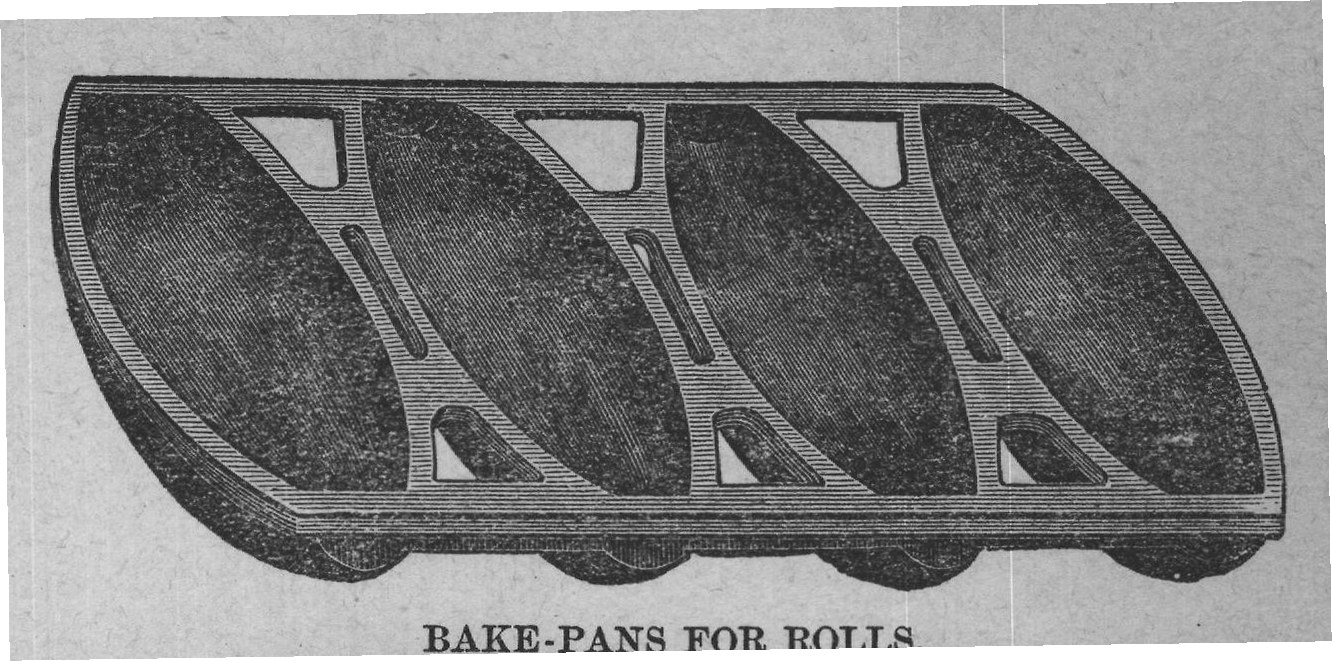
The stray lines at the top and bottom are captions from illustrations on the same page of the original book, not part of the method. What remains is a cook's shorthand: no quantities, no temperature, no times, on the assumption that you already have bread dough rising on the back of the stove.
- Start with risen bread doughStart with bread dough -- "Some of the dough you make bread of" means a lump of your ordinary bread dough; the text does not say at what stage, but taking it after the first rise works well, roughly 1 to 1 1/2 lb for a 9x13 pan. Enriching it at that point is sound; the gluten is already developed and the added fat and sugar will slow but not stop the yeast.
- How much to work inFor 1 1/2 lb of dough, about 3 tablespoons softened butter and 3 tablespoons sugar kneaded in gives a soft, sweet dough without a second full development. Expect the dough to slacken and become greasy before it comes back together.
- The cinnamon pasteEqual weights softened butter and brown or white sugar, with cinnamon to taste, spread the consistency of thick frosting. About 4 oz butter, 4 oz sugar and 2 to 3 teaspoons cinnamon fills a batch. Softened, not melted, or it will run out of the spiral as you roll.
- "Roll out thin"A rectangle about 1/4 inch thick, roughly 12 by 16 inches. Roll from the long side for more turns of filling, seal the seam, then cut 1 1/2 inch slices with a serrated knife or a length of thread.
- "Until they become light"The final proof, 45 minutes to an hour and a half in a warm room. The rolls should look puffed and touch each other in the pan, and a gentle press should leave a dent that fills in slowly. The sugar and fat make this rise noticeably slower than plain bread dough.
- The ovenThe original gives none. Bake at 350-375F for 20 to 25 minutes, until the centre rolls read about 190F and the tops are deep gold. Sugar in the filling scorches, so tent with foil if they colour early.
- YieldAbout a dozen rolls from 1 1/2 lb of dough. There is no icing here; the book simply says to eat them with your coffee or tea, just as you like.
This is bread-book economy rather than pastry: a household already making several loaves a week diverts a lump of dough and turns it into something sweet, a habit related to the sweet breads found in different kitchens across Europe and America. Cinnamon-and-sugar rolled buns are generally traced to Northern European sweet-dough traditions, and German and Scandinavian immigrant baking is usually credited with establishing them in the American Midwest, where turn-of-the-century compilations like this one were put together. The absence of quantities is characteristic of the period's bread chapters: the writer assumes a reader who bakes bread constantly and needs only the idea, not the arithmetic. The intrusive lines about a cottage costing $1,100 and bake-pans for rolls come from other material crowding the same page, a reminder that these volumes were general household encyclopedias as much as cookbooks.