Home › Bread-Making › Split Rolls
Split Rolls
One egg well beaten; one tablespoonful of sugar; one yeast-cake dissolved in a cup of warm milk; two teaspoonfuls of salt; flour enough to make a stiff batter; set to rise; when risen, work in a large spoonful of butter, and flour enough to roll; roll out an inch thick, spread over with butter or lard; fold in half; cut with biscuit-cutter, and let it rise and bake.
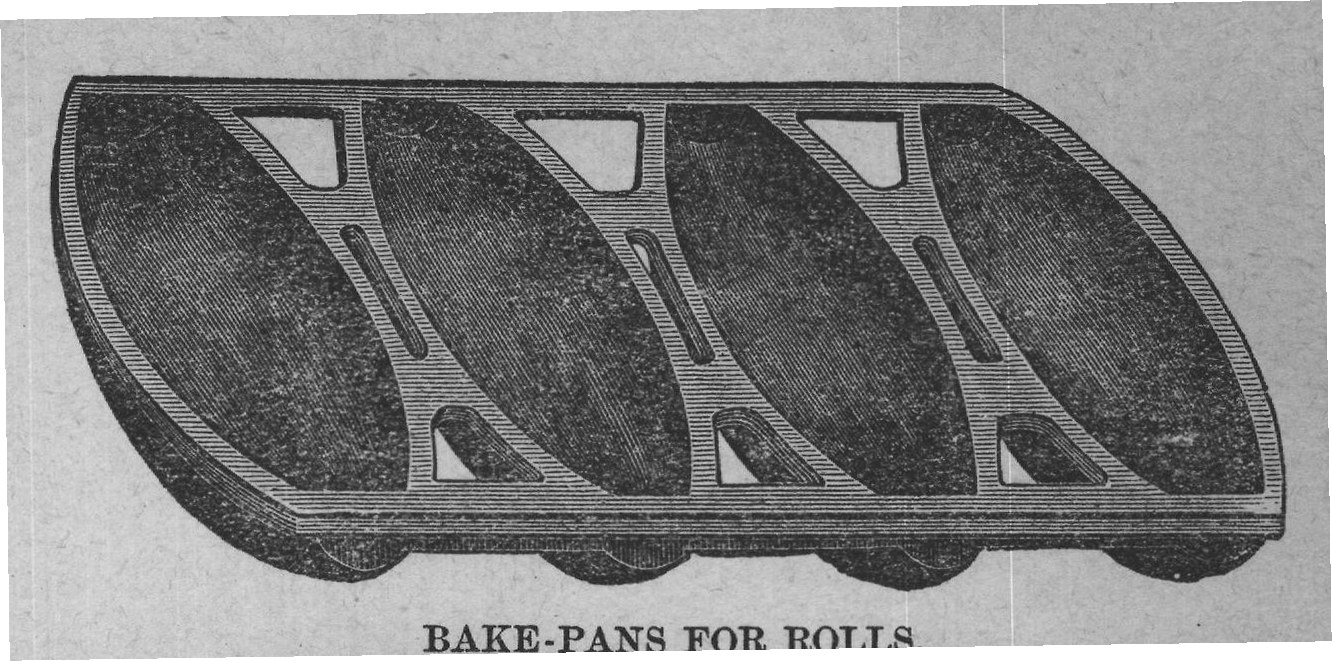
A sponge-method folded roll, closely related to the Parker House roll. Two stray lines from the page's illustrations — the cottage plan and the caption for the bake-pans — have been set into the text by the printer and are not part of the recipe.
- The yeastOne yeast-cake was a small commercial cake of yeast, compressed fresh or dried; compressed cakes of the familiar sort run about 0.6 oz. Substitute one packet, about 2¼ teaspoons, of active dry yeast dissolved in the cup of warm milk (100–110F); the milk should be warm to the finger, not hot.
- Flour, unmeasuredThe recipe gives no flour quantity at either stage. With one egg and one cup of milk, expect roughly 1½ cups to reach a stiff batter and another 1½ to 2 cups to make a dough you can roll — about 3 to 3½ cups total. Add the second lot gradually and stop while the dough is still slightly tacky.
- "A large spoonful of butter"Read as a generous tablespoon, about 2 tablespoons in modern terms. It is worked into the risen sponge, which is why the crumb comes out soft rather than bready.
- Two risings, no times givenThe sponge needs about an hour in a warm room until doubled and bubbled; the cut and folded rolls need 30 to 45 minutes on the pan until visibly puffed and light. Judge by volume, not the clock — a period kitchen ran cooler than yours.
- The fold is the pointButtering the sheet before folding is what makes these split rolls: the fat keeps the two halves from knitting, so the baked roll pulls apart cleanly along the seam. Skimp on the butter and you get a thick lopsided biscuit shape instead.
- Oven temperatureThe original says only "bake." Rolls of this kind want a hot oven, 400 to 425F, for 12 to 18 minutes until the tops are deep gold. Lower and they dry out before they colour.
- Rolling thicknessAn inch thick before folding gives a finished roll about two inches deep, which is larger than most modern dinner rolls. Three-quarters of an inch is easier to handle and bakes more evenly.
- YieldAbout a dozen rolls from a 2½-inch cutter. Bake them close together in the pan — touching, or nearly — so they rise upward and stay soft at the sides.
Split or folded rolls belong to the American hotel-bread tradition, and the shape is generally traced to the Parker House in Boston, where a similar buttered, folded roll became a fixture on nineteenth-century menus and was widely copied in domestic cookbooks. What makes this version characteristic of its moment is the yeast-cake: compressed fresh yeast, sold commercially in America from around 1868 and spreading more widely after the 1876 Centennial, replaced the homemade hop or potato ferments that earlier bread chapters spent pages explaining, and it let a housekeeper build an enriched sponge in an afternoon rather than overnight. The intrusion of a cottage floor plan and a caption for bake-pans into the middle of the instructions may well reflect the way the period's subscription household volumes were assembled, from stock illustration blocks and recipe copy set side by side, and where the compositor's slip was often left to stand.