Home › Some Useful Recipes › Onion and Meat Stew
Onion and Meat Stew
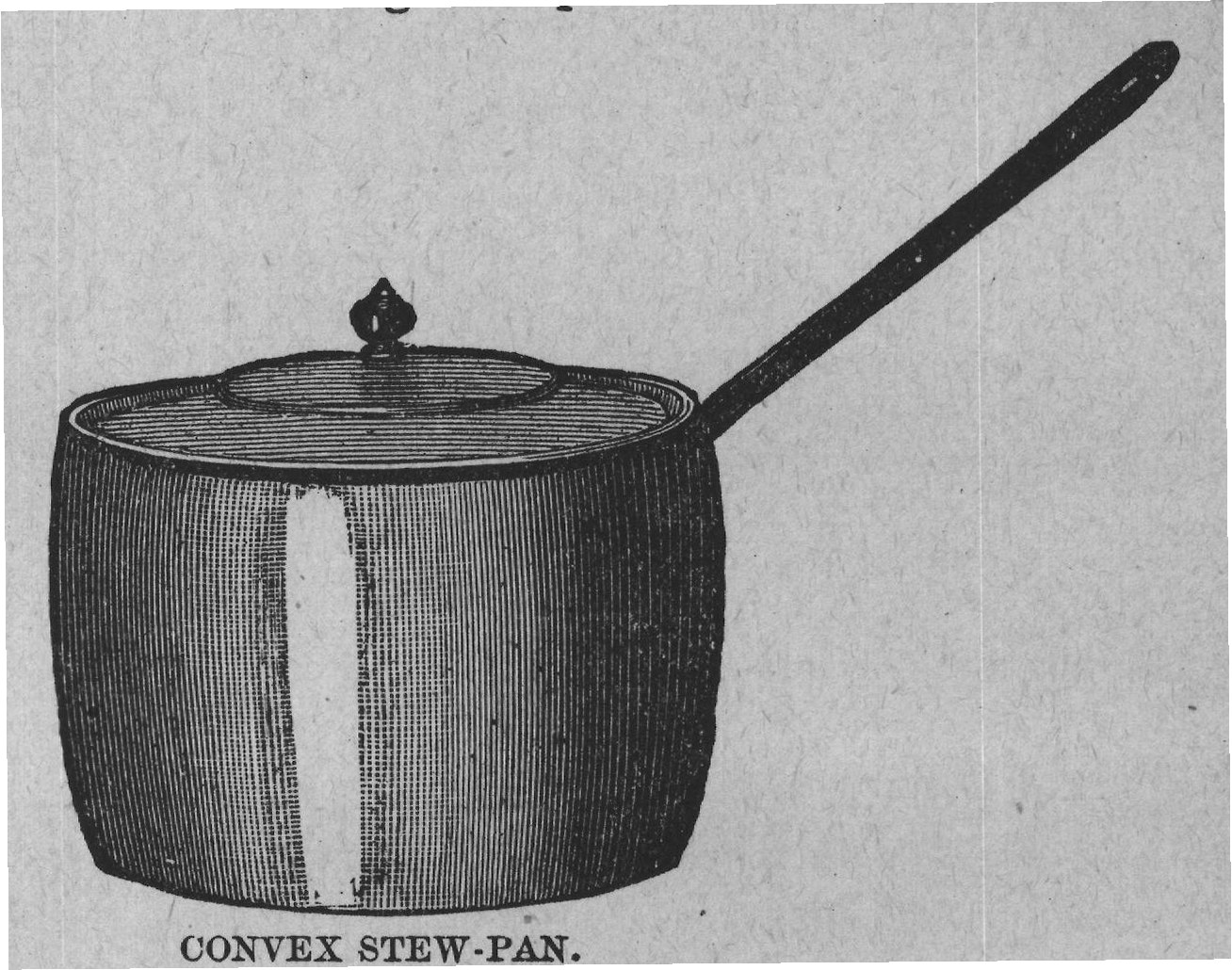
Slice some onions and fry brown. Pound the meat, fry it over a hot fire until it browns a little, turning each piece as soon as it has been a few seconds in the pan, to keep in the juice. Put it into a saucepan, pour water into the fryingpan, and put this brown liquor, with the fried onions, to the beef.
Let it simmer slowly for an hour.
Other seasoning may be added, according to taste, or to vary the dish, such as tomatoes, fresh or in catsup, sage and summer savory, or a grated carrot. Young green onions, such as must be thinned out, are good cut up in it; pepper and salt, and a teaspoonful of curry powder are a great improve-
A quantity-free stew of the kind written for cooks who judged by eye; the method is sound, but the text gives no weights and breaks off mid-sentence.
- "Convex stew-pan"The heading names the vessel rather than the dish, and is not itself an instruction. Any heavy saucepan or Dutch oven with a lid will do.
- Quantities are absentWork to about 2 lb of stewing beef, two large onions, and enough liquid to just cover — roughly 2 cups. The recipe assumes you will taste and adjust.
- "Pound the meat"Nineteenth-century stewing beef was tough and often from working animals; pounding with a mallet broke down connective tissue. With modern chuck it is optional, though flattening thick pieces helps them brown evenly.
- The hinge is the browningSear in small batches over high heat so the pan stays hot and the meat colours rather than steams. Turning "as soon as it has been a few seconds" is the point — the aim is a crust, not cooked-through meat.
- Deglazing the frying panPouring water into the hot pan and adding that "brown liquor" to the beef is the whole flavour of the dish. Scrape the base while the water bubbles, and do not leave any of it behind.
- One hour is shortAn hour of gentle simmering will not fully tenderise chuck or shin. Expect 2 to 2½ hours at a bare simmer, lid on, checking that the liquid does not fall below the meat.
- Curry powder and savoryPeriod curry blends varied, and were often turmeric-heavy; they may well have been milder than some jars sold now, so add half a teaspoonful, taste, then add more. Summer savory is peppery and thyme-like — thyme with a pinch of marjoram is the usual substitute.
- YieldAbout four servings. Serve with boiled potatoes, rice or bread; the recipe is written as a way of stretching a small amount of meat.
- The text ends mid-wordThe final line is cut off in the original — "a great improve-" was almost certainly "improvement." The method itself is complete; what is lost is the tail of the seasoning list, and there is no way to know if anything followed it.
This belongs to the large family of household stews built on the principle that onions and long moist heat could make cheap, sinewy cuts palatable. The instruction to sear the meat quickly "to keep in the juice" reflects the searing-seals-in-juices theory popularised by the chemist Justus von Liebig in the mid-nineteenth century and repeated in cookbooks for decades; it is now known to be wrong as physics, though browning does create flavour through the Maillard reaction, so the practice survived its explanation. The list of optional additions — tomato catsup, sage, summer savory, grated carrot, thinnings from the onion bed, curry powder — suggests a recipe treated as a framework to be filled with whatever the season offered.