Home › Sauces, Salads, Pickles and Condiments › Ripe Tomato and Fruit Pickles
Ripe Tomato and Fruit Pickles
To seven pounds of fruit add three pounds of sugar and one quart of vinegar. Simmer them together for fifteen minutes, skim out the fruit, boil the syrup a few minutes longer, add cloves, cinnamon and other spices to suit the taste, and pour over while warm, preferably in glass jars that may be sealed. The same will apply to all mixed or other fancy pickles, since they look pretty if nicely arranged.
This is a nineteenth-century sweet pickle formula of the standard 7-3-1 type, and the problems with it are all in what it leaves out rather than what it says.
- No processing step at allThe fruit is simmered fifteen minutes, then the syrup is poured over it "while warm" and the jars sealed. Nothing here brings the sealed jar to a temperature that destroys spoilage organisms, and a warm fill will not reliably drive the headspace air out to form a safe vacuum. Current practice for any sealed sweet pickle calls for a measured boiling-water process timed to the jar size.
- Ripe tomatoes are not a high-acid fruitTomatoes sit around pH 4.3 to 4.9 depending on variety and ripeness, which straddles the line at which Clostridium botulinum can grow in a sealed, oxygen-free jar. Modern tomato canning recipes specify added lemon juice or citric acid by measured amount for exactly this reason. This recipe adds no acid other than the vinegar.
- The vinegar is an unknown quantityOne quart of vinegar to seven pounds of fruit and three pounds of sugar is a heavy dilution, and the strength of the vinegar is never given. Household vinegar of the period varied widely and was often home-made; today's canning recipes require 5 percent acidity so the final pH can be predicted. Without both the strength and a target pH, there is no way to know whether the finished pickle is safe to keep sealed.
- "Fancy pickles" makes it worseThe closing line invites the cook to apply the same method to "all mixed or other fancy pickles." Mixed vegetable pickles can include genuinely low-acid items such as beans, corn, onions and peppers, and a single unmeasured procedure cannot be safe across all of them.
- Sealing meant something differentA jar "that may be sealed" would, in the nineteenth century, more likely have meant a wax seal, a zinc cap with a rubber ring, or a glass-lidded bail jar than a modern two-piece lid, none of which gave the same reliable, testable vacuum.
- If you want the flavourSpiced ripe tomato pickle is still made, and a current tested recipe from a food-preservation authority will give you the acid ratio, the headspace and the processing time this one omits. Use one of those instead of adapting this text.
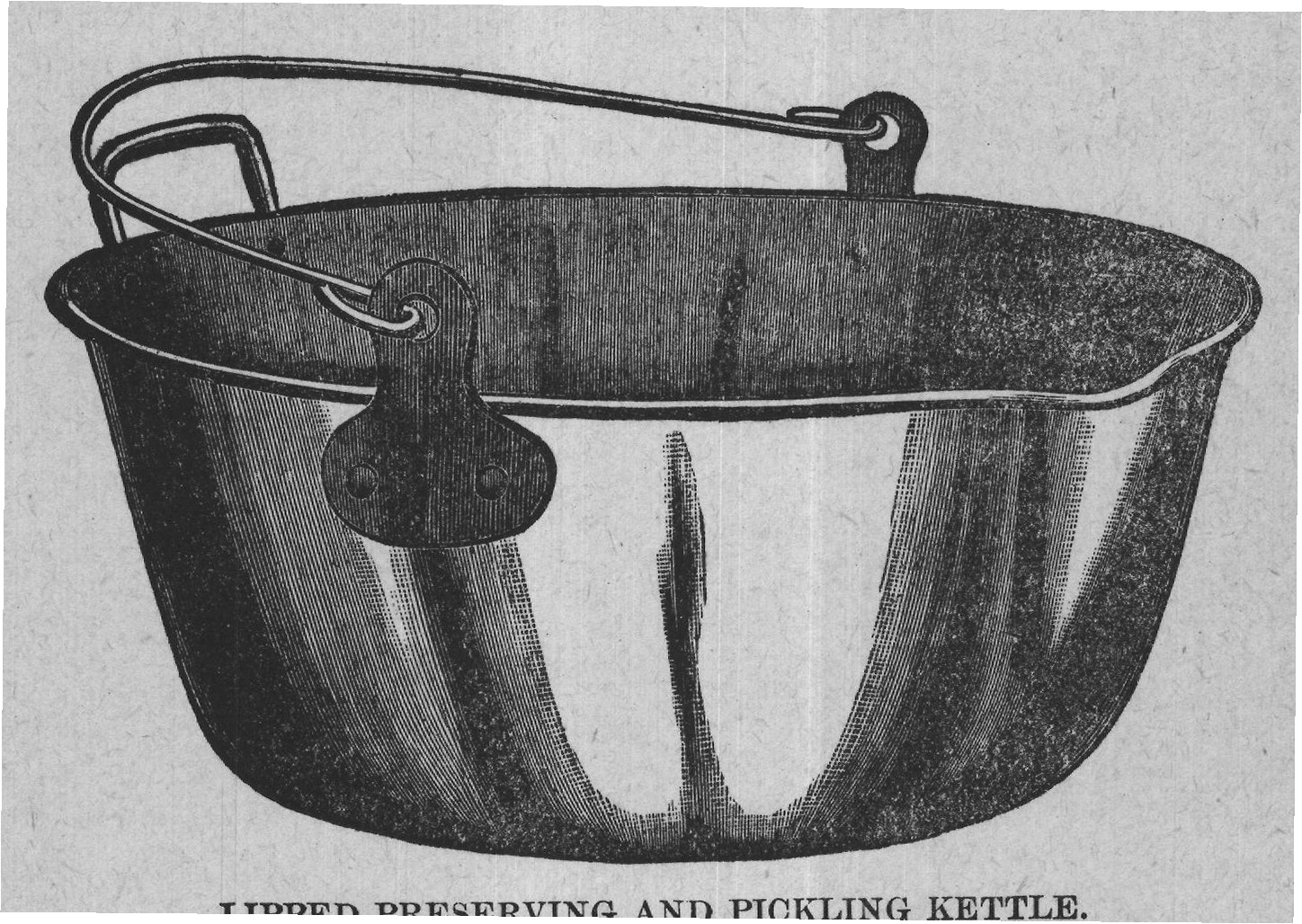
- Reading the equipment noteThe stray heading refers to a lipped preserving kettle, that is, one with a pouring lip. The relevant point for any reader is that the kettle must be non-reactive; brass and copper preserving pans react with vinegar.
The proportions here "seven pounds of fruit, three pounds of sugar, one quart of vinegar" are a set piece of American household cookery, repeated with small variations and applied indifferently to peaches, pears, plums, crabapples, watermelon rind and, as here, ripe tomatoes. The tomato was still being handled as a fruit in this tradition rather than a vegetable, and sweet spiced tomato pickle was a common way to use a glut of ripe fruit late in the season, when there were more tomatoes than could be eaten fresh. The reliance on sugar and vinegar as the whole of the preservation, with no timed heat processing, reflects a period before the home-canning research of the 1910s and 1920s established measured processes; the note that mixed pickles "look pretty if nicely arranged" is a reminder that these jars were as much for display on the pantry shelf and the supper table as for keeping.