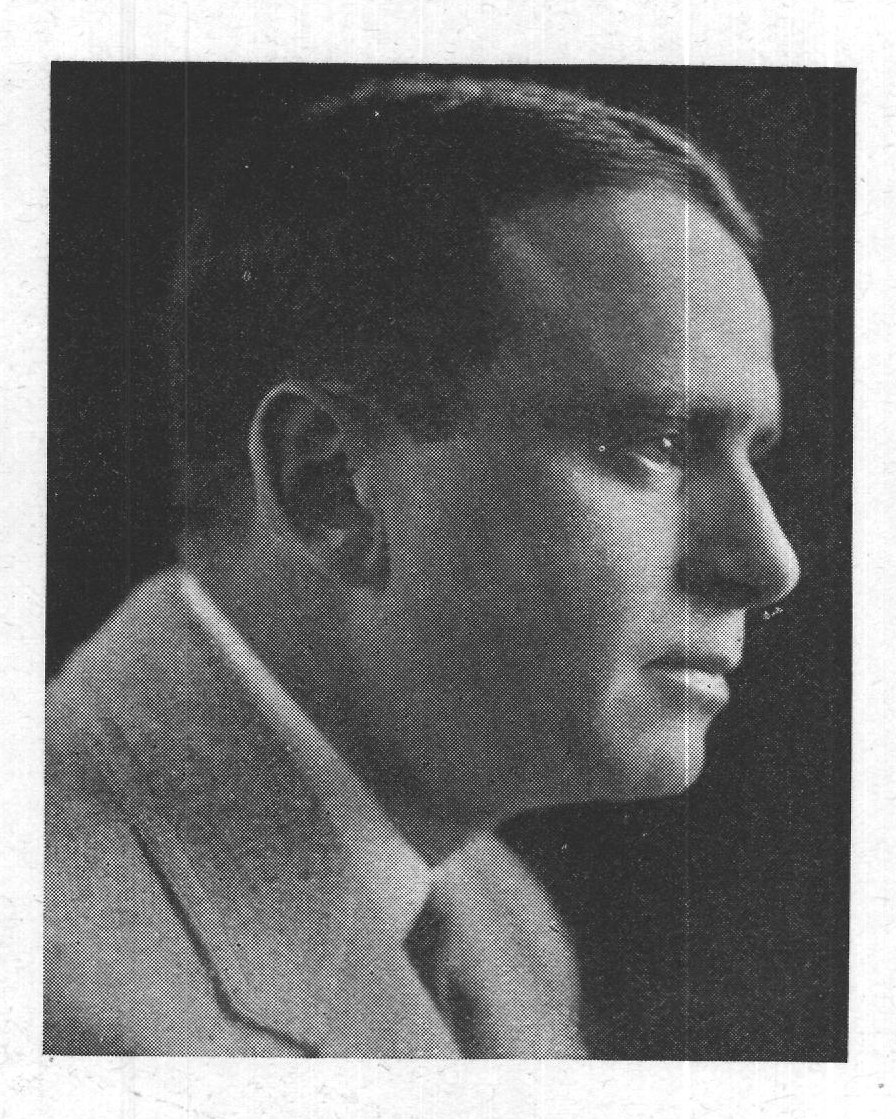
Douglas Fairbanks

A SOUTHERN DELICACY
Take the meat of a large crab, already cooked, leaving out the gray parts and flake it into small pieces and weigh it.
Bangs To every half pound take two ounces of finely grated bread crumbs, a gill of unsweetened ketchup, a teaspoonful of lemon juice, a wineglassful of sherry and salt and pepper to taste.
Stir over the fire for fifteen minutes, but do not let it actually boil.
While still very hot add one or two tablespoonfuls of cream and serve at once on garnished toast with lemon slices.
A chafing-dish supper dish that depends almost entirely on restraint at the stove: the crab is already cooked, so everything after it goes into the pan is a matter of warming through, not cooking.
- Do not stir it for fifteen minutesCooked crab held over heat that long shreds into cotton and weeps liquid. Bring the crumbs, ketchup, lemon and sherry to a bare simmer first, fold the crab in at the end, and give it two or three minutes off the boil until hot.
- "Unsweetened ketchup"In this period the word still covered mushroom or walnut ketchup: a thin, dark, salty condiment closer to Worcestershire than to anything in a squeeze bottle. Modern tomato ketchup at a gill (half a cup) would make the dish sweet and red. Mushroom ketchup is still sold; mushroom broth with a spoonful of Worcestershire and soy is a common stand-in.
- A gill and a wineglassfulA gill is half a cup (4 fl oz). A wineglassful in period cookbooks is about 2 fl oz, not the 6 oz a modern glass holds. Together that is three quarters of a cup of liquid to half a pound of crab, which the two ounces of crumbs are there to absorb.
- The gray partsThe gills, stomach and membrane, and the soft hepatopancreas (the "mustard," the crab equivalent of lobster tomalley). It is edible in principle but concentrates contaminants, and it is what turns the dish muddy. Health advisories now recommend discarding it, which is what the recipe directs.
- How much crabOne large crab rarely yields the half pound the ratios assume: a big Dungeness gets close, a blue crab gives an ounce or two. Buy half a pound of picked lump or backfin crabmeat and treat that as the unit.
- Breadcrumbs"Finely grated" means dry crumbs grated from stale bread, not the coarse fresh crumbs of a food processor. Dry, fine crumbs from plain white bread thicken without going gluey; panko will stay too distinct.
- Cream at the endAdded off the boil, it is there to loosen and enrich. Heavy cream, a tablespoon or two, stirred in with the pan already off the heat so it does not break against the acid of the lemon and ketchup.
- Yield and servingHalf a pound of crab makes two generous portions or four small ones on toast. Toast the bread just before serving; the sauce is loose enough to soak through a slice that has been sitting.
- The stray word"Bangs" in the middle of the ingredient list appears to be a stray artifact of the printing or transcription rather than an instruction or an ingredient; its origin is unclear. Ignore it.
The chafing dish was fashionable equipment in American entertaining from roughly the 1890s through the 1920s — a spirit lamp under a shallow pan, set on the table so the host could cook in front of guests. Crab was a common subject, particularly in the Chesapeake and Gulf traditions that gave rise to deviled crab and crab imperial, which may be what the "Southern" in the title points to; picked crabmeat cooks in moments and needs only sherry, cream and something sharp to be a whole course. Sherry appears often alongside crab in American recipes of the period. Celebrity cookbooks of this kind were typically compiled as fundraisers or publicity, and the dishes chosen say as much about the persona as the palate: a recipe performed at the table suited a star whose career was built on doing the thing himself, in view.