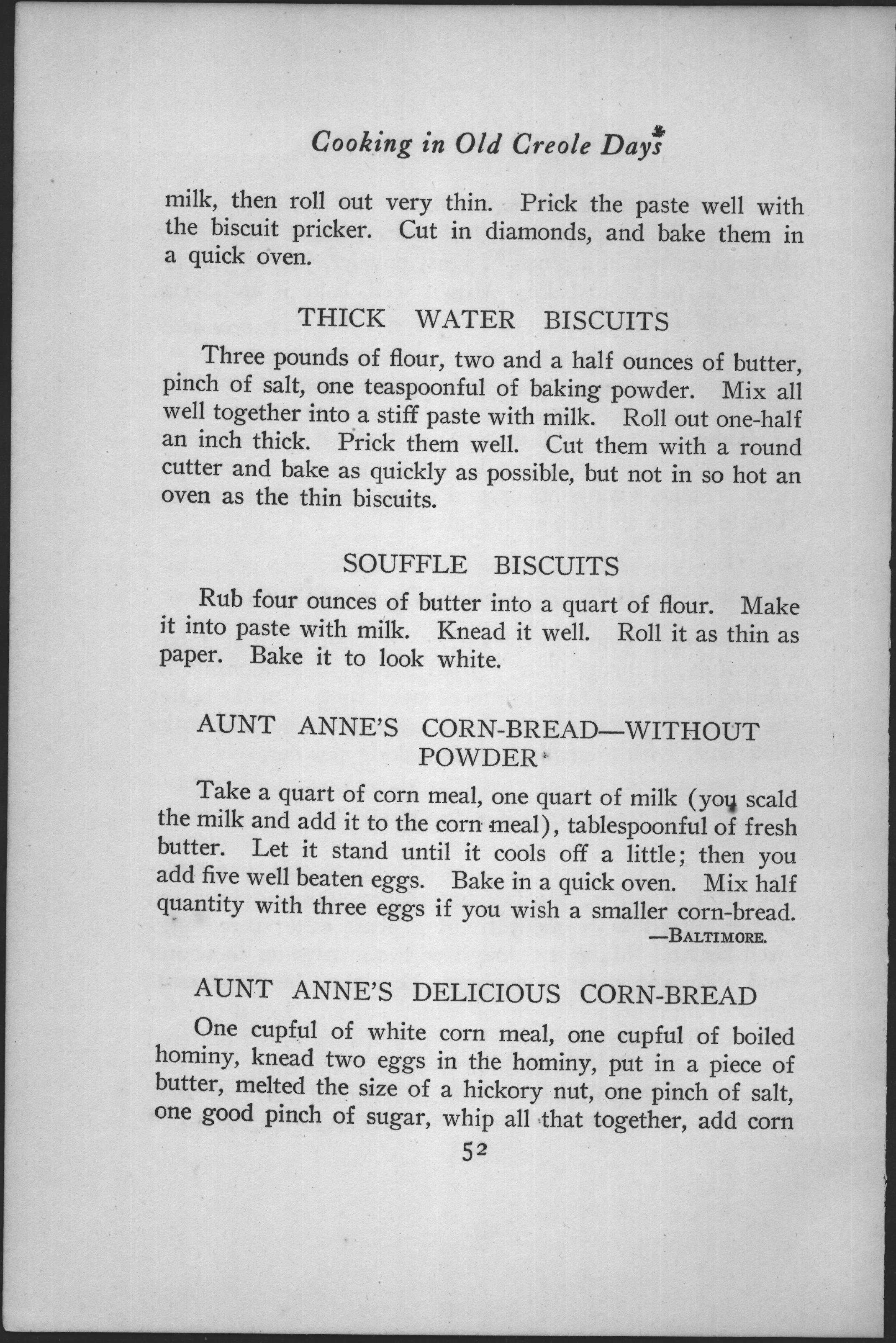
Aunt Anne's Corn-Bread — Without Powder
Baltimore
Take a quart of corn meal, one quart of milk (you scald the milk and add it to the corn meal), tablespoonful of fresh butter. Let it stand until it cools off a little; then you add five well beaten eggs. Bake in a quick oven. Mix half quantity with three eggs if you wish a smaller corn-bread.
The “without powder” is the whole trick — no baking powder, just scalded cornmeal and a lavish five eggs to lift it into something soft and custardy, close to a spoonbread.
- “A quart of corn meal”About 4 cups of cornmeal to a quart (4 cups) of milk. Halve it with 3 eggs, as the recipe notes, for a smaller pan.
- Scald the milkHeating the milk to a bare simmer and stirring it into the meal swells the starch for a smooth, tender batter — then let it cool before the eggs go in, or they will cook on contact.
- Eggs are the leaveningWith no soda or powder, the five beaten eggs do all the lifting, so beat them well; whipping the whites separately makes it lighter still.
- “Fresh butter”A tablespoon of unsalted butter, stirred into the warm meal; it enriches the crumb and helps build the crust.
- A quick ovenBake in a hot oven, 425–450°F, in a greased dish until puffed and set, 30–40 minutes. Serve it hot — like spoonbread, it settles as it cools.
A cornbread raised by eggs rather than a chemical leavener is the very essence of Southern spoonbread, or “batter bread” — soft enough to eat with a spoon, more soufflé than loaf. The scalded-meal method lends it a custardy tenderness that plain cornbread never reaches. The Baltimore attribution fits neatly: the Chesapeake and the wider South made spoonbread a point of regional pride. Calling it “Aunt Anne’s” and pointedly “without powder” marks it as an heirloom from before baking powder became the default — a cook’s quiet badge of the older, egg-lifted way.
From page 52 of the 1904 edition.
Original page from the book