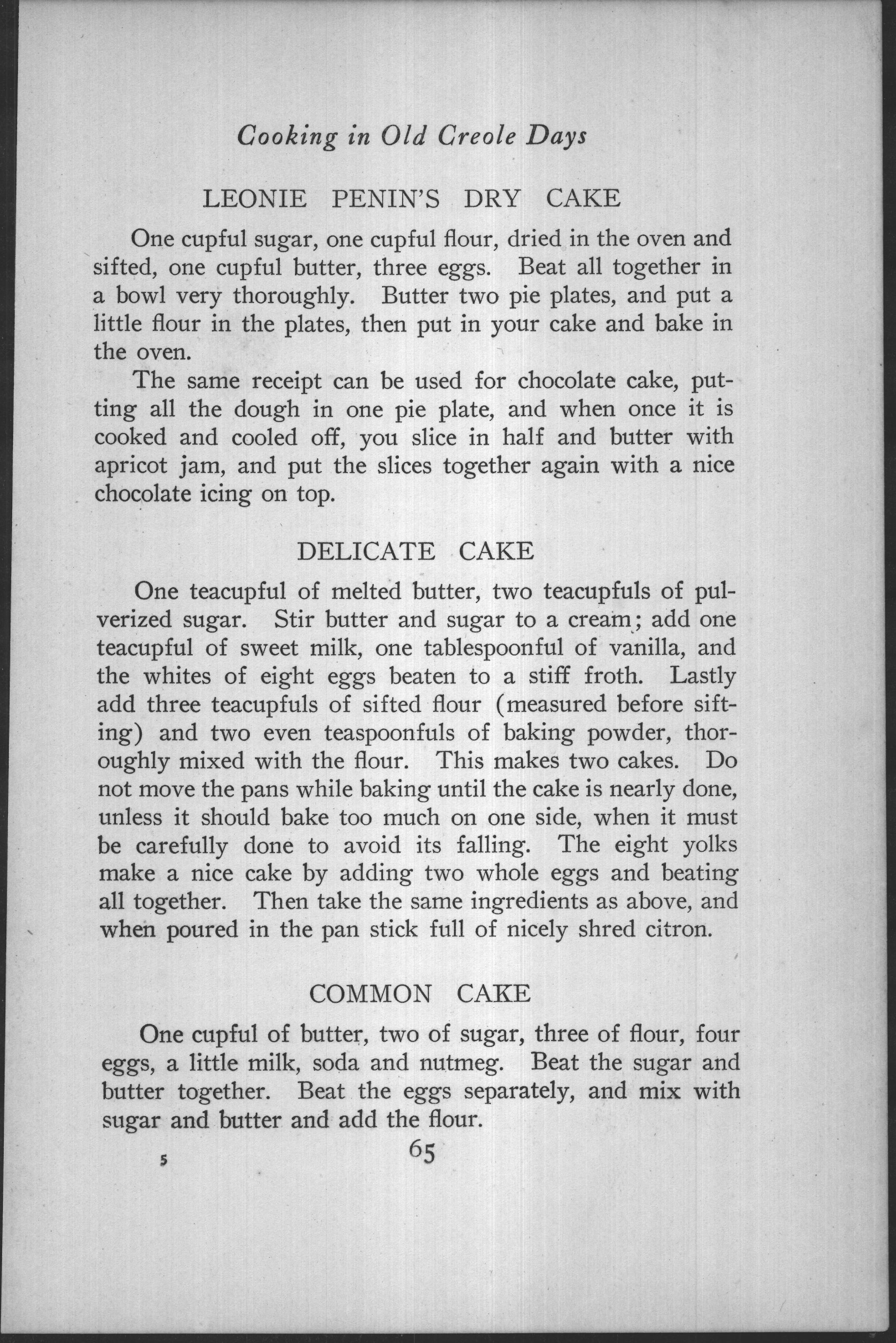
Common Cake
One cupful of butter, two of sugar, three of flour, four eggs, a little milk, soda and nutmeg. Beat the sugar and butter together. Beat the eggs separately, and mix with sugar and butter and add the flour.
The plain, everyday butter cake — the famous 1-2-3-4 formula that generations of cooks knew by heart.
- The 1-2-3-4 ratioOne cup butter, 2 sugar, 3 flour, 4 eggs — a foundational American cake so reliable it needed no other name.
- “A little milk”Add about ½ to 1 cup milk to loosen the batter to a smooth, droppable consistency.
- Leavening“Soda” alone needs acid to work; with plain sweet milk you’ll get a better rise from about 2 teaspoons baking powder instead.
- Season to tasteThe unspecified nutmeg is a grating or so — start with ½ teaspoon, freshly grated.
- Moderate ovenBake at 350°F in a tube or loaf pan until a pick comes out clean.
“Common cake” is the everyday face of the 1-2-3-4 cake, one of the most enduring recipes in American baking precisely because it is so easy to remember. Its rise tracks a quiet revolution in the kitchen: through the nineteenth century, cooks shifted from weighing ingredients on scales to measuring by the cupful, a change championed by domestic writers and cemented by Fannie Farmer’s standardized cups and spoons in 1896. A cake countable on one hand — one, two, three, four — suited that new, democratic way of cooking without a scale.
From page 65 of the 1904 edition.
Original page from the book