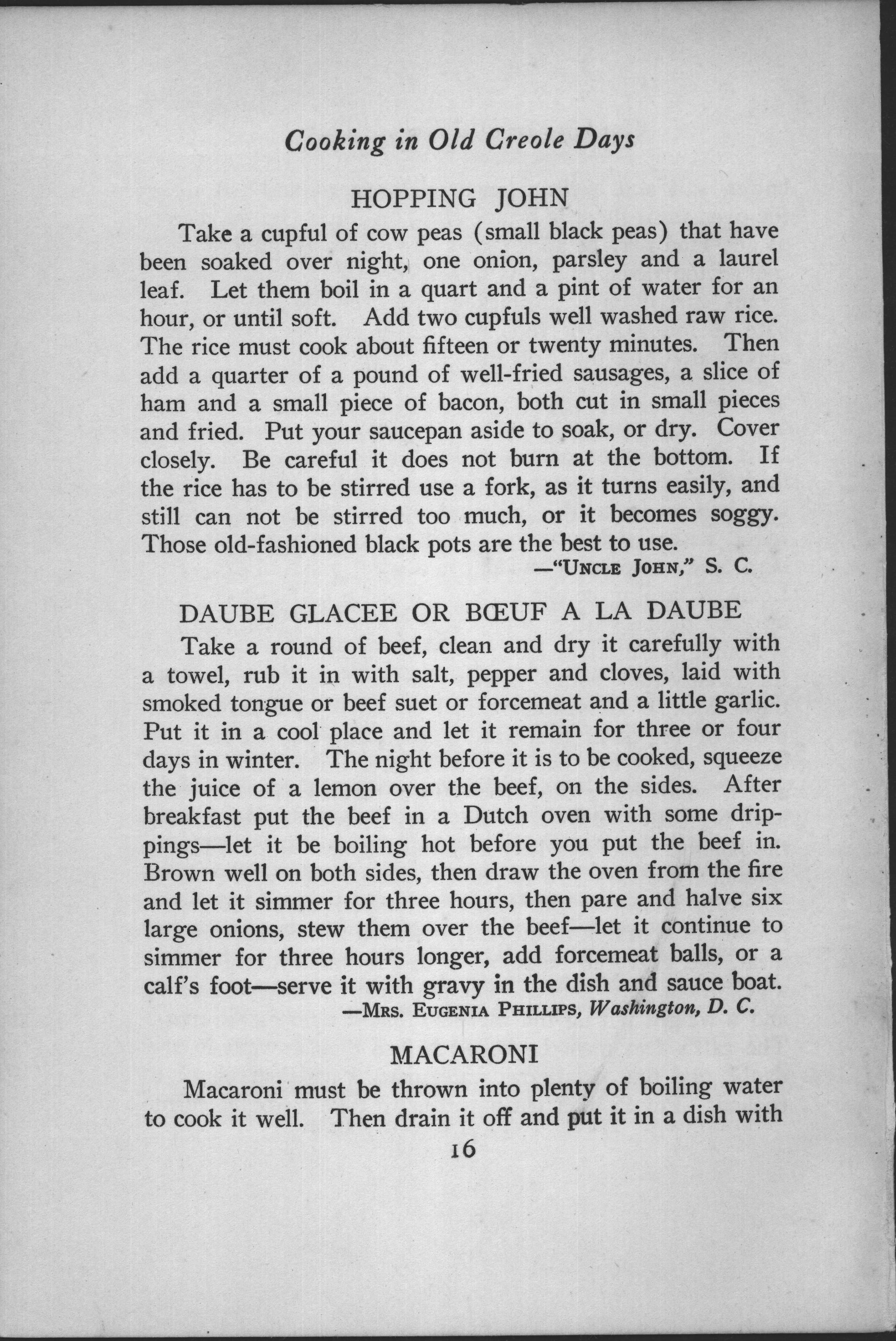
Daube Glacée or Bœuf à la Daube
Mrs. Eugenia Phillips, Washington, D. C.
Take a round of beef, clean and dry it carefully with a towel, rub it in with salt, pepper and cloves, laid with smoked tongue or beef suet or forcemeat and a little garlic. Put it in a cool place and let it remain for three or four days in winter. The night before it is to be cooked, squeeze the juice of a lemon over the beef, on the sides. After breakfast put the beef in a Dutch oven with some drippings—let it be boiling hot before you put the beef in. Brown well on both sides, then draw the oven from the fire and let it simmer for three hours, then pare and halve six large onions, stew them over the beef—let it continue to simmer for three hours longer, add forcemeat balls, or a calf's foot—serve it with gravy in the dish and sauce boat.
A grand Creole braise: a whole round of beef cured, seared, and slowly cooked with a calf’s foot so the gravy sets to jelly when chilled — the “glacée” of the name.
- Refrigerate the multi-day cureThe three-to-four-day rest “in a cool place” means the refrigerator — never leave salted beef at room temperature for days. Modern kitchens can shorten this to an overnight cure with the same seasonings.
- “Dutch oven” hereIn this era the term meant a heavy lidded pot or cast-iron camp oven. Any enameled Dutch oven or braiser works; get the drippings smoking-hot before the beef goes in so it sears rather than steams.
- Forcemeat = seasoned stuffingForcemeat is finely ground, seasoned meat, here rolled into little balls. A modern shortcut is well-seasoned sausage meat, browned separately and added near the end.
- The calf’s foot is the pointIt supplies natural gelatin so the strained gravy sets when cold — that jelly is what makes it a daube glacée. No calf’s foot? Stir 1–2 envelopes of unflavored gelatin into the hot, strained gravy.
- Low and slow“Simmer” means the barest bubble — a 300–325°F (150–165°C) oven holds a braise there beautifully for the full six hours without watching.
The daube is a slow beef braise from Provençal France, traditionally cooked long and gently in a squat earthenware pot called a daubière. New Orleans Creoles adapted it into something distinctively local: daube glacée, a cold version set in a clear, savory jelly drawn from calf’s feet, sliced from a mold. It became a fixture of Creole holiday tables. The dish shows the French backbone of Creole cooking — a Provençal country stew reborn as an elegant, quivering centerpiece for New Orleans winters, when cool weather let the aspic set before refrigeration was common.
From page 16 of the 1904 edition.
Original page from the book