Daube Glacée
Mme. Eustis, Mère
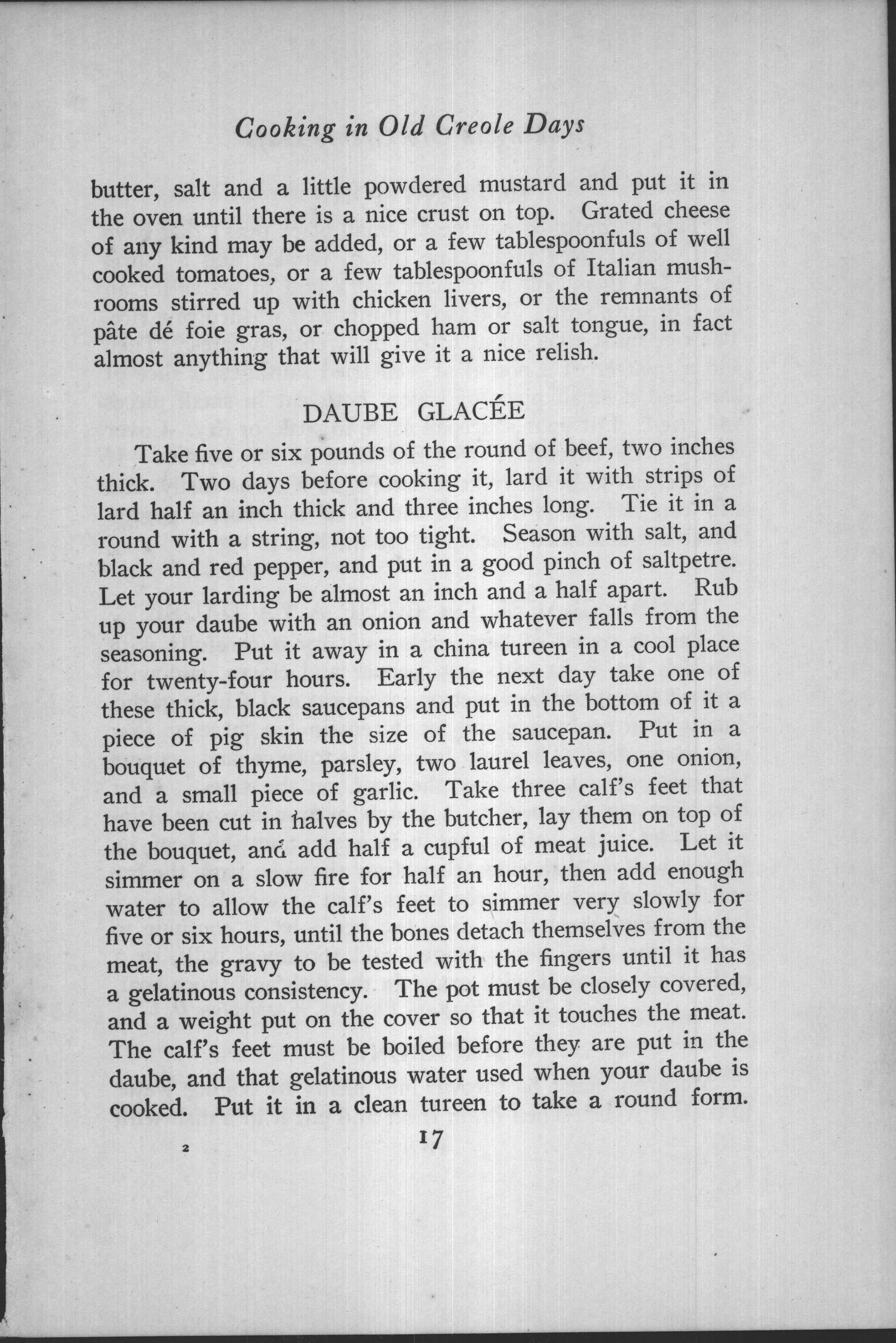
Take five or six pounds of the round of beef, two inches thick. Two days before cooking it, lard it with strips of lard half an inch thick and three inches long. Tie it in a round with a string, not too tight. Season with salt, and black and red pepper, and put in a good pinch of saltpetre. Let your larding be almost an inch and a half apart. Rub up your daube with an onion and whatever falls from the seasoning. Put it away in a china tureen in a cool place for twenty-four hours. Early the next day take one of these thick, black saucepans and put in the bottom of it a piece of pig skin the size of the saucepan. Put in a bouquet of thyme, parsley, two laurel leaves, one onion, and a small piece of garlic. Take three calf's feet that have been cut in halves by the butcher, lay them on top of the bouquet, and add half a cupful of meat juice. Let it simmer on a slow fire for half an hour, then add enough water to allow the calf's feet to simmer very slowly for five or six hours, until the bones detach themselves from the meat, the gravy to be tested with the fingers until it has a gelatinous consistency. The pot must be closely covered, and a weight put on the cover so that it touches the meat. The calf's feet must be boiled before they are put in the daube, and that gelatinous water used when your daube is cooked. Put it in a clean tureen to take a round form.
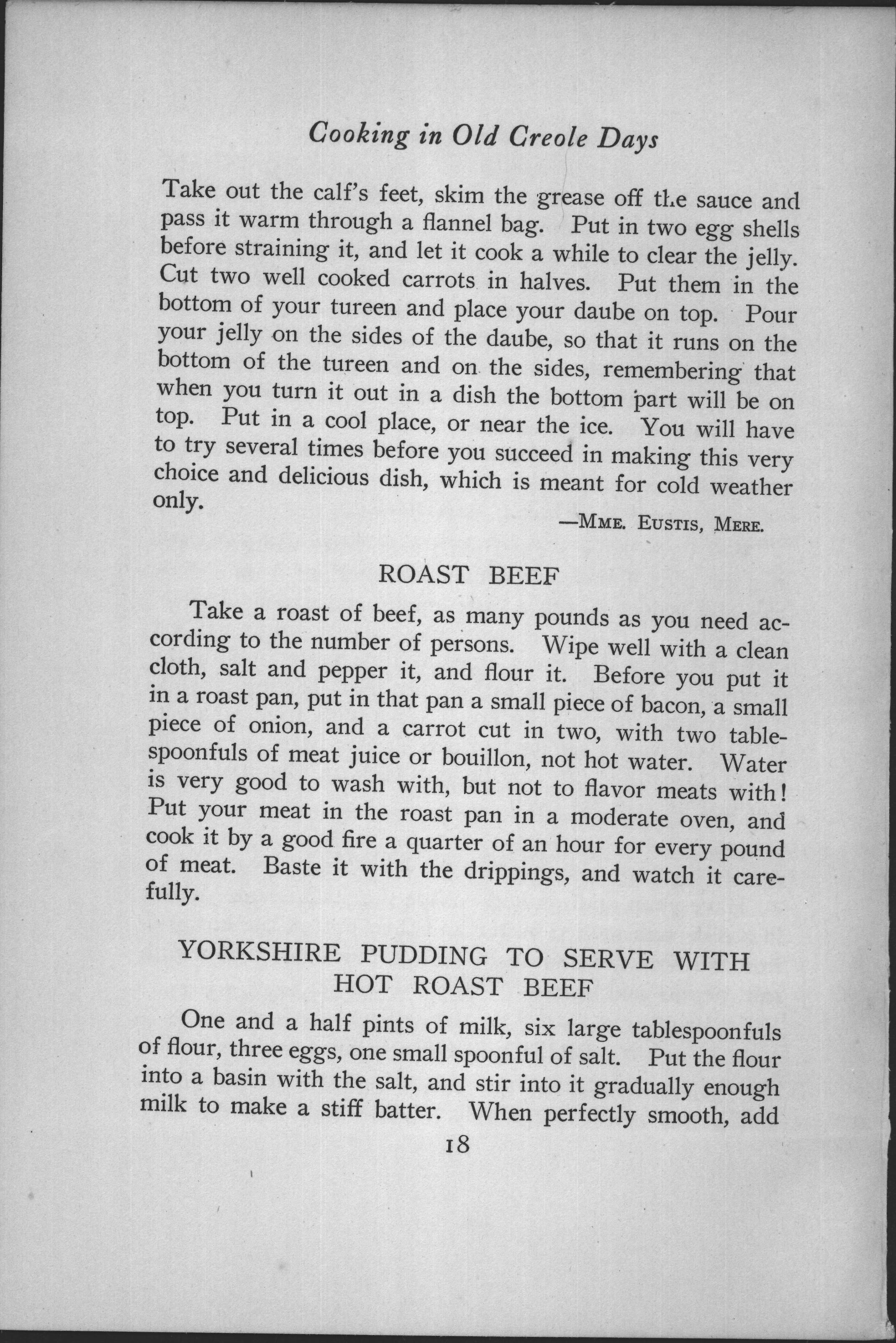
Take out the calf's feet, skim the grease off the sauce and pass it warm through a flannel bag. Put in two egg shells before straining it, and let it cook a while to clear the jelly. Cut two well cooked carrots in halves. Put them in the bottom of your tureen and place your daube on top. Pour your jelly on the sides of the daube, so that it runs on the bottom of the tureen and on the sides, remembering that when you turn it out in a dish the bottom part will be on top. Put in a cool place, or near the ice. You will have to try several times before you succeed in making this very choice and delicious dish, which is meant for cold weather only.
Madame Eustis’s version is the master class — larded round of beef set in a hand-clarified calf’s-foot jelly, with the frank warning that you may fail a few times before you get it right.
- Larding, explainedThreading strips of pork fat through lean beef keeps it moist. No larding needle? Ask the butcher, or simply bard the roast — tie sheets of fatback or bacon around it — for a similar effect.
- “A good pinch of saltpetre”Saltpetre (potassium nitrate) was added only to keep the meat rosy. It is easy to omit entirely — the daube is perfectly good without it — or use a measured pink curing salt rather than an eyeballed pinch.
- Calf’s feet and pig skin = gelatinBoth are pure collagen and give the jelly its set. If you can’t get them, use about 1 oz (4 envelopes) unflavored gelatin, softened and stirred into the finished, strained stock.
- Clarifying the jellyThe egg shells (traditionally the whites too) trap cloudiness as the stock simmers; then “pass it through a flannel bag” — strain through a jelly bag or several layers of cheesecloth for a crystal-clear aspic.
- Measures and chilling“Half a cupful of meat juice” is ½ cup of good stock. “Near the ice” simply means well chilled — refrigerate until fully set, remembering the molded daube turns out upside-down.
Before packaged gelatin, cooks drew their own from calf’s feet, pig skin, and knuckle bones, long-simmered until the collagen dissolved into a stock that set firm when cold. Clarifying it with egg white and straining through flannel, as Madame Eustis directs, was the mark of a serious kitchen. This labor is why aspic dishes signaled refinement: they demanded time, skill, and cold. Her candid note that the cook may “try several times before you succeed” is a rare honest admission in old cookbooks, where recipes usually pretend everything works the first time.
From page 17 of the 1904 edition.
Original pages from the book