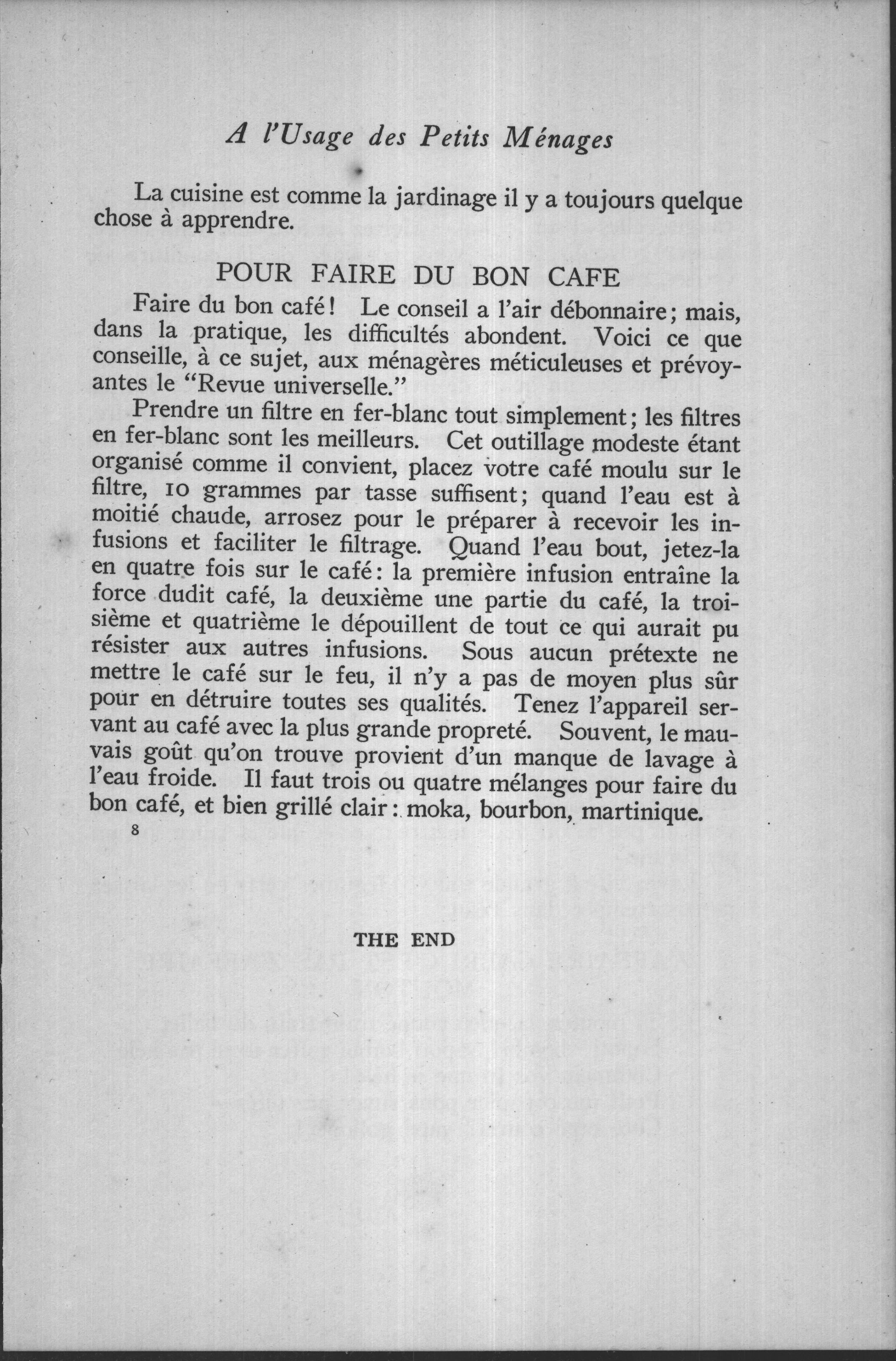
Pour Faire du Bon Cafe
La cuisine est comme la jardinage il y a toujours quelque chose à apprendre.
Faire du bon café! Le conseil a l'air débonnaire; mais, dans la pratique, les difficultés abondent. Voici ce que conseille, à ce sujet, aux ménagères méticuleuses et prévoyantes le "Revue universelle."
Prendre un filtre en fer-blanc tout simplement; les filtres en fer-blanc sont les meilleurs. Cet outillage modeste étant organisé comme il convient, placez votre café moulu sur le filtre, 10 grammes par tasse suffisent; quand l'eau est à moitié chaude, arrosez pour le préparer à recevoir les infusions et faciliter le filtrage. Quand l'eau bout, jetez-la en quatre fois sur le café: la première infusion entraîne la force dudit café, la deuxième une partie du café, la troisième et quatrième le dépouillent de tout ce qui aurait pu résister aux autres infusions. Sous aucun prétexte ne mettre le café sur le feu, il n'y a pas de moyen plus sûr pour en détruire toutes ses qualités. Tenez l'appareil servant au café avec la plus grande propreté. Souvent, le mauvais goût qu'on trouve provient d'un manque de lavage à l'eau froide. Il faut trois ou quatre mélanges pour faire du bon café, et bien grillé clair: moka, bourbon, martinique.
Not a dish but the book’s method for a proper cup — the French drip approach that shaped New Orleans coffee, quoted here from a French journal.
- The drip filterA plain tin drip pot (filtre en fer-blanc), ancestor of the New Orleans drip method: grounds in an upper chamber, hot water poured through.
- The dose“10 grams per cup” is about 2 tablespoons of ground coffee per cup — a sensible modern ratio.
- Bloom the groundsWetting the grounds with not-quite-boiling water first (quand l’eau est à moitié chaude) is exactly today’s “bloom,” letting the coffee degas and extract evenly.
- Pour in stagesAdding boiling water in four passes mirrors modern pour-over technique for full, even extraction.
- Never boil the brewThe firm rule to never set the coffee on the fire still holds — reheating or boiling brewed coffee turns it bitter and flat.
- Keep it cleanRancid oils build up in a pot; rinse well in cold water, as the text insists, to avoid off-flavors.
The names at the end — moka, bourbon, martinique — are a little map of the 19th-century coffee world. Mocha came through the Yemeni port of that name; Martinique from the French Caribbean; and Bourbon is a coffee variety named for the Île Bourbon (today Réunion), where the French cultivated it. New Orleans was one of America’s great coffee ports, and its café-au-lait culture, often stretched with roasted chicory, grew from exactly this French drip tradition. The advice to blend several beans for balance is still how fine coffee is built today.
From page 113 of the 1904 edition.
Original page from the book